Ancient Rome · 62 BC
Did Marius’ army reform kill the Roman Republic?
The seminar question: “How did changes in recruitment help weaken the Republic, and how much weight should we give them compared with individual ambition?”
Rome’s conquests enriched a narrow elite while ruining the small farmers who filled the legions. The reforming tribunes Tiberius and Gaius Gracchus were killed in 133 and 121 BC, Marius opened the legions to the landless, and in 88 BC Sulla marched his own legions on Rome, beginning civil war.
Chapter 4 is included with every paid plan. WW2 is free in full, and chapter 1 of every atlas is free. A free account opens 3 more chapters a day. Starter, at $9 a month, opens all 21 with no daily limit — see the plans.
Rome’s small farmers had supplied soldiers for its armies. The demands of conquest placed that arrangement under pressure: long service overseas could damage a farm, while wealthy Romans acquired estates worked by enslaved people. The gains of empire accumulated unevenly, and the Republic had to decide what should become of citizens who had lost their footing.
The short answer
- Victory’s losers: the smallholder crisis. The citizen who provided his own arms and served in a legion had often been a farmer. Long campaigns overseas put his farm under pressure, while conquest supplied enslaved labor for the estates of wealthy landholders. Land reform promised to address poverty and protect a recruiting base, but it also threatened established holders. The resistance the Gracchi faced became violent.
- The Marian reform: THE structural cause. From 107 BC Marius recruited poorer citizens to meet the army’s needs. A veteran seeking land could depend on his commander to obtain it from the Senate, and support from veterans could give that commander political leverage. Sulla, Pompey, Caesar and Octavian each used the relationship differently. In Chapter 6, Augustus establishes a state military treasury as a more permanent way to fund veterans.
- Empire’s profits, concentrated; empire’s costs, socialized. Empire produced great wealth through provincial extortion, tax farming and slave-worked estates. The original account describes its concentration in a few hundred families, even as the urban poor multiplied. Politicians could seek support with grain and games or mobilize people in need. Institutions formed for a city-state of farmers now had to govern an empire whose rewards and burdens were distributed very unevenly.
- No monopoly on violence. A law needs people willing and able to enforce it. Rome had no police force or standing army in Italy that could independently enforce a political settlement, and little organized force stood between a magistrate’s bodyguard and a legion. After the killings of 133 BC, factions used street violence; Sulla later brought legions to the city. The Republic could reach decisions, but powerful opponents could challenge them by force.
THE TURNING POINT
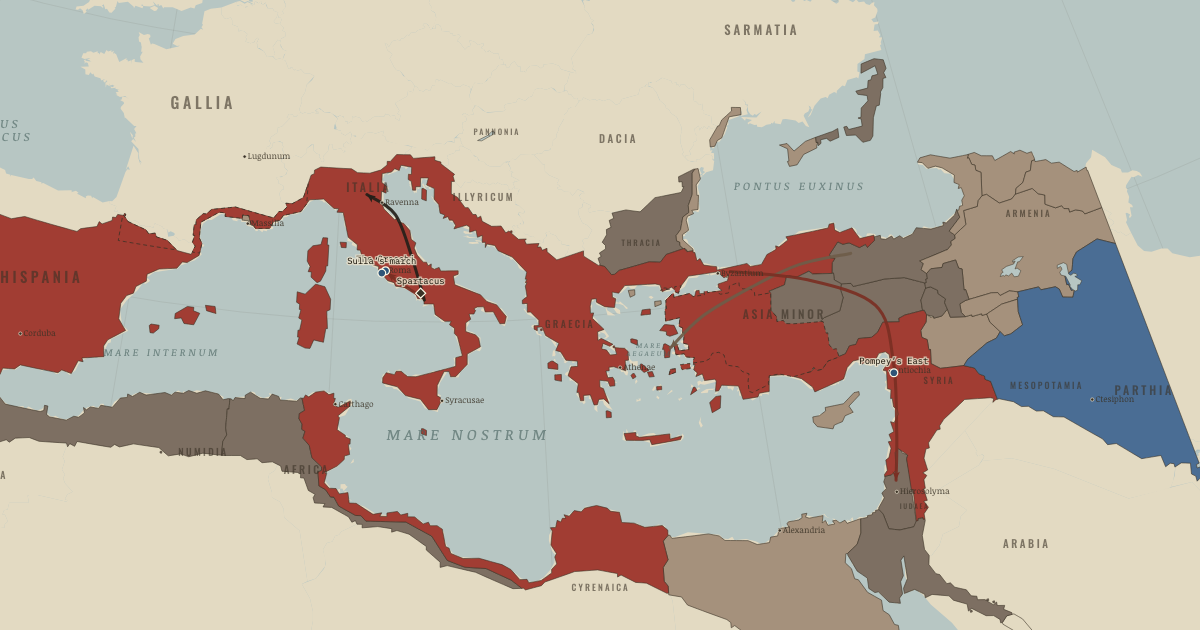
Sulla marches on Rome, 88 BC. Sulla asked his officers to march on Rome in 88 BC. All but one reportedly refused. His soldiers, however, followed him: their hopes of reward were tied to their commander’s prospects. Sulla used that loyalty to overturn a political decision by force. Religious, legal and customary boundaries had been expected to keep Roman armies out of the city, but those safeguards could not enforce themselves against an army willing to enter.
What it changed
The east acquires an architecture. Between 66 and 62 BC Pompey reorganized the east: Syria was annexed, Judea and Armenia became clients, cities were founded, and Mithridates was dead. The map shows coastal provinces in red, a grey-tan buffer of client kings, and Parthia in blue beyond the Euphrates. The settlement organized a vast region under one commander’s personal authority, revealing how much power the Republic had entrusted to him.
The First Triumvirate. In 60 BC three men joined their interests in a private alliance. Pompey had military glory and veterans whose settlement he sought; Crassus brought wealth; Caesar sought advancement and carried debts. Caesar obtained a five-year command in Gaul. Together they could shape decisions through and around republican offices, although their cooperation would not last.
Violence ratchets, never resets. The Gracchan killings, Sulla’s proscriptions and the gangs active in elections in the 50s each left examples for later rivals. A faction considering restraint could fear that an armed opponent would take advantage of it. Political scientists describe such a problem as a broken equilibrium; Romans could see the anger of the gods at work. In either interpretation, a settlement that all sides would obey had become harder to restore.
The full answer, argued
Begin with what soldiers expected after service. Before 107 BC armies drew heavily on men with property who could return to their farms. Poorer recruits seeking land could instead depend on their commander’s ability to persuade the Senate. That gave soldiers a stake in his political success, and gave him supporters when he challenged rivals. Sulla’s march, Pompey’s threats, Caesar’s crossing and Octavian’s career show different uses of military power in this setting. The structural argument explains why several ambitious men found similar opportunities. Yet the land crisis and the killing of the Gracchi came before Marius, and historians dispute how much he changed recruitment. His measures could be a response to an existing crisis and a cause of further trouble. The structure made particular choices possible; the individuals who made them still mattered.
An interesting fact
Ancient writers say Mithridates feared being poisoned by Rome and took small doses of toxins for years. His name survives in “mithridatism,” the idea of acquiring immunity in this way. Their account gives the practice a bitter ending: cornered by rebellion in 63 BC, he took poison, found it ineffective and asked a bodyguard to kill him with a sword. Pliny says Pompey found an antidote recipe in the king’s own handwriting among the spoils. European pharmacies continued to prepare “mithridatium,” attributed to that tradition, into the eighteenth century.
This is the study layer of Crisis of the Roman Republic, chapter 4 of The Rise and Fall of Rome, 264 BC – AD 476; the full index of the atlas is here.
Related questions
THE FREE PRINTABLE STUDY GUIDE
Get the printable study guide for Rome free. I’ll send you a few short letters, then one when a new atlas opens. That’s all. — Paul
NO TRACKING · YOUR ADDRESS IS USED FOR THE DISPATCH AND NOTHING ELSE · UNSUBSCRIBE ANYTIME