American Civil War · JUL 1848
Was the Mexican–American War fought for slavery?
The seminar question: “Was the Mexican War a war for slavery?”
In the 1840s the belief in Manifest Destiny drove American expansion: Texas joined the United States in 1845 and Oregon was split with Britain in 1846. When Mexico refused to sell California, President Polk sent troops into disputed land, and the Wilmot Proviso of 1846 tied the conquest to the question of slavery.
WW2 is free in full, and chapter 1 of every atlas is free. A free account opens 3 more chapters a day. Starter, at $9 a month, opens all 21 with no daily limit — see the plans.
Free printable American Civil War study guide, sent by email ↓
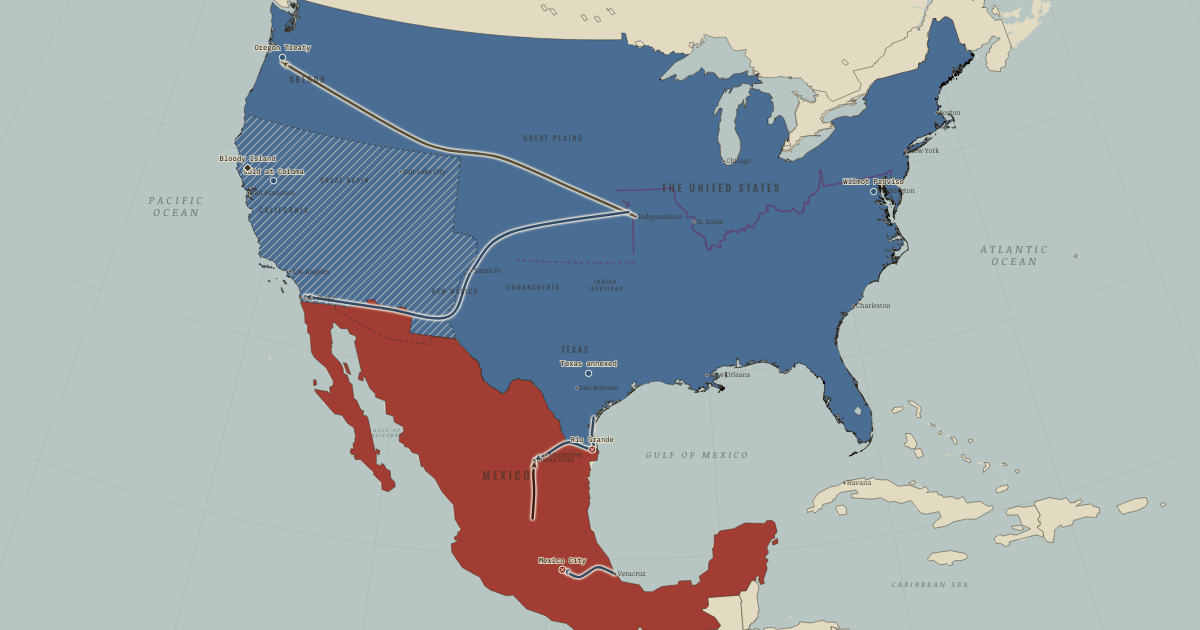
In the 1840s, Americans traveled west in growing numbers, and expansionists expected the government to secure the lands they entered. They called their cause Manifest Destiny: Providence, or God’s plan, had supposedly assigned the continent to the United States. This promise of national greatness carried a racial assumption that white Americans should rule. President James K. Polk made expansion a policy. Texas, a slaveholding republic since its break from Mexico in 1836, entered the Union in 1845 by a joint resolution of both houses, after the Senate rejected an annexation treaty. Britain and the United States divided Oregon at the 49th parallel, now the Canadian border; its hatching disappears from the map in June 1846.
The short answer
- Land hunger and an ideology of destiny. The brown arrow follows the Oregon Trail, traveled by thousands in the 1840s. As settlers moved west, they looked to Washington to secure the land they entered. Expansionists gave the movement a larger meaning through Manifest Destiny: Providence had supposedly assigned the continent to the United States. Pacific ports promised trade with China, while racial ideas encouraged the belief that Mexicans and Native peoples should give way.
- Polk’s determination to have California. Polk took office in 1845 determined to acquire California, whose harbors at San Francisco and San Diego offered access to the Pacific. He first sent John Slidell to Mexico City, authorized by most accounts to offer up to $25 million. Mexico refused to receive him. Polk then sent Taylor’s army to the Rio Grande, into land held by Mexico and claimed by Texas. An attempt to buy territory had given way to an armed standoff.
- A Mexican state at its weakest. Mexico had little room to respond to Polk. Its treasury was empty, generals made and unmade governments, and Comanche and Kiowa raids had devastated northern states. A leader who discussed selling land risked overthrow: Paredes toppled Herrera after Herrera showed willingness to talk. Mexico was poorly placed both to deter the United States and to bargain with it.
- Texas and the politics of slavery. The argument over Texas was also an argument over slavery. In 1844 Calhoun told the British minister that annexation would protect it from British abolitionism; the Senate rejected the treaty that June partly for that reason. Texas entered as a slave state by joint resolution in 1845. Northern opponents saw the “slave power,” their name for slaveholders’ supposed control of federal government, extending its reach. When war brought the prospect of still more territory, that suspicion followed it into Congress.
THE TURNING POINT
The Wilmot Proviso, 8 August 1846. David Wilmot was a first-term Pennsylvania congressman when, on the night of 8 August 1846, he added a sentence to a bill granting Polk $2 million to negotiate peace. His proviso would exclude slavery from any territory taken from Mexico. The House approved it 83 to 64: Northern Democrats and Whigs joined against Southerners of both parties. The national parties depended on cooperation across the sections, and this vote showed how slavery could break that cooperation. The Senate never passed the proviso, but the question returned in 1850, 1854, and 1860.
What it changed
Free soil becomes a party. Opposition to slavery’s expansion could unite Northerners who were not prepared to challenge slavery where it already existed. Their cause was free soil: western land reserved for free labor. In 1848 the Free Soil Party nominated former president Martin Van Buren and won about ten percent of the popular vote. Many of its leaders and its slogan, “Free Soil, Free Speech, Free Labor, and Free Men,” passed into the Republican Party in the 1850s. Lincoln’s 1860 platform carried forward the principle of the Wilmot Proviso.
The Fugitive Slave Act radicalizes the North. The Fugitive Slave Act was meant to reassure the South, but its enforcement brought the power of slavery into Northern towns. Accused fugitives received no jury trial, and federal commissioners were paid $10 for sending a person south and $5 for setting one free. Crowds in Boston and elsewhere tried to rescue captured people. Harriet Beecher Stowe wrote Uncle Tom’s Cabin in response. A concession to slaveholders became a source of Northern resistance.
Popular sovereignty carries the quarrel to Kansas. Why not let settlers decide whether to permit slavery? Popular sovereignty offered that democratic answer, and Stephen Douglas applied it to Kansas and Nebraska in 1854. His legislation repealed the Missouri Compromise’s 1820 line at 36°30′ between slave and free territory. On the continental map, hatching spreads across the plains in June 1854. The decision itself became the object of fighting: Kansas turned into a small civil war, carrying the quarrel from Congress to a frontier where no one could arbitrate it.
Mexico trains the generals of 1861. Grant, Lee, Jackson, Longstreet, McClellan, and Jefferson Davis served in Mexico before becoming commanders in 1861. They learned their trade in the same war and knew one another’s habits. Grant later wrote that the Southern rebellion “was largely the outgrowth of the Mexican war,” and saw the Civil War as punishment for that conquest. The earlier war had trained men who would fight over the question its victory reopened.
The full answer, argued
Texas supplies a strong reason to connect the war with slavery. It entered the Union as a slave state after Calhoun had defended annexation as protection for slavery, and many Southerners supported the war. Yet support and opposition did not divide neatly by section: Northern Democrats backed the war, while Southern Whigs opposed it partly because they feared the effect of new territory on the Union. Polk’s own aims centered on California’s harbors and trade, and few planters expected cotton to grow in much of the Mexican Cession, the land Mexico gave up in 1848. The distinction between why the war began and what followed from it matters. It was fought chiefly for land and ports. Once that land had been won, Congress had to confront the expansion of slavery. Slavery shaped the consequences of conquest even where it had not determined the decision to fight.
An interesting fact
Nicholas Trist signed the peace treaty after Polk had ordered him home. The recall was issued in October 1847 and reached Trist in mid-November. He stayed, explaining in a letter of some sixty-five pages that Mexico’s moderate government might fall before a replacement could arrive. On 2 February 1848 he signed at Guadalupe Hidalgo. Polk was furious, but the treaty gave him nearly everything he wanted, so he sent it to the Senate. Trist was dismissed and remained unpaid until 1871, when Congress, pressed by Senator Charles Sumner, paid his salary and expenses.
This is the study layer of Mexican–American War, chapter 1 of The American Civil War, 1840–1877; the full index of the atlas is here.
Related questions
THE FREE PRINTABLE STUDY GUIDE
Get the printable study guide for The American Civil War free. I’ll send you a few short letters, then one when a new atlas opens. That’s all. — Paul
NO TRACKING · YOUR ADDRESS IS USED FOR THE DISPATCH AND NOTHING ELSE · UNSUBSCRIBE ANYTIME