American Civil War · SEP 1862
Why was the Emancipation Proclamation so important?
The seminar question: “The Proclamation excluded loyal slave states and needed Union force to take effect in rebel territory. Why might it still be called the war’s most important single document?”
In September 1862 Lee invaded Maryland and Bragg advanced into Kentucky, and both invasions failed. Antietam, on 17 September, cost about 23,000 casualties, the bloodiest single day in American history. Five days later Lincoln announced emancipation in areas still in rebellion, taking effect on 1 January 1863.
Chapter 7 is included with every paid plan. WW2 is free in full, and chapter 1 of every atlas is free. A free account opens 3 more chapters a day. Starter, at $9 a month, opens all 21 with no daily limit — see the plans.
Free printable American Civil War study guide, sent by email ↓
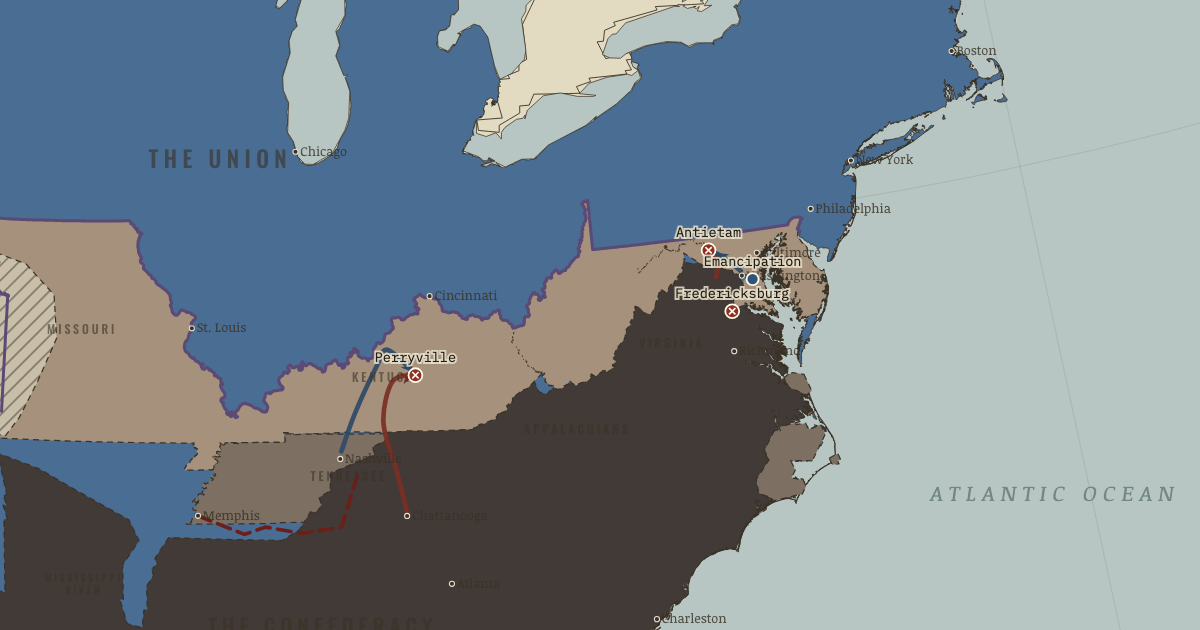
In September 1862, Lee entered Maryland and Bragg advanced into Kentucky. The two campaigns sought a result that battlefield gains alone could not provide. Supplies and border-state recruits would help the Confederate armies, while a victory on Northern or border soil might affect the autumn elections and persuade Britain to mediate. A Union soldier then discovered a lost copy of Lee’s orders. McClellan could see that his opponent’s army was dangerously divided, but at Antietam he committed his forces in stages and left large reserves idle. Lee’s battered army held its ground and withdrew; Bragg also retreated after Perryville.
The short answer
- Why Lee invaded. Virginia’s stripped farms could no longer feed Lee’s army easily, so Northern fields offered a practical reason to move. The invasion also offered a chance to change the politics of the war. A victory before the midterms might strengthen peace Democrats, while Palmerston’s cabinet had agreed to consider mediation if Lee won again. Mediation would have approached recognition in all but name. The Maryland campaign sought pressure on Northern resolve from both home and abroad.
- Why the Proclamation waited. Lincoln drafted emancipation in July, but Seward advised him to wait. After the summer’s defeats, he warned, the announcement would sound like “the last shriek on the retreat” — a losing government’s appeal for slave revolt. A military success could give the same policy the standing of a deliberate decision. Meanwhile Lincoln prepared the political ground in his reply to Greeley: “If I could save the Union without freeing any slave I would do it…”. He presented his course in terms of saving the Union and military necessity.
- The border-state calculus. Kentucky, Missouri and Maryland supplied men and strategic ground to the Union. Losing their loyalty would have made the war harder to fight. In 1861–62 Lincoln resisted emancipation orders by Frémont and Hunter partly for that reason. Exempting loyal slave states helped preserve the coalition while allowing him to use emancipation against slavery in rebel territory. The order of the decisions mattered: hold the border states, then strike at an enemy resource.
- McClellan’s last battle. Lee’s lost orders gave McClellan unusual knowledge of his opponent’s position. Yet he attacked in succession rather than concentrating his force, and Lee’s damaged army remained across the field for another day before escaping. Historians still dispute the part played by politics, temperament and McClellan’s assessment of the danger. Lincoln’s judgment was clear enough: in November he removed him for good. “He has got the slows.”
THE TURNING POINT
Antietam, 17 September 1862. Lee left Maryland without the rising he had hoped for. Britain did not mediate, the midterms did not break Lincoln’s government, and Lee’s reputation for invincibility was shaken. On the field Antietam was close to a tactical draw; in politics it gave Lincoln an occasion to announce emancipation from greater strength. The consequences of a battle can reach far beyond the ground held at its end.
What it changed
The war acquires a second war aim. From January 1863, a Union advance could put the Proclamation into effect. Hover over the map’s grey-tan zones to see notes on garrisons, contraband camps and Black regiments recruiting along occupied coasts and rivers. As freedom became tied to Union victory, a negotiated return to the order of 1860 became harder to sustain. Confederate survival depended on defeating or exhausting the Union.
Europe steps back for good. British cabinet discussions of mediation ended in October–November 1862. Emancipation added a further difficulty: intervention for a slaveholding Confederacy would have been hard to defend before an anti-slavery public. Cotton and battlefield success had failed to bring the European help Confederate leaders sought, and the Confederacy continued the war without it.
Fredericksburg: the year ends in blood. The year ended badly for the North. In December Burnside, McClellan’s successor, attacked Marye’s Heights at Fredericksburg and lost about 12,600 casualties without taking the position. Morale fell and “peace” Democrats gained ground. That bleak moment is part of the background to Lincoln’s election victory in November 1864.
The full answer, argued
Its immediate reach was limited, but its effects depended on what happened next. In designated rebel areas the Proclamation declared freedom for people treated as “property”; advancing Union forces could give that declaration effect. It authorized Black enlistment, and roughly 180,000 Black soldiers served. Lincoln later regarded their service as indispensable to victory. The policy joined Union victory to the destruction of slavery and made European intervention harder to defend. Its war-power foundation might be threatened by peace, so the Thirteenth Amendment was needed to establish permanent abolition in the Constitution, including beyond the Proclamation’s reach.
An interesting fact
In New York, a month after Antietam, crowds entered Mathew Brady’s Broadway gallery to see “The Dead of Antietam”. Alexander Gardner and James Gibson, Brady’s operators, had photographed the field before the burial parties finished. The New York Times wrote that Brady had done something “to bring home to us the terrible reality and earnestness of war,” as if he had placed the bodies “in our dooryards and along the streets.” People far from the battlefield could now see its dead.
This is the study layer of Antietam and emancipation, chapter 7 of The American Civil War, 1840–1877; the full index of the atlas is here.
Related questions
THE FREE PRINTABLE STUDY GUIDE
Get the printable study guide for The American Civil War free. I’ll send you a few short letters, then one when a new atlas opens. That’s all. — Paul
NO TRACKING · YOUR ADDRESS IS USED FOR THE DISPATCH AND NOTHING ELSE · UNSUBSCRIBE ANYTIME