American Civil War · JUL 1862
Does the better general actually decide wars?
The seminar question: “How much could generalship decide when Jackson and Lee faced larger Union armies?”
In 1862 McClellan shipped the Army of the Potomac to the Virginia Peninsula and advanced slowly on Richmond, while Jackson’s Shenandoah Valley campaign tied down Union troops. Lee took command and attacked in the Seven Days battles of 25 June–1 July, drove McClellan back, then won at Second Bull Run.
Chapter 6 is included with every paid plan. WW2 is free in full, and chapter 1 of every atlas is free. A free account opens 3 more chapters a day. Starter, at $9 a month, opens all 21 with no daily limit — see the plans.
Free printable American Civil War study guide, sent by email ↓
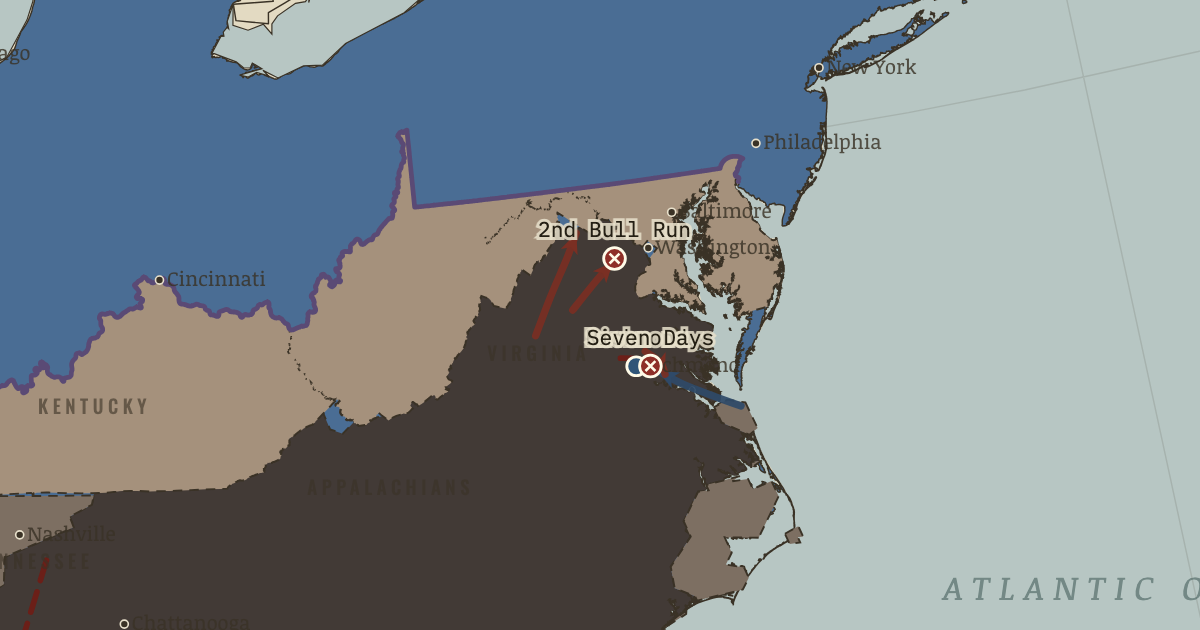
McClellan had a plan for reaching Richmond without marching all the way overland. Union command of the sea allowed him to transport the Army of the Potomac to the Virginia Peninsula, and he organized and supplied that great army with considerable skill. He also believed he faced a much larger enemy: his intelligence service repeatedly estimated Confederate strength at roughly twice its true size. His preference for a limited war ending in reconciliation reinforced his caution. By late May 1862 his men were reportedly close enough to hear Richmond's church bells, but the reinforcements he wanted were being held near Washington, where the government feared for its own safety.
The short answer
- McClellan’s mathematics of caution. McClellan commanded an army described as the largest yet assembled in the hemisphere. He nevertheless repeatedly believed the enemy outnumbered him. Pinkerton's intelligence supplied estimates often double the enemy's actual strength, confirming his expectations. His political aims also made a careful campaign attractive: a Democrat opposed to emancipation, he wanted to restore the Union through a limited war that disrupted Southern society as little as possible.
- Interior lines and the Valley. Larger Union forces threatened Virginia from different directions, but they had to coordinate their movements before they could act together. Confederate commanders could use railroads and the Shenandoah Valley as shorter routes between those threats. Jackson exploited this advantage, striking separated forces in the Valley. The danger his small army appeared to pose to Washington helped keep many more Union troops guarding the capital.
- Lee’s gamble on the offensive. Lee saw danger in waiting around Richmond. A larger Union army could lay siege, so he sought instead to disrupt its plans by attacking. An offensive could restore initiative, strengthen Southern morale and encourage war-weariness in the North. It repeatedly created opportunities, but the Confederacy paid in men its smaller population could not readily replace. Chapter 9 returns to that problem.
THE TURNING POINT
Gaines’ Mill and the Seven Days, 25 June–1 July 1862. During the Seven Days McClellan's army fought effectively as it retreated, and at Malvern Hill it inflicted heavy losses. It had not been destroyed. McClellan nevertheless wired Washington that the government had “sacrificed” his army and gave up the advance on Richmond. Lee had removed the immediate threat by costly attacks and drew encouragement for further offensives. Decisions made during that week shaped both armies' conduct for the next two years and helped prolong a war many had hoped would end in 1862.
What it changed
The war radicalizes. The failure before Richmond weakened the argument for a limited war. In July Congress passed the Second Confiscation Act, which provided for freedom for enslaved people held by rebels under its terms. That month Lincoln also read his cabinet a draft emancipation proclamation. He was advised to wait for a military success before announcing it; Antietam supplied the occasion, as Chapter 7 explains.
Lee’s ascendancy — and its cost. From June 1862, Confederate hopes and reputation increasingly rested on Lee's Army of Northern Virginia. Yet the Seven Days showed the price of its victories: Confederate losses approached a quarter of the army. A stronger position around Richmond had been bought with men needed for the longer struggle. Chapter 9 returns to the cost.
Second Bull Run opens the door north. After Second Bull Run, defeated and scattered Union forces left Lee an opening to cross the Potomac. Maryland's fields, not yet devastated by war, offered supplies for his army. Lee also hoped to threaten Washington and influence Northern opinion before the fall elections. A victory on Northern soil might strengthen the case for British recognition. The coming campaign would test those hopes.
The full answer, argued
Generalship could change the local balance. Jackson's marches and Lee's attacks bought the Confederacy time, a valuable achievement for a government trying to survive rather than conquer the North. But their victories did not reopen the Tennessee River, lift the blockade or replace roughly 20,000 Confederate casualties in the Seven Days. Commanders worked within a wider contest over supplies, manpower and political support. Union generals including Grant, Sherman and Thomas would bring different abilities to that struggle. To judge a general, we must ask what his victories made possible in the war he was fighting.
An interesting fact
In March 1862, Johnston's army left its lines at Centreville. Union troops entering them found logs stripped, painted black and mounted where heavy artillery should have stood. Soldiers called these imitations “Quaker guns.” Photographers recorded them, and Northern newspapers used the discovery to criticize McClellan's earlier caution. The ruse had precedents going back to the Revolution. The logs were part of the defenses confronting McClellan, though they alone do not explain his delay.
This is the study layer of Peninsula Campaign and Seven Days, chapter 6 of The American Civil War, 1840–1877; the full index of the atlas is here.
Related questions
THE FREE PRINTABLE STUDY GUIDE
Get the printable study guide for The American Civil War free. I’ll send you a few short letters, then one when a new atlas opens. That’s all. — Paul
NO TRACKING · YOUR ADDRESS IS USED FOR THE DISPATCH AND NOTHING ELSE · UNSUBSCRIBE ANYTIME