American Civil War · DEC 1865
Was the American Civil War inevitable or avoidable?
The seminar question: “Was the Civil War “irrepressible” — or could different political choices have averted it?”
Civil War deaths were traditionally counted at about 620,000; demographic research now suggests roughly 750,000, and disease killed more soldiers than battle. The war preserved the Union and abolished slavery, while the Lost Cause interpretation later minimized slavery’s role through monuments and textbooks.
Chapter 13 is included with every paid plan. WW2 is free in full, and chapter 1 of every atlas is free. A free account opens 3 more chapters a day. Starter, at $9 a month, opens all 21 with no daily limit — see the plans.
Free printable American Civil War study guide, sent by email ↓
An account of what the Civil War achieved has to begin with what it cost. Military records supplied the long-accepted estimate of about 620,000 deaths. A study of survival rates in the censuses suggests a figure closer to 750,000, though neither method can give us an exact count. More soldiers died from disease, helped along by crowded camps and poor sanitation, than from weapons. Civilian deaths are still less completely recorded, especially among displaced and formerly enslaved people.
The short answer
- How the Lost Cause gained authority. A shared account of courage helped white Northerners and Southerners come together after the war. Reunion literature, joint veterans’ encampments and Wilson-era histories could celebrate that courage while leaving aside the war’s racial meaning. The account also reached children through schools: the United Daughters of the Confederacy vetted textbooks across the South as Black citizens were being disfranchised. Those who could shape public memory had institutions at their disposal; those excluded from political power had less opportunity to contest them. The resulting story can be tested against the evidence of secession and the war.
- The cost and the alternatives. If roughly 750,000 people died, the question of a less costly path to emancipation deserves serious attention. Lincoln proposed compensated emancipation, and the South refused it even in 1862. A critic of the war can ask whether paying for emancipation might have spared lives; a defender can ask how such a purchase could have succeeded without the agreement of those holding people in bondage. The death estimate cannot settle that disagreement. It does give human weight to phrases such as “hard war” and “unconditional”: behind them were families and communities left to mourn.
- A stronger national government. The federal government acquired new means of acting during the war. Income tax, national currency and banking, and conscription helped it finance and supply the armies. Other wartime measures looked beyond the battlefield: the Homestead and Morrill Acts supported settlement and education, and a charter authorized a transcontinental railroad. The reunited country emerged with stronger institutions for governing a continental nation, machinery later reformers could use. Americans increasingly spoke of the United States in the singular: the United States “is.”
THE TURNING POINT
Gettysburg, 19 November 1863. At Gettysburg on 19 November 1863, Lincoln asked his listeners to see the war as a test of a nation founded on the Declaration’s proposition of equality. Union survival and a “new birth of freedom” belonged together in that account. The military battle had turned the course of the fighting; the address gave the fighting a meaning that reached beyond victory. Its call to continue the “unfinished work” left later generations a standard by which to judge the peace. The address’s 272 words outlasted the guns that fought the war.
What it changed
The Union and abolition endure. Secession had been argued as a constitutional possibility. The war settled that struggle by force, and no state has seceded since. The Thirteenth Amendment abolished slavery, except as punishment for crime after conviction, and remains part of the Constitution. These settlements endured at an immense cost, even as Americans continued to dispute what freedom should mean in practice.
Citizenship remains contested. A constitutional promise of citizenship leaves many practical questions to be answered. Who can vote, attend school, serve on a jury or hold a property deed? From Colfax to Selma, Black Americans pressed claims recognized by the wartime amendments but not secured in daily life by their words alone. A map of twentieth-century civil rights belongs beside this one: its geography shows the struggle over that settlement continuing across the South. The planned civil-rights atlas is a sequel in spirit.
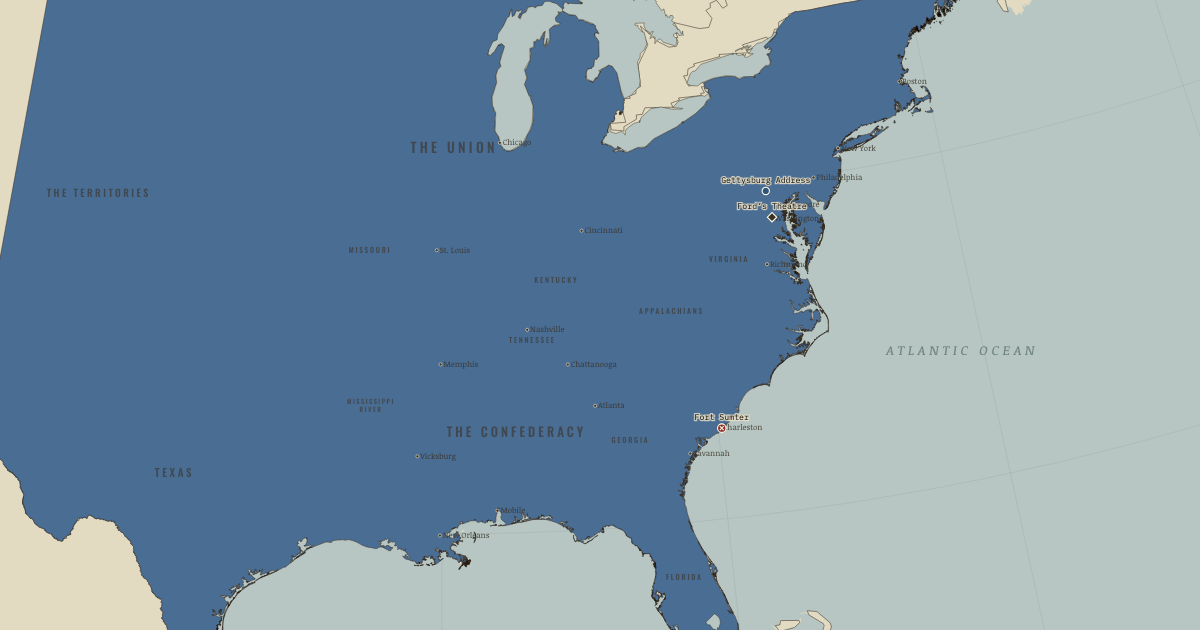
Follow a change on the map. In Free Explore, scrub from 1861 to 1865 and choose one change to follow. You could watch the Mississippi close, trace the border-state belt that never flips, or follow the hatched guerrilla country that no army pacified. Charleston harbor offers a route from the first shell at Sumter to the flag raised again there on 14 April 1865. That same day Lincoln was shot at Ford’s Theatre. Each route brings a particular geography into the larger story of the war.
The full answer, argued
The case for an avoidable war begins with choices. Kansas–Nebraska, Dred Scott, secession and the attack on Sumter could each have taken another course. A generation of historians emphasized political blundering because they could see decisions at which different leaders might have acted differently. That is a serious argument: a conflict does not turn itself into a war without people making decisions. Yet changing a decision would still leave the question of slavery. The Crittenden proposal and other territorial lines offered protections for it; Lincoln proposed compensated emancipation. Each approach required agreement about the future of millions of people held as property, and agreement proved elusive. Enslaved people also acted upon the conflict, escaping, resisting and later serving as soldiers. Their actions belong in any account of the choices available. The conflict over slavery was deep and persistent. Whether war itself was inevitable is harder to establish, and its timing, duration and terrible cost depended on choices. Distinguishing the conflict from the particular war allows us to see both the structural problem and the decisions made in response to it.
An interesting fact
A Civil War pension was still being paid in 2020. Irene Triplett received $73.13 a month from the pension of her father, Mose Triplett, a North Carolinian who deserted the Confederate army and enlisted in Union blue. She died that year, a century and a half after Appomattox. Albert Woolson, the last verified Union veteran, died in 1956. The last Confederate veteran is harder to identify: every man later celebrated under that title has failed documentary checking. Walter Williams, nationally celebrated and mourned by presidential proclamation in 1959, appears in the 1860 census as a five-year-old.
This is the study layer of Legacy of the Civil War, chapter 13 of The American Civil War, 1840–1877; the full index of the atlas is here.
Related questions
THE FREE PRINTABLE STUDY GUIDE
Get the printable study guide for The American Civil War free. I’ll send you a few short letters, then one when a new atlas opens. That’s all. — Paul
NO TRACKING · YOUR ADDRESS IS USED FOR THE DISPATCH AND NOTHING ELSE · UNSUBSCRIBE ANYTIME