American Civil War · JUL 1864
Was General Grant a butcher?
The seminar question: “Was Grant a “butcher”? What evidence would help us judge?”
Made overall Union commander in 1864, Grant applied pressure on every front at once. In Virginia he kept moving south after the Wilderness, Spotsylvania and Cold Harbor until Lee was fixed in the trenches at Petersburg, at a cost of roughly 55,000 Union casualties in six weeks, while Sherman pressed toward Atlanta.
Chapter 9 is included with every paid plan. WW2 is free in full, and chapter 1 of every atlas is free. A free account opens 3 more chapters a day. Starter, at $9 a month, opens all 21 with no daily limit — see the plans.
Free printable American Civil War study guide, sent by email ↓
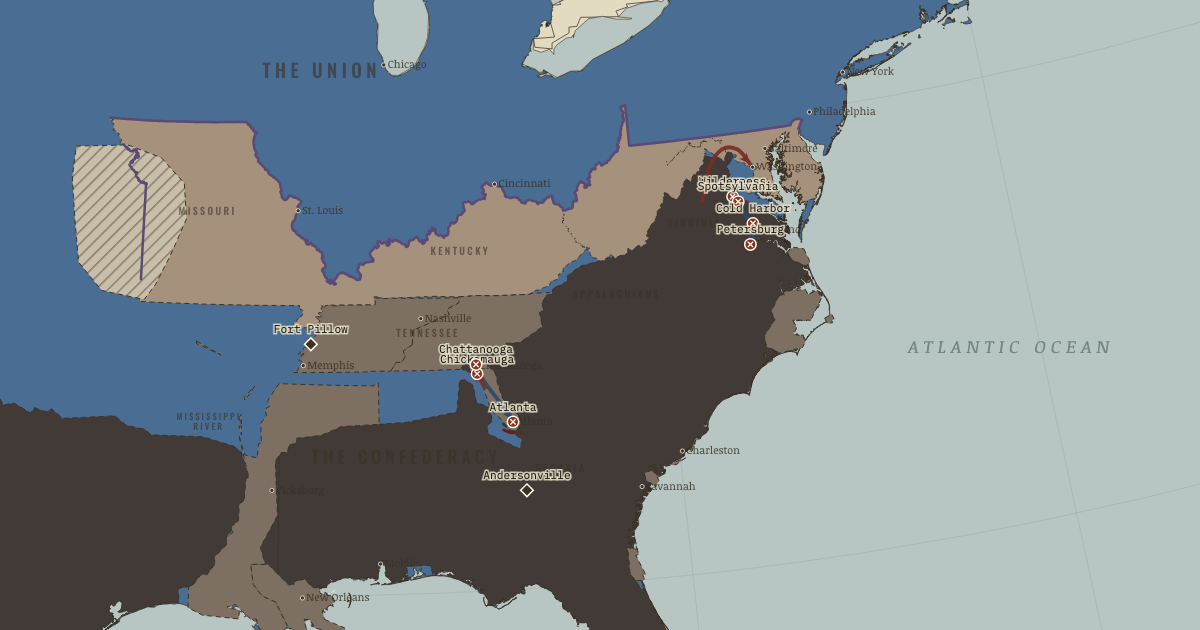
The Confederacy had a way to meet a threat in one theater: send troops from another. Longstreet’s corps had traveled from Virginia to help win at Chickamauga. In 1864 Grant tried to make that choice harder. Union armies would advance in the same weeks, so that Confederate commanders had to face dangers in several places at once. Even a secondary drive that failed to reach its objective could occupy troops needed elsewhere.
The short answer
- Pressure on several fronts. Longstreet’s journey from Virginia to Chickamauga shows what Confederate railroads could accomplish: troops released from one theater could help win a battle in another. Grant’s May 1864 plan put that mobility under strain. Meade would face Lee, Sherman would advance against Johnston, and three secondary drives would begin in the same week. Most lesser drives failed to reach their objectives, yet a Confederate force held in place by one of them could not readily reinforce another army. A campaign could contribute to the larger design without achieving its own objective.
- Earthworks and assault. An army that stopped in 1864 could soon be behind earthworks. Veterans knew how to dig them, and rifled muskets made the approach to such positions dangerous even for an attacker with a three-to-one advantage. Cold Harbor showed the cost at its worst. Heavy casualties were a hazard of contact with entrenched troops, though that fact does not settle whether a particular assault was justified. These lines anticipated features of the war of 1914–18, half a century later.
- The election clock. The vote on 8 November gave military events a political timetable. Grant sought to keep Lee from taking the initiative before it; Lee sent Early toward Washington’s suburbs in July 1864, hoping to embarrass Lincoln. Johnston gave ground toward Atlanta while trying to gain time. If Atlanta held and Northern voters saw only losses and stalemate, Confederate leaders could hope for a change in Union policy.
- Black soldiers and prisoner exchange. The Confederacy threatened captured Black soldiers with death or re-enslavement and refused to include them equally in prisoner exchanges. Grant stopped exchanges that excluded them. His insistence on equal treatment had a heavy cost for prisoners: the breakdown prolonged captivity and helped fill camps such as Andersonville. Fort Pillow revealed the lethal consequences of Confederate policy toward Black soldiers. Both the principle at issue and the suffering of captives belong in the account.
THE TURNING POINT
South at Brock Road, 7 May 1864. After two days in the burning scrub of the Wilderness, Lee could arguably claim a tactical success. The Army of the Potomac had learned to expect withdrawal after such fighting. At the Brock Road crossroads on 7 May, the columns instead turned south toward Spotsylvania, and exhausted soldiers cheered. The distance traveled was small, but the decision told Lee that the campaign would continue. Grant meant to put the Union’s greater resources behind sustained pressure.
What it changed
Petersburg and the railroads. Lee had to defend roughly thirty miles of works around Petersburg and Richmond with an army that could scarcely man them. For nine months Grant extended his left toward the railroads on which the position depended; the fighting included the disastrous assault at the Crater. In April the loss of those connections would force Lee to abandon the lines. The fortified position had bought time, but its supply routes made it vulnerable.
The approach to Atlanta. Johnston’s retreat had traded ground for time. Davis replaced him with Hood, who attacked Sherman in three costly battles and badly weakened his own army. Sherman continued to close on Atlanta. Its September fall would transform the Northern election campaign, connecting the fate of a city to the vote on how the war would continue.
Captivity and massacre remembered. Fort Pillow and Andersonville became places of atrocity and tragedy in American memory. The massacre raises the question of what Confederate treatment of Black soldiers revealed about the cause it defended; Andersonville brings the cost of captivity without exchange into view. The atlas marks both as memorial sites, where the human consequences deserve attention in their own right.
The full answer, argued
The charge asks us to judge both the losses and what they accomplished. Grant’s Overland Campaign cost roughly 55,000 Union casualties. Lee lost fewer men, but they were a larger share of his smaller force and much harder for the Confederacy to replace. By June Lee was increasingly confined to fortified lines. Sustained contact had changed his army’s freedom to maneuver. What else could Grant have done? Earlier withdrawals gave Confederate forces opportunities to recover, while McClellan’s cautious approach included Antietam and was followed by two more years of war. Grant’s victories at Vicksburg and Chattanooga also matter when judging his generalship. None of this settles every decision: Cold Harbor can be criticized as a badly managed assault, and the comparison does not prove a longer war was the only alternative. A fair judgment keeps the strategic result and the 55,000 casualties in view together.
An interesting fact
At Fort Wagner the 54th Massachusetts fought while refusing its pay. Black soldiers had been offered $10 a month, less $3 for clothing; white privates received $13 plus clothing. For eighteen months the regiment refused all pay and declined Massachusetts’s offer to make up the difference. The dispute concerned recognition as soldiers and citizens as well as money. In September 1863 Corporal James Henry Gooding asked Lincoln: “Are we Soldiers, or are we Labourers?” Congress equalized pay in June 1864. Gooding had been captured at Olustee and died at Andersonville that July.
This is the study layer of Overland and Atlanta campaigns, chapter 9 of The American Civil War, 1840–1877; the full index of the atlas is here.
Related questions
THE FREE PRINTABLE STUDY GUIDE
Get the printable study guide for The American Civil War free. I’ll send you a few short letters, then one when a new atlas opens. That’s all. — Paul
NO TRACKING · YOUR ADDRESS IS USED FOR THE DISPATCH AND NOTHING ELSE · UNSUBSCRIBE ANYTIME