Age of Revolutions · JUL 1807
Was Napoleon the Revolution’s heir or its gravedigger?
The seminar question: “In what ways did Napoleon preserve and overturn the French Revolution?”
Napoleon inherited armies transformed by the Revolution and added fast concentration and unified command, winning from Italy in 1796 to Austerlitz in 1805. Taking power in the coup of 18 Brumaire in 1799, he issued the Civil Code while suppressing political liberty and restoring colonial slavery; Tilsit in 1807 marked his peak.
Chapter 6 is included with every paid plan. WW2 is free in full, and chapter 1 of every atlas is free. A free account opens 3 more chapters a day. Starter, at $9 a month, opens all 21 with no daily limit — see the plans.
Free printable Age of Revolutions study guide, sent by email ↓
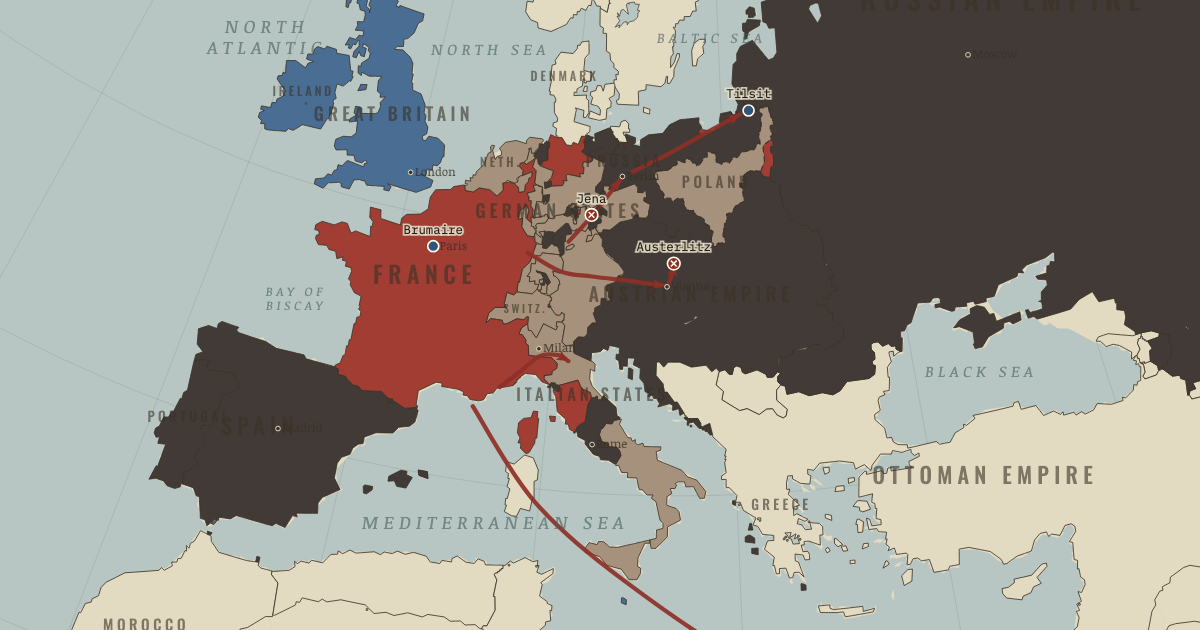
Napoleon's Italian campaign in 1796 displayed a method that would serve him repeatedly: move fast enough to separate enemy armies, then defeat them one at a time. Egypt showed the limits of victory on land. His expedition won near the Pyramids in 1798, but Nelson destroyed the French fleet, leaving it strategically isolated. Napoleon returned to France and, in the coup of 18 Brumaire in 1799, helped overthrow the Directory and took power himself.
The short answer
- An army made by revolution. Napoleon inherited much of the military machinery that made his victories possible. Revolutionary France had expanded recruitment and opened promotion beyond aristocratic birth. Its armies used requisition and mobile formations that could move separately and concentrate for battle. Napoleon coordinated these resources under strong personal command. At Jena the Prussians faced a force able to move and assemble with remarkable speed; revolutionary institutions supplied the means, and Napoleon directed their use.
- Enemies who fought separately. Austria, Prussia and Russia had interests of their own and distrusted one another. Their combined strength mattered little if Napoleon could meet each before the others joined it. Prussia stayed out of the 1805 campaign, Austria out of the war of 1806–7, and defeated powers made separate peace. This division gave Napoleon opportunities to concentrate against forces smaller than the coalition as a whole.
- The appeal of order. A decade of revolution had given many French people something they wanted to keep: transferred land, equality before the law and opportunities for advancement. Napoleon offered landholders, the army and property owners a government capable of securing those gains. Their support helped him consolidate power after Brumaire. The promise of order was attractive to beneficiaries of the Revolution, even as his government narrowed political liberty.
- Britain’s command of the sea. Nelson's victory over the Franco-Spanish fleet at Trafalgar on 21 October 1805 came in the same fortnight as Ulm. France could win on the continent, but Napoleon could not readily cross the sea to invade Britain. Britain, meanwhile, could finance further enemies on land. The naval defeat left a powerful opponent able to continue the war beyond the reach of French armies.
THE TURNING POINT
Austerlitz, 2 December 1805. At Austerlitz on 2 December 1805, Napoleon withdrew from the dominant Pratzen Heights to invite an attack on his weakened right. The allies moved toward it; he struck their center and took the heights. Allied casualties are estimated at 27,000, against 9,000 French, and Austria made peace within the month. Pitt reportedly looked at a map of Europe and said to “roll it up — it will not be wanted these ten years.” The victory secured Napoleon's dominance, but the later wars in Spain and Russia would test whether battles could solve every problem of governing an empire.
What it changed
Reform and resentment in Germany. Germany's political landscape contracted from roughly 300 states to around 40. In parts of Germany, the Confederation of the Rhine brought the Civil Code, secularized lands and modern administration; it also brought French garrisons and conscription. The reforms came with foreign domination, and resistance grew. Fichte lectured in occupied Berlin on “the German nation,” and German forces would fight Napoleon at Leipzig in 1813.
A blockade that had to be enforced. With invasion of Britain beyond reach, Napoleon issued the Berlin decree in 1806 to close Europe to British trade. The blockade could work only if ports complied. Governments with an interest in commerce had reason to resist, and enforcing the policy would draw France into conflicts involving Portugal, Spain and eventually Russia.
Polish hopes and French power. Eleven years after Poland's final partition, the Duchy of Warsaw gave Poles a new state. Find its tan patch on the Vistula. About 100,000 Poles would fight for Napoleon, hoping for a fuller restoration, but the Vienna settlement ended the duchy in 1815. The hope and the disappointment both remained in Polish memory.
The full answer, argued
Napoleon preserved important gains: he protected revolutionary land transfers and legal equality for men, opened careers to ability and removed feudal privileges. His political settlement moved the other way. Censorship, police rule, managed plebiscites and empire curtailed liberty, while the restoration of colonial slavery violated the promise of universal freedom. He secured selected social gains under authoritarian rule.
An interesting fact
The army Napoleon took to Egypt included 167 scholars, among them engineers, chemists, naturalists and artists. Their research helped produce the Description de l’Égypte, twenty-three volumes published over two decades that influenced the development of Egyptology. In 1799 soldiers strengthening a fort found the Rosetta Stone; after the 1801 capitulation it passed to Britain. The French scholar Champollion used copies and ink rubbings to decipher hieroglyphs in 1822.
This is the study layer of Rise of Napoleon, chapter 6 of The Age of Revolutions, 1775–1848; the full index of the atlas is here.
Related questions
THE FREE PRINTABLE STUDY GUIDE
Get the printable study guide for The Age of Revolutions free. I’ll send you a few short letters, then one when a new atlas opens. That’s all. — Paul
NO TRACKING · YOUR ADDRESS IS USED FOR THE DISPATCH AND NOTHING ELSE · UNSUBSCRIBE ANYTIME