American Civil War · NOV 1864
Sherman’s march: atrocity or a way to shorten the war?
The seminar question: “How should we judge Sherman’s march: its conduct, its effect, and its human cost?”
By August 1864 Lincoln expected he might lose re-election, but Mobile Bay, the fall of Atlanta on 2 September and Union success in the Shenandoah changed the mood, and he won 55 percent of the vote. Sherman then marched from Atlanta to Savannah, and Hood’s army was destroyed at Franklin and Nashville.
Chapter 10 is included with every paid plan. WW2 is free in full, and chapter 1 of every atlas is free. A free account opens 3 more chapters a day. Starter, at $9 a month, opens all 21 with no daily limit — see the plans.
Free printable American Civil War study guide, sent by email ↓
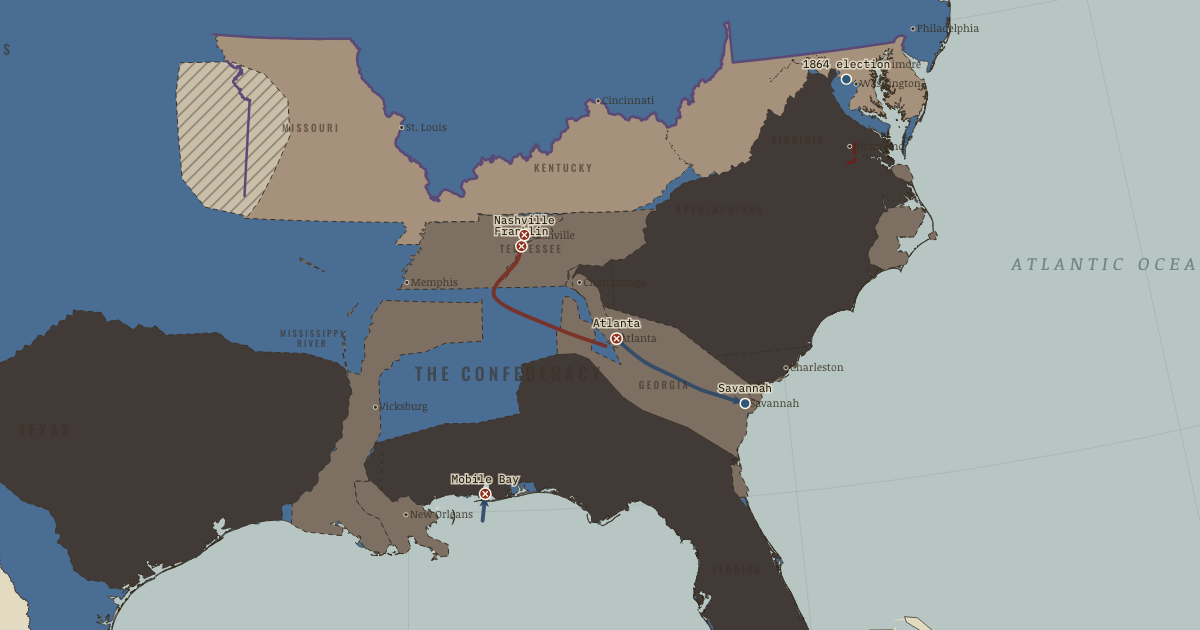
In the summer of 1864, the Confederacy had reason to watch the Northern election as closely as the battlefield. Heavy losses and apparent stalemate had tested the public’s willingness to continue. The Democratic platform declared the war a failure and demanded an armistice. McClellan, its candidate, rejected parts of that platform and wanted to restore the Union. Even so, stopping the fighting while Confederate armies remained intact would have changed the bargaining position sharply. If those armies could hold out until November, Northern politics might offer the South a way to survive.
The short answer
- The election as a strategic front. After Gettysburg, Confederate leaders could hope to win time until Northern voters lost patience with the war. By the summer of 1864 that hope was plausible: gold reached 285, draft riots were only a year past, and the Overland Campaign had cost about 55,000 Union casualties. Atlanta’s fall did not destroy a Confederate army, but it changed what those losses seemed likely to purchase. Voters could now see a prospect of victory in return for continued sacrifice.
- A demonstration across Georgia. About 60,000 Union troops crossed Georgia against limited opposition, destroying property that sustained the war. Their passage demonstrated how little protection the Confederacy could offer its interior. Sherman called the operation “statesmanship” and intended to make “old and young, rich and poor, feel the hard hand of war”. He distinguished pressure on property from violence against people; the distinction helps explain his design, while the experiences of civilians show what the campaign meant on the ground.
- Hood moves into Tennessee. Hood chose a different response to Sherman’s advance: move into Tennessee, take Nashville, threaten the Ohio, and force Sherman to return. The plan required him to defeat Thomas with a smaller, poorly supplied army in winter. After a missed opportunity the day before Franklin, Hood ordered a devastating attack there. Thomas then defeated him at Nashville. The effort to draw Sherman away left the Army of Tennessee shattered as a fighting organization.
THE TURNING POINT
The vote of 8 November 1864. On 8 November voters chose Lincoln. A McClellan victory might have led to armistice talks with Confederate armies still intact and slavery’s future in the political struggle, though his commitment to restoring the Union makes the outcome uncertain. Lincoln’s re-election closed that immediate opening and strengthened the drive for the Thirteenth Amendment. He sought votes for it, and the outgoing House passed it in January. Alongside the victories of 1863, the ballot was a major turning point; armies still had to fight to end the war.
What it changed
Pressure reaches soldiers’ homes. Sherman’s advance carried destruction into the Confederate interior, adding to the hardship of soldiers’ families. Letters from home could pull men away from the ranks, and desertion increased. By spring, reports suggested Lee was losing the equivalent of a regiment a night, although precise rates varied. An army’s ability to stay in the field depended partly on the condition of the homes its soldiers had left behind.
Savannah and the sea. Sherman reached the sea after roughly 300 miles through Confederate territory. Rather than be trapped, Hardee led about 10,000 defenders across the river, and Sherman entered Savannah intact on 21 December. His Christmas-gift telegram announced the result; the march had cost fewer than 2,200 casualties. Resupplied by the fleet, his army would go north through the Carolinas toward Grant. East of the Mississippi, Confederate holdings now appeared on the map as separated patches.
Forty acres and its reversal. Thousands of freedpeople followed Sherman, bringing an urgent question with them: how were they to support themselves in freedom? In January 1865 Field Order No. 15 set aside the sea islands and a coastal strip for Black settlement in forty-acre plots. Andrew Johnson later revoked the arrangement. The promise survived in memory as a measure of what access to land might have made possible; Chapter 12 returns to that question.
The full answer, argued
Start with what the army was authorized to do. Sherman knew the 1863 Lieber Code, under which military necessity could justify destroying property while violence against civilians was forbidden. The march damaged war-supporting property, but individual acts still need judgment. Columbia’s burning the following February remains disputed. The campaign demonstrated Confederate weakness, and its effect belongs alongside the costs of continued fighting; we cannot know exactly how much longer the war would otherwise have lasted. Experiences also differed sharply. Enslaved people could find liberation in the Union advance, while white Georgians faced loss, fear, and humiliation. A verdict must account for the military purpose, the conduct of the troops, and the unequal experiences of those in their path.
An interesting fact
Four days before Field Order No. 15, Sherman and Secretary of War Stanton met twenty Black ministers and lay leaders in Savannah and recorded their answers about what freedpeople needed. Their spokesman was Garrison Frazier, a 67-year-old Baptist minister who had bought freedom for himself and his wife for $1,000 in gold and silver. He said: “The way we can best take care of ourselves is to have land, and turn it and till it by our own labor.” The order for coastal settlement responded to the leaders’ request for land.
This is the study layer of 1864 election and March to the Sea, chapter 10 of The American Civil War, 1840–1877; the full index of the atlas is here.
Related questions
THE FREE PRINTABLE STUDY GUIDE
Get the printable study guide for The American Civil War free. I’ll send you a few short letters, then one when a new atlas opens. That’s all. — Paul
NO TRACKING · YOUR ADDRESS IS USED FOR THE DISPATCH AND NOTHING ELSE · UNSUBSCRIBE ANYTIME