Ancient Rome · AD 312
Did Diocletian’s reforms save or weaken the Roman Empire?
The seminar question: “Did the larger state created under Diocletian and Constantine weaken the empire it helped preserve?”
From 284 Diocletian rebuilt the Roman state: the Tetrarchy of four rulers, about a hundred provinces, separate civil and military commands, and a larger army and tax system. The Tetrarchy collapsed after he retired in 305, and Constantine won the civil wars that followed, including the Battle of the Milvian Bridge in 312.
Chapter 9 is included with every paid plan. WW2 is free in full, and chapter 1 of every atlas is free. A free account opens 3 more chapters a day. Starter, at $9 a month, opens all 21 with no daily limit — see the plans.
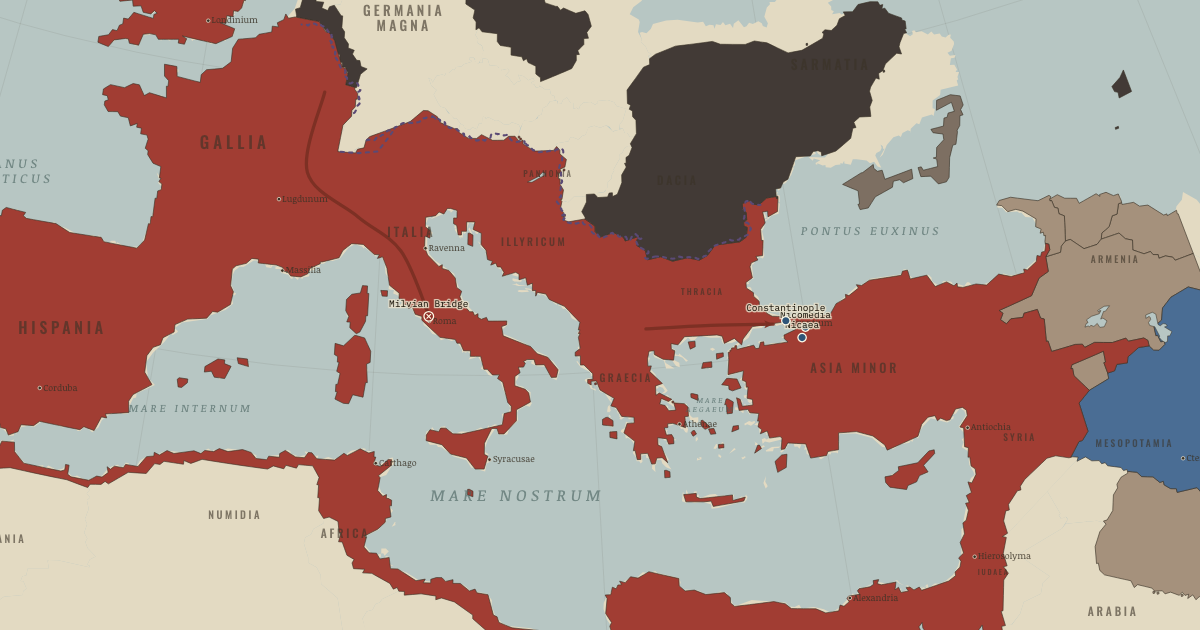
The third-century crisis had exposed two connected problems. Armies needed emperors close enough to respond to danger, yet every army that raised its own candidate threatened to start another civil war. Diocletian’s Tetrarchy gave the empire four legitimate rulers stationed near frontiers: two senior emperors and two junior colleagues intended to succeed them. Government itself acquired a more imposing appearance. From Nicomedia in the Greek east, Diocletian presented the emperor as a sacred, half-divine figure, surrounded by ceremony. Augustus had posed as the first citizen; the new monarchy, often called the Dominate from the Latin for “lord and master,” made the ruler’s exalted position unmistakable.
The short answer
- Answers to the third century. The repeated usurpations and failures of the third century shaped Diocletian’s choices. Four rulers addressed the struggle for a single throne; separate civil and military offices limited the power of governor-generals. Taxes in goods answered debased coinage, while sacred ceremony raised the dignity of an office whose holders had so often been killed. These measures were designed for dangers already experienced. Barbarian settlement and the west’s thinner economy would present further tests.
- Persecution and the church. From 303 to 311 the Great Persecution sought to break Christianity. Authorities burned scriptures, imprisoned clergy and required Christians to sacrifice. Yet Christians were connected across communities, held official posts and included people willing to die for their faith. The campaign failed; an eastern edict ended persecution in 311. Constantine’s support, a decade after the campaign began, brought the emperor into partnership with a network the state had been unable to destroy.
- An eastern centre. Constantinople did not create the east’s importance. Diocletian had governed from Nicomedia and visited Rome only once: cities, revenues, recruits and dangerous frontiers had already drawn the court eastward. Constantine gave that orientation a new capital. When eastern and western courts were formally separated in 395, the east had a defensible capital and resources to garrison it; the west retained Rome’s prestige and its exposure. Chapter 11 follows their unequal fortunes.
- An organised Christian community. Roman traditional religion joined many local cults to civic life. Christianity connected communities differently. Bishops in cities, councils, letters and charitable work gave the church an infrastructure that crossed social and ethnic divisions. Its universal membership and account of authority under one God also offered a way to relate religious and imperial power. Constantine gained organized partners, and their disputes came with them. Chapter 12 follows the church beyond the western state it joined.
THE TURNING POINT
The Milvian Bridge, 28 October 312. On 28 October 312 Constantine won at the Milvian Bridge under a sign he later linked to Christianity. The sources differ about what he experienced, but his public support for the church continued for the remaining twenty-five years of his rule. Christians were perhaps a tenth of the empire; their proportion in the army is uncertain. Their faith moved from persecution to legal recognition and imperial sponsorship. Later, under Theodosius, imperial law increasingly favored orthodox Christianity and restricted traditional worship. The battle’s consequences lay in the choices its winner and his successors made with power.
What it changed
The cost of government. A larger government had to be paid for. Courts, officials and soldiers depended on taxes and compulsory obligations, including those placed on guilds and tenant farmers, or coloni, tied to estates. A contemporary pamphleteer complained of “more tax-eaters than taxpayers,” Diocletian’s Price Edict of 301 attempted to control inflation by fixing prices, but a prescribed price could not ensure that goods would be offered at it. Did the heavier state preserve the empire or damage the economy and loyalty it needed? Chapter 11 returns to the question in the west.
Church and imperial power. By sponsoring the church, emperors became involved in its disputes: Constantine called bishops to Nicaea to address one of them. Church leaders could also challenge imperial conduct. Within eighty years Bishop Ambrose required Theodosius to perform public penance after Thessalonica. The alliance made cooperation possible, while giving religious and political authorities reasons to contest one another. Chapter 12 considers that relationship’s longer history.
An eastern capital. Constantinople acquired its own court, senate, mint and grain supply, including grain redirected from Egypt. The eastern government could therefore operate from a center less dependent on Rome. Compare its foundation in 330 for a united empire with the formal division in 395 and the end of the western imperial line in 476. The eastern empire survived until 1453. The capital was only part of that difference, but its defensible position and resources helped the eastern court govern and defend itself.
The full answer, argued
The reformed state could defend the empire: after 284 its frontiers held for a century, Persia was repeatedly defeated, and the east retained the apparatus for centuries longer. Those results give the case for paying for a larger government its force. The costs matter too. Sources describe tax flight, local elites trying to escape council duties and burdens on farmers. Salvian later reported people preferring barbarian rulers to Roman exactions; his complaint cannot establish what every taxpayer thought. The east’s greater wealth made the demands easier to sustain there than in the west. We must weigh the protection against its cost, and ask whether a lighter government could have provided comparable defense.
An interesting fact
Diocletian’s fortified retirement palace on the Dalmatian coast became part of a living city. In the seventh century refugees from nearby Salona settled within its walls, helping to form Split, Croatia. Roughly 3,000 people still live in the palace complex, with laundry hanging between imperial columns. His mausoleum became Split’s cathedral, dedicated to a bishop martyred during his persecution of Christians. The emperor’s body vanished from history.
This is the study layer of Diocletian and Constantine, chapter 9 of The Rise and Fall of Rome, 264 BC – AD 476; the full index of the atlas is here.
Related questions
THE FREE PRINTABLE STUDY GUIDE
Get the printable study guide for Rome free. I’ll send you a few short letters, then one when a new atlas opens. That’s all. — Paul
NO TRACKING · YOUR ADDRESS IS USED FOR THE DISPATCH AND NOTHING ELSE · UNSUBSCRIBE ANYTIME