American Civil War · APR 1865
Were Grant’s terms at Appomattox too soft a peace?
The seminar question: “Did Grant’s generous surrender terms make Reconstruction’s later failure more likely?”
In early 1865 Sherman moved north through the Carolinas while Grant extended the Petersburg lines. After the Union victory at Five Forks on 1 April, Petersburg and Richmond were abandoned, and Lee surrendered at Appomattox on 9 April 1865. Lincoln was assassinated five days later.
Chapter 11 is included with every paid plan. WW2 is free in full, and chapter 1 of every atlas is free. A free account opens 3 more chapters a day. Starter, at $9 a month, opens all 21 with no daily limit — see the plans.
Free printable American Civil War study guide, sent by email ↓
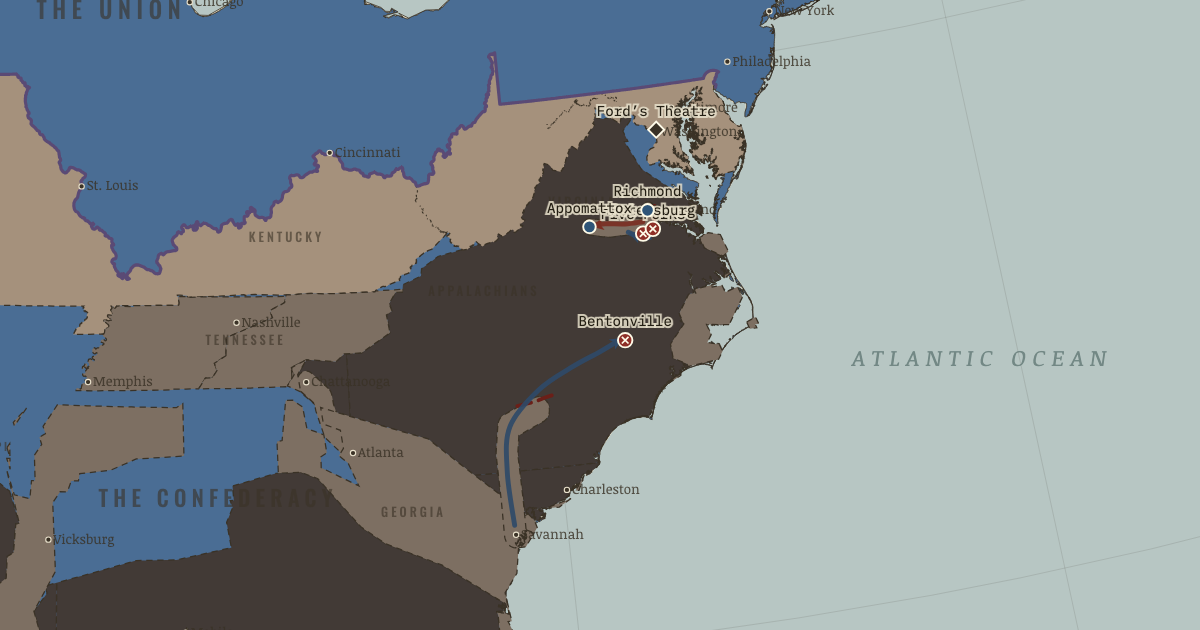
For months, the lines around Petersburg seemed to hold. But Grant was attacking the means by which Lee could keep an army there. Railroads brought food and ammunition to Petersburg and Richmond; as Union troops extended their lines west toward those routes, Lee had to defend more ground with fewer men. Hunger and desertion further reduced his force. Sherman’s advance north through the Carolinas threatened to bring another Union army into the contest.
The short answer
- Why the end came fast. The defenses around Petersburg concealed a weakening supply system. Every westward extension brought Grant closer to the railroads carrying food and ammunition to Lee’s army and Richmond, while Lee’s shrinking force had to cover a longer line. Five Forks endangered the Southside route, and Lee evacuated. The tide chart falls sharply at the end; the months of pressure explain why the loss of one remaining connection mattered.
- The terms as war aims achieved. At City Point in March, Lincoln gave the approaching peace its tone: “Let them up easy.” Grant’s terms served a particular purpose. Parole, food, and private horses helped roughly 28,000 men leave Lee’s army and return home. Union victory and the proposed Thirteenth Amendment had brought reunion and the abolition of slavery within reach. They had not decided how freedpeople would obtain land, rights, or protection.
- Why no guerrilla war?. A surrender did not have to end resistance. Jefferson Davis wanted the war continued from the hills, but Lee warned that partisan warfare would “bring on a state of affairs it would take the country years to recover from.” He surrendered, and Johnston followed against Davis’s wishes. Nathan Bedford Forrest, associated with Fort Pillow, told his men to go home and “be good citizens.” These commanders had prestige as well as armed followers; their decisions helped prevent the fighting from continuing in another form.
THE TURNING POINT
Appomattox Court House, 9 April 1865. Lee did not surrender the largest force; Johnston would surrender more men. But Lee and his army held an exceptional place in the Confederacy, so their acceptance of defeat carried exceptional weight. Grant’s men did not parade prisoners through Northern cities, and the ceremonies included an exchange of salutes. Such restraint helped the armies dissolve. The treatment of Confederate political leaders raised a separate question: would leniency allow them to shape the peace? Both questions stood at the threshold of McLean’s parlor.
What it changed
Assassination changes the peace. Lincoln died just as the country moved from war to Reconstruction. Andrew Johnson, a Unionist Democrat with white-supremacist views, succeeded him; his broad pardons favored the restoration of the old Southern elite. We cannot know what Lincoln would have done. Johnson’s decisions are part of the record, as is the larger role Congress took in 1867.
The armies vanish. The Union armies displayed their victory in Washington’s two-day Grand Review in May 1865. United States Colored Troops were conspicuously absent. Then the vast army went home: roughly a million Union soldiers were mustered out within a year. Some had feared that victory would leave a permanently militarized republic. The scale of the demobilization shows the different course the Union took.
What the map settles. At the final snapshot, the Confederate color and dashed 1860 line disappear: the Union is whole. The Thirteenth Amendment abolished slavery in December 1865; in 1869, Texas v. White rejected unilateral secession. The map cannot show who controls the courthouse, who votes, or on whose land freed families work. Those questions belong to Reconstruction.
The full answer, argued
Grant had to bring an army still in the field to surrender. Parole, rations, and horses helped its soldiers go home and discouraged further organized resistance. Johnson’s broad pardons, the return of plantation land, and the appearance of former Confederates seeking seats in Congress by December 1865 were later political choices. They were not terms imposed by Grant. A government could have treated soldiers generously while protecting Black rights and limiting former leaders. Whether it could have sustained that protection is the harder question: doing so required federal power and Northern support over many years.
An interesting fact
Lieutenant Colonel Ely S. Parker wrote out the surrender terms Lee signed. Donehogawa, as he was also known, was a Tonawanda Seneca sachem and a trained engineer; he had been refused admission to the New York bar because he was not a citizen. Parker later recalled Lee saying, “I am glad to see one real American here,” and his own reply, “We are all Americans”. The exchange rests on Parker’s account. Grant appointed him the first Native Commissioner of Indian Affairs in 1869; a general grant of US citizenship to Native Americans followed in 1924.
This is the study layer of Appomattox and the end of the war, chapter 11 of The American Civil War, 1840–1877; the full index of the atlas is here.
Related questions
THE FREE PRINTABLE STUDY GUIDE
Get the printable study guide for The American Civil War free. I’ll send you a few short letters, then one when a new atlas opens. That’s all. — Paul
NO TRACKING · YOUR ADDRESS IS USED FOR THE DISPATCH AND NOTHING ELSE · UNSUBSCRIBE ANYTIME