American Civil War · NOV 1865
Could Reconstruction have succeeded?
The seminar question: “Could Reconstruction have succeeded, or did its circumstances make failure inevitable?”
After 1865 the Thirteenth, Fourteenth and Fifteenth Amendments abolished slavery, established birthright citizenship and barred racial restrictions on voting, and about 2,000 Black men held office. Klan terror, the depression of 1873 and Northern fatigue ended Reconstruction when the last federal troops left the South in 1877.
Chapter 12 is included with every paid plan. WW2 is free in full, and chapter 1 of every atlas is free. A free account opens 3 more chapters a day. Starter, at $9 a month, opens all 21 with no daily limit — see the plans.
Free printable American Civil War study guide, sent by email ↓
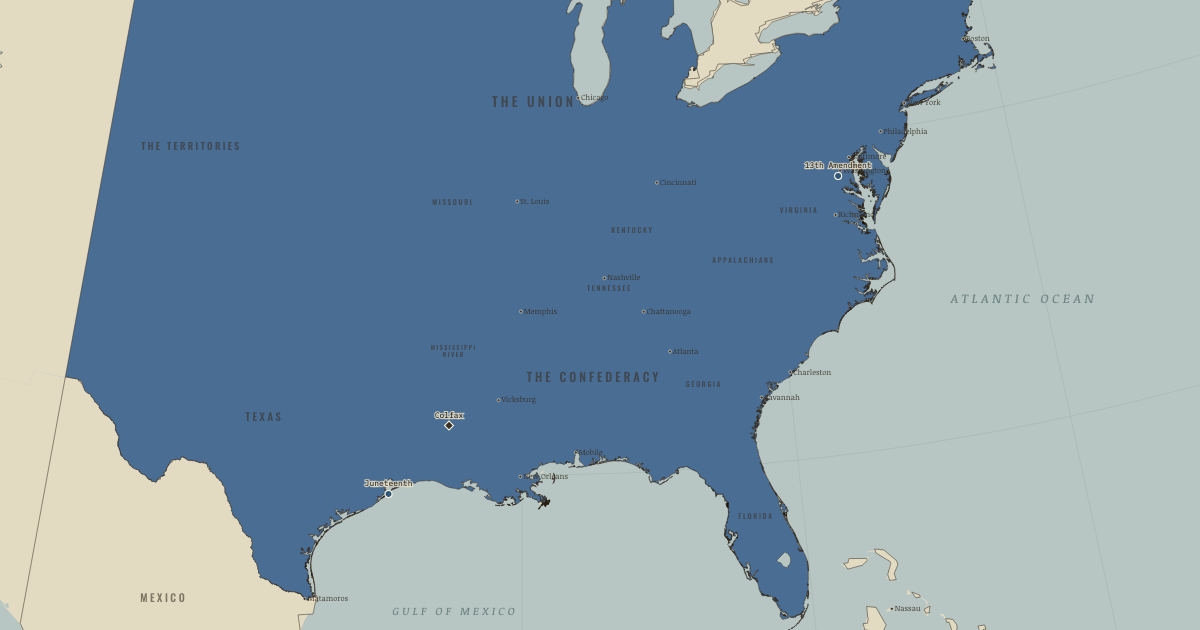
Emancipation opened questions that the end of slavery alone could not answer. Freedpeople legalized marriages and searched for relatives who had been sold away. They built churches and schools and entered public life. About 2,000 Black men held office, and new state governments established the South’s first public school systems. Three constitutional amendments gave the revolution a national foundation: they abolished slavery, defined national citizenship, and barred racial discrimination in voting. Federal law and the army helped protect what people were building.
The short answer
- Land was the revolution not attempted. A family freed from slavery needed a livelihood. Most received no land, so many rented fields from former owners; by 1870 sharecropping was already drawing families into debt. Other policies were available. Sherman’s Field Order No. 15 reserved coastal land in forty-acre plots, but Johnson reversed it within months. The Southern Homestead Act was undermined, and Thaddeus Stevens’s confiscation proposals failed. The political revolution proceeded without a comparable redistribution of land.
- Johnson’s presidency as the pivot. Johnson had two years in which to shape the peace before Congressional Reconstruction began in 1867. He pardoned former Confederates, returned land, vetoed civil-rights legislation, and encouraged Southern states to reject the Fourteenth Amendment. Congress overrode major vetoes—the first overrides of major legislation in US history—but the former ruling class had already had time to reorganize. Lincoln’s assassination had placed a president hostile to Black equality in charge at a decisive moment.
- The occupation the North would not sustain. An amendment could state a right, but people facing armed opposition needed protection to exercise it. Grant’s campaign against the first Klan showed what federal intervention could accomplish. Continued protection required money and political support. Northern fatigue after the depression of 1873 made that support harder to secure; in 1876 the entire US Army numbered about 25,000 men, most in the West. The problem was how to make rights effective as military and political commitment weakened.
- The courts as counter-revolution’s partner. The attackers at Colfax raised a question for the courts: when could the federal government punish private violence against citizens’ rights? In United States v. Cruikshank (1876), the Supreme Court read the Fourteenth Amendment as a restriction on states rather than private individuals, narrowing federal prosecution. Two decades later, Plessy v. Ferguson (1896) upheld “separate but equal.” One ruling limited a remedy against attacks; the other sanctioned segregation.
THE TURNING POINT
Colfax, Easter Sunday 1873. A disputed Louisiana election brought Black citizens to the courthouse at Colfax to defend it on Easter Sunday 1873. A white paramilitary force attacked with a cannon. Estimates put the dead between 60 and 150, many killed after surrender. Three years later Cruikshank overturned key federal convictions and narrowed national enforcement power. The attack and the ruling belong together: violence struck political participation, and federal prosecution became harder. By the settlement of 1877, much damage had already been done.
What it changed
Jim Crow — but not immediately. Black political life did not disappear the moment troops withdrew in 1877. In parts of the South, Black men continued to vote and win office through the 1880s. The broad wave of disfranchising and segregation statutes came largely in the 1890s. Political space closed over years of contest, not in a single instant.
The Great Migration is loaded here. For later generations, leaving became one response to sharecropping, terror, and disfranchisement. Between 1916 and 1970 roughly six million Black Americans left the South, many for Northern cities. The Great Migration reshaped cities, politics, and music, carrying the consequences of Reconstruction’s settlement far beyond the South.
The lever survives. Although Reconstruction governments fell, their amendments remained in the Constitution. Brown v. Board (1954) drew on the Fourteenth Amendment; the Voting Rights Act (1965) enforced the Fifteenth. The civil-rights movement’s term “Second Reconstruction” captured the connection: later activists demanded enforcement of promises made in the earlier period.
The full answer, argued
The answer depends on what we mean by success. Full equality faced formidable opposition and was probably beyond the politics of 1865. Durable Black voting citizenship in substantial parts of the South remained possible into the 1870s: people were already exercising those rights. Alternatives included confiscation and land distribution, sustained military protection, Northern efforts to change Southern institutions tried in fragments, and longer restrictions on former Confederates’ political power. Each needed continuing Northern support despite cost, fatigue, and racism. Those constraints were powerful, but they did not make every decision inevitable. Johnson’s pardons, the doctrine of Cruikshank, and the 1877 settlement helped destroy rights Black citizens had actually exercised.
An interesting fact
Congress chartered the Freedman’s Savings and Trust Company in March 1865. Black veterans, washerwomen, farmers, and churches deposited money there by the tens of thousands; for many families these were their first savings held in law. White trustees invested in railroad and real-estate loans, and speculation and the Panic of 1873 helped ruin the bank. Frederick Douglass became president in its final months and put in $10,000 of his own money, but could not save it. When it closed in June 1874, about 61,000 depositors were owed roughly $3 million. Years of payments returned at best three-fifths, and many families received nothing. Douglass called it “the black man’s cow, but the white man’s milk.”
This is the study layer of Reconstruction era, chapter 12 of The American Civil War, 1840–1877; the full index of the atlas is here.
Related questions
THE FREE PRINTABLE STUDY GUIDE
Get the printable study guide for The American Civil War free. I’ll send you a few short letters, then one when a new atlas opens. That’s all. — Paul
NO TRACKING · YOUR ADDRESS IS USED FOR THE DISPATCH AND NOTHING ELSE · UNSUBSCRIBE ANYTIME