11 ATLASES
History of Mongolia in maps
Mongolia as it appears in 11 interactive history atlases, from 1206 to 2000: Mongolia — the heartland, Mongolia. Each era below lists who ruled the land and when control changed, linked to the dated map that shows it.
WW2 is free in full, and chapter 1 of every atlas is free. A free account opens 3 more chapters a day. Starter, at $9 a month, opens all 21 with no daily limit — see the plans.
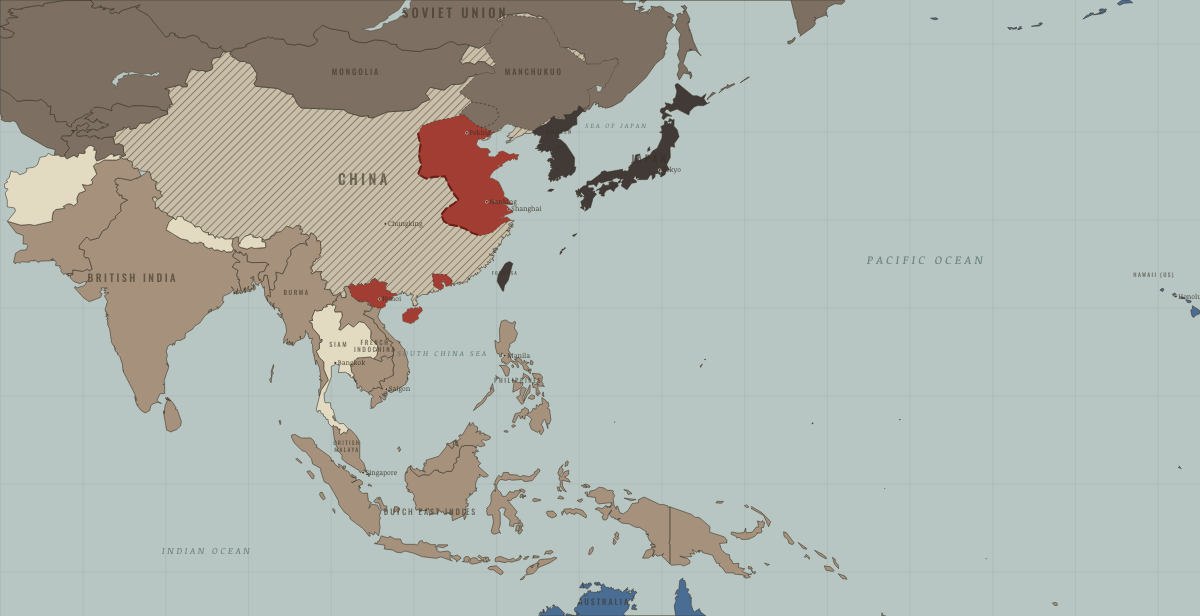
What was Mongolia before it was Mongolia? The sections below follow this land through every era covered by the Maps of History atlases: who ruled it, what it was called, and when control changed. Each line links to the dated map. Modern borders serve as an approximation, as each atlas says on the map itself.
Mongolia — the heartland · Mongol Empire
The empire began in Mongolia, though its heartland was in some ways the place it changed least. The tribes united in 1206 supplied the horses and officers of a world state. In 1272 its capital moved to Beijing; after the Yuan fell in 1368, the ruling family rode home. The founder’s portrait appears on Mongolian money today, while his grave remains undiscovered, as intended.
| The Mongol Empire — the opening position |
MONGOL EMPIRE: EVERY CHAPTER AND MAP →
Mongolia · Industrial Revolution
INDUSTRIAL REVOLUTION: EVERY CHAPTER AND MAP →
Mongolia · Meiji Japan and post-Soviet Russia
Mongolia was part of the Qing empire until 1911. In 1924 it became the world’s second communist state, a Soviet satellite in all but name. Street protests brought its first multiparty elections in 1990, during the same wave of change that ended the Soviet bloc, and Soviet troops departed by 1992. Its peaceful move to democracy offers a comparison with Russia, as does the severe economic collapse that followed the loss of Soviet aid.
| Independent neighbours — the opening position | |
| Independent neighbours |
MEIJI JAPAN AND POST-SOVIET RUSSIA: EVERY CHAPTER AND MAP →
Mongolia · Russian Revolution
Mongolia became an unlikely second front in 1921, when the White warlord Baron Ungern-Sternberg seized it. The Red Army and Mongolian revolutionaries drove him out. In 1924 Mongolia became the world’s second communist state and a Soviet satellite.
| Neutral or independent — the opening position |
RUSSIAN REVOLUTION: EVERY CHAPTER AND MAP →
Mongolia · WWI
Outer Mongolia (Soviet orbit) · Chinese Revolution
As the Qing fell in December 1911, Outer Mongolia declared independence under the Bogd Khan. It was contested and occupied in the turmoil that followed, and from 1921 became a Soviet-protected people’s republic, the world’s second communist state. For Chinese governments, its fate showed what they feared might happen to every borderland: independence under the protection of another power. Chiang’s China conceded Mongolian independence by treaty in 1945–46 as the price of Yalta. The parchment at the top of the map marks a Qing loss that the succession never recovered.
| Neutral / de-facto independent — the opening position |
CHINESE REVOLUTION: EVERY CHAPTER AND MAP →
Mongolia (Mongolian People’s Republic) · Stalin’s Soviet Union
Mongolia became the world’s second communist state in 1921–24. It was independent in name, though a Soviet satellite in practice. Its leader, Khorloogiin Choibalsan, adopted Stalin’s methods: herds were collectivised and Buddhist monasteries destroyed in 1937–39, when tens of thousands of monks and others were killed. Soviet and Mongolian troops defeated Japan at Khalkhin Gol in 1939. China recognised Mongolian independence only in 1946.
| Satellites & communist allies — the opening position |
STALIN’S SOVIET UNION: EVERY CHAPTER AND MAP →
Mongolia (Soviet-aligned) · Road to WW2
| Neutral & unaligned — the opening position | |
| Aggressor clients & partners | |
| Democracies & powers fighting them |
ROAD TO WW2: EVERY CHAPTER AND MAP →
Mongolia · WW2
Mongolia had been a Soviet satellite since the 1920s. The border battle at Khalkhin Gol in 1939 (Ch. 7) helped redirect Japanese strategy south, giving an obscure battle far-reaching consequences. Mongolian cavalry later joined the 1945 offensive into Manchuria.
| Soviet Union — the opening position |
Mongolia · Cold War
| Soviet-aligned states — the opening position | |
| Non-aligned & neutral |
COLD WAR: EVERY CHAPTER AND MAP →
Mongolia (the Mongolian People’s Republic) · Mao’s China
Mongolia had been independent under Soviet protection since 1921. Beijing accepted it as a buffer in 1950, but came to resent it after the split with Moscow. Mongolia sided with Moscow in the 1960s, and from 1966 Soviet divisions were stationed there within striking distance of Beijing. In September 1971 the jet carrying Lin Biao crashed on the steppe near Öndörkhaan; Mongolian officials reached the wreck first.
| Beijing’s allies and friends — the opening position | |
| Beijing’s adversaries |
MAO’S CHINA: EVERY CHAPTER AND MAP →
Related
THE FREE PRINTABLE STUDY GUIDE
Get a printable atlas study guide of your choice free. I’ll send you a few short letters, then one when a new atlas opens. That’s all. — Paul
NO TRACKING · YOUR ADDRESS IS USED FOR THE DISPATCH AND NOTHING ELSE · UNSUBSCRIBE ANYTIME