11 ATLASES
History of Kazakhstan in maps
Kazakhstan as it appears in 11 interactive history atlases, from 1206 to 2000: the Qipchaq steppe, Kazakh steppe, Kazakhstan, Russian Turkestan, Soviet Central Asia, Soviet Kazakhstan. Each era below lists who ruled the land and when control changed, linked to the dated map that shows it.
WW2 is free in full, and chapter 1 of every atlas is free. A free account opens 3 more chapters a day. Starter, at $9 a month, opens all 21 with no daily limit — see the plans.
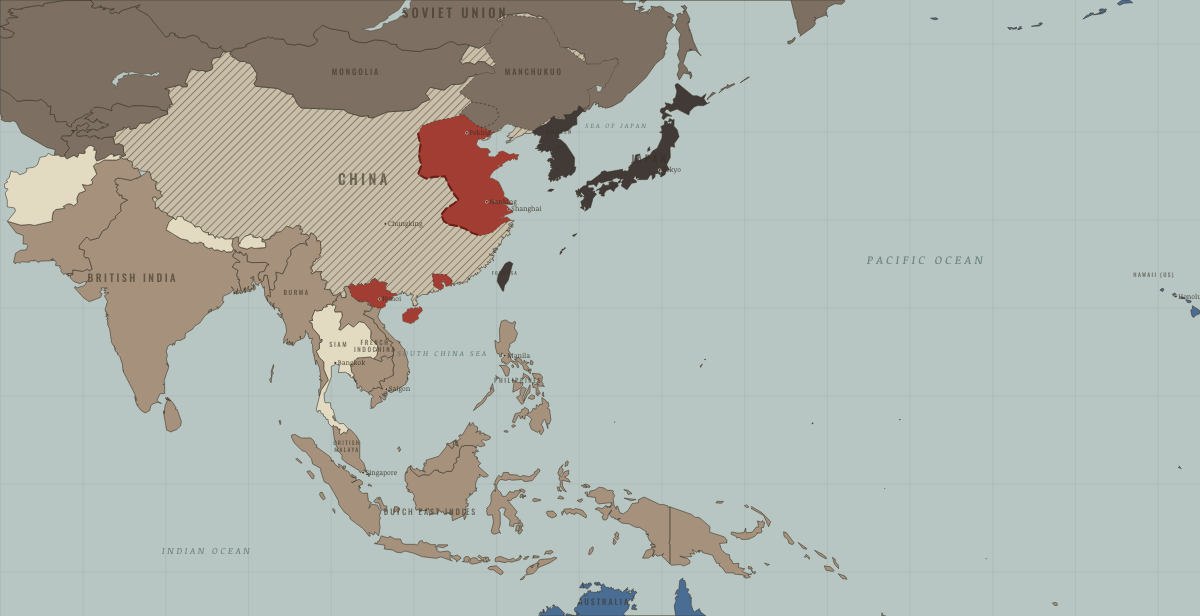
What was Kazakhstan before it was Kazakhstan? The sections below follow this land through every era covered by the Maps of History atlases: who ruled it, what it was called, and when control changed. Each line links to the dated map. Modern borders serve as an approximation, as each atlas says on the map itself.
Kazakhstan · Norse and Aztecs
| Other peoples and states — the opening position |
NORSE AND AZTECS: EVERY CHAPTER AND MAP →
The Qipchaq steppe (mod. Kazakhstan) · Mongol Empire
The Qipchaq steppe formed the corridor through which conquest passed. The Great Raid broke its Cuman-Qipchaq confederations, and after 1236 they were absorbed wholesale. Qipchaq peoples contributed substantially to the Golden Horde’s armies, language and successor peoples; the steppe merged with its conquerors as well as falling to them. Boys sold from this same steppe to Cairo became the Mamluks who stopped the Mongols.
| Beyond the conquests — the opening position | |
| The Mongol Empire |
MONGOL EMPIRE: EVERY CHAPTER AND MAP →
Kazakh steppe (Russian Empire) · Industrial Revolution
| Colony or dependency — the opening position | |
| Colony or dependency |
INDUSTRIAL REVOLUTION: EVERY CHAPTER AND MAP →
Kazakhstan · Meiji Japan and post-Soviet Russia
Kazakhstan was the largest Central Asian republic; in 1989 Kazakhs and Russians each accounted for about two-fifths of its population. The Alma-Ata protests of December 1986 were the first open national unrest of the glasnost years. Yet Kazakhstan was the last republic to declare independence, on 16 December 1991. Its leader, Nursultan Nazarbayev, had wanted a reformed Union; he ruled the new state until 2019.
| The USSR, then Russia — the opening position | |
| Independent neighbours |
MEIJI JAPAN AND POST-SOVIET RUSSIA: EVERY CHAPTER AND MAP →
Russian Turkestan (mod. Kazakhstan) · Russian Revolution
Russia brought the Kazakh steppe under its rule in stages from the 1730s to 1864. In that final year, chains of Russian forts along the Syr Darya and in Semirechye met, and the steppe became a base for the conquest of Central Asia. During the revolution, the national movement Alash Orda was caught between Reds and Whites; by 1920 the region had been drawn into Soviet Turkestan. It is shown here as part of Russian Turkestan. A decade later, famines under Soviet collectivization would shatter its nomadic society.
| The Tsarist empire — the opening position | |
| Provisional Government, then the Whites | |
| Contested / peasant war | |
| Soviet power |
RUSSIAN REVOLUTION: EVERY CHAPTER AND MAP →
Kazakhstan · WWI
| The Entente & Allies — the opening position | |
| Russia in revolution |
Soviet Central Asia (mod. Kazakhstan) · Chinese Revolution
Soviet Central Asia ran along the whole western border of Xinjiang. The Tsars had taken Turkestan; the Soviets reorganized it into republics and collectivized it at terrible cost. The Kazakh famine of 1930–33 killed a third of the Kazakh people. Across the border, Soviet pressure drew Xinjiang close: Sheng Shicai’s warlord regime relied on Soviet arms, advisers and trade along these roads in the 1930s, and carried out purges to match. Moscow’s wartime distraction then allowed Chungking to claw the province back in 1942–44. Influence over Xinjiang had not required an empire to cross the border.
| Foreign empires — British, French, Russian, American — the opening position |
CHINESE REVOLUTION: EVERY CHAPTER AND MAP →
Kazakhstan (Kazakh SSR from 1936) · Stalin’s Soviet Union
Until 1936 Kazakhstan was an autonomous republic within Russia; it then became a union republic. Collectivisation and the forced settlement of nomads in 1929–33 caused a famine that killed perhaps two-fifths of all Kazakhs. Deportees arrived afterwards: “kulaks”, Koreans, Volga Germans, Chechens and others. Kazakhstan also held the camps of Karlag and ALZhIR. By 1939 Kazakhs were a minority in their own republic, a legacy that lasted into independence.
| The Soviet Union — the opening position | |
| Famine regions (memorial) | |
| The Soviet Union |
STALIN’S SOVIET UNION: EVERY CHAPTER AND MAP →
Soviet Kazakhstan · Road to WW2
| Neutral & unaligned — the opening position | |
| Aggressor clients & partners | |
| Democracies & powers fighting them | |
| Aggressor clients & partners | |
| Democracies & powers fighting them |
ROAD TO WW2: EVERY CHAPTER AND MAP →
Kazakhstan · Cold War
| USSR & Warsaw Pact — the opening position | |
| Non-aligned & neutral |
COLD WAR: EVERY CHAPTER AND MAP →
Soviet Central Asia (mod. Kazakhstan) · Mao’s China
| Beijing’s allies and friends — the opening position | |
| Beijing’s adversaries |
MAO’S CHINA: EVERY CHAPTER AND MAP →
Related
THE FREE PRINTABLE STUDY GUIDE
Get a printable atlas study guide of your choice free. I’ll send you a few short letters, then one when a new atlas opens. That’s all. — Paul
NO TRACKING · YOUR ADDRESS IS USED FOR THE DISPATCH AND NOTHING ELSE · UNSUBSCRIBE ANYTIME