11 ATLASES
History of Afghanistan in maps
Afghanistan as it appears in 11 interactive history atlases, from 1206 to 2000: Herat, Balkh & Ghur, Afghanistan. Each era below lists who ruled the land and when control changed, linked to the dated map that shows it.
WW2 is free in full, and chapter 1 of every atlas is free. A free account opens 3 more chapters a day. Starter, at $9 a month, opens all 21 with no daily limit — see the plans.
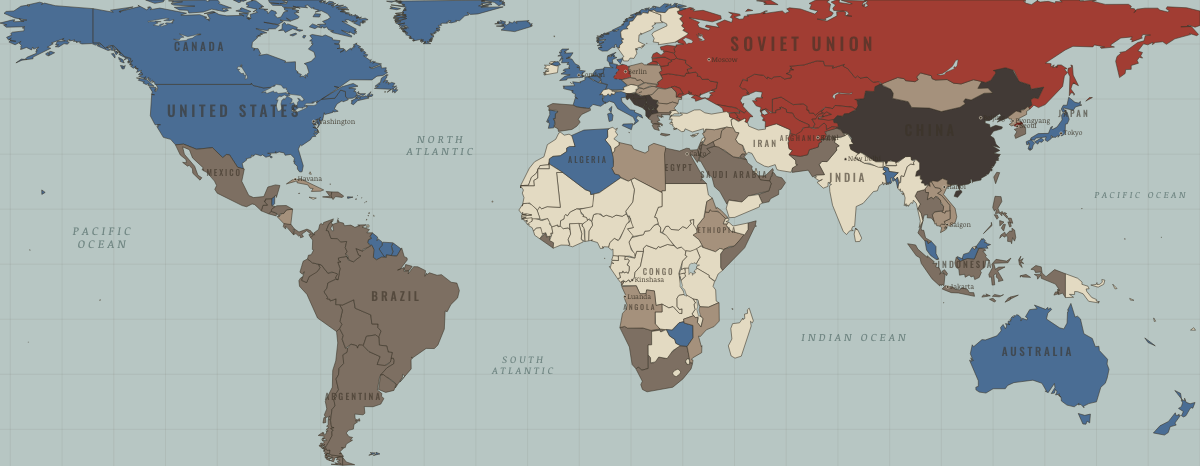
What was Afghanistan before it was Afghanistan? The sections below follow this land through every era covered by the Maps of History atlases: who ruled it, what it was called, and when control changed. Each line links to the dated map. Modern borders serve as an approximation, as each atlas says on the map itself.
Herat, Balkh & Ghur (mod. Afghanistan) · Mongol Empire
On Khorasan’s eastern rim, Herat, Balkh and Ghur suffered some of the campaign’s worst systematic destruction. Balkh was razed in 1221, and Herat was massacred after a revolt in 1222. Bamiyan’s valley was reportedly annihilated in retaliation for the death of the khan’s grandson. The cities needed generations to recover; some qanat systems never recovered at all.
| The Islamic powers — the opening position | |
| The Mongol Empire |
MONGOL EMPIRE: EVERY CHAPTER AND MAP →
Afghanistan · Industrial Revolution
INDUSTRIAL REVOLUTION: EVERY CHAPTER AND MAP →
Afghanistan · Meiji Japan and post-Soviet Russia
Afghanistan appears on the Eurasia map as the Soviet Union’s last war. A communist coup in 1978 provoked revolt, and Soviet troops invaded in December 1979. Estimates of Afghan deaths in the war range from about half a million to 2 million, with many near a million; about 5 million people fled to Pakistan and Iran. Soviet troops withdrew in February 1989, and the communist government fell in 1992. Civil war continued through the decade, shown by hatching on every map.
| Non-aligned or stateless — the opening position | |
| War, rebellion, breakaway |
MEIJI JAPAN AND POST-SOVIET RUSSIA: EVERY CHAPTER AND MAP →
Afghanistan · Russian Revolution
After winning full independence from Britain in 1919, Afghanistan became one of the first states to recognize Soviet Russia. Moscow courted the buffer kingdom as a lever against the British Empire in Asia.
| Neutral or independent — the opening position |
RUSSIAN REVOLUTION: EVERY CHAPTER AND MAP →
Afghanistan (independent 1919) · Indian independence
Afghanistan was the first to break free. It had been nominally sovereign but British-steered since 1880; in May 1919, amid the Punjab’s convulsions, it attacked across the Durand Line. At Rawalpindi in August it won control of its foreign policy. Watch the map’s northwest corner turn red in 1919, twenty-eight years before anything else moves. Kabul spent the era as a listening post between empires. After 1947, Afghanistan inherited a dispute over the Durand Line with Pakistan that continues today.
| Beyond the Raj · Portuguese & French India — the opening position | |
| Self-rule / independent |
INDIAN INDEPENDENCE: EVERY CHAPTER AND MAP →
Afghanistan · WWI
Afghanistan · Chinese Revolution
Afghanistan fought Britain to a treaty in 1919 and remained the one state on the map’s western edge that belonged to no empire. During the world war it maintained neutrality between the Soviet north and British south, a small achievement of survival diplomacy. From Kabul, the catastrophe in China was a distant rumor. The countries shared only a sliver of border up the Wakhan corridor, the quietest line on the map.
| Neutral / de-facto independent — the opening position |
CHINESE REVOLUTION: EVERY CHAPTER AND MAP →
Afghanistan · Stalin’s Soviet Union
STALIN’S SOVIET UNION: EVERY CHAPTER AND MAP →
Afghanistan · Road to WW2
| Neutral & unaligned — the opening position |
ROAD TO WW2: EVERY CHAPTER AND MAP →
Afghanistan · Cold War
The Soviet Union invaded Afghanistan in 1979 to save a client regime. For nine years it faced resistance funded by the CIA and Saudi Arabia and run through Pakistan, before withdrawing in 1989 (Ch. 10). A million or more Afghans died, and the Soviet state’s self-belief died with them. The war also built weapons and networks that became the next era’s problem, presented in turn to every sponsor.
| USSR & Warsaw Pact — the opening position | |
| USSR & Warsaw Pact | |
| Soviet-aligned states | |
| Non-aligned & neutral |
COLD WAR: EVERY CHAPTER AND MAP →
Afghanistan · Mao’s China
| Neutral, non-aligned or colonial — the opening position |
MAO’S CHINA: EVERY CHAPTER AND MAP →
Related
THE FREE PRINTABLE STUDY GUIDE
Get a printable atlas study guide of your choice free. I’ll send you a few short letters, then one when a new atlas opens. That’s all. — Paul
NO TRACKING · YOUR ADDRESS IS USED FOR THE DISPATCH AND NOTHING ELSE · UNSUBSCRIBE ANYTIME