MAPS OF HISTORY · WW2 · ALL CHAPTERS · CHAPTER 3
CHAPTER 3 · APR–JUN 1940 · JUN 1940
Blitzkrieg in the West
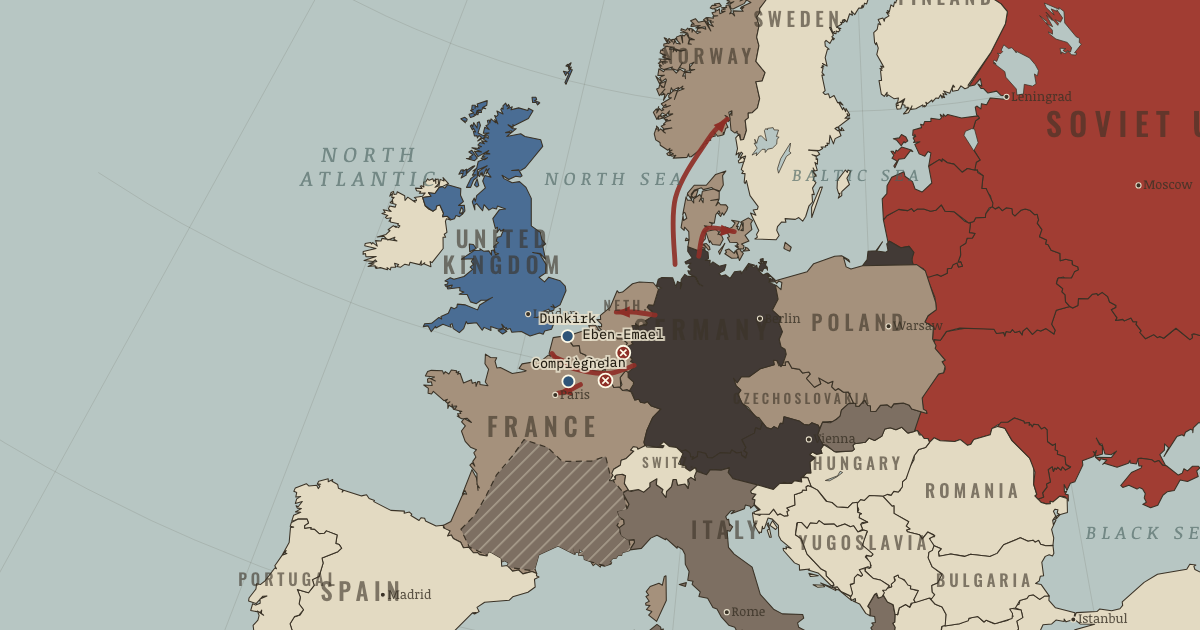
The map above is the world of JUN 1940 — France falls.
BRIEF EXPLANATION — THE ESSENTIAL ARGUMENT
The fall of France in 1940 stunned the world, and the reason lies in how Germany turned a smaller and less well-equipped force into a decisive one. Germany first secured its northern flank by occupying Denmark and invading Norway in April 1940, protecting the sea route that carried Swedish iron ore. On 10 May it struck west against the Netherlands, Belgium, Luxembourg, and France. The Allies rushed their strongest armies north into Belgium, because they expected Germany to repeat the broad sweep it had used in 1914.
The real blow fell elsewhere. Germany sent its armoured divisions through the wooded hills of the Ardennes, a route the Allies thought unsuitable for tanks, and crossed the River Meuse at Sedan before racing to the Channel coast. This drive cut off the Allied armies that had advanced into Belgium. About 338,000 troops were evacuated from the beaches at Dunkirk, yet France signed an armistice after only six weeks of fighting. The map shows the result, with German-occupied France in the north and west and a collaborationist French government based at Vichy ruling the south.
GUIDED EXPLANATION
Germany opened the campaign by securing Scandinavia before turning west. Control of Norway protected the winter shipping route that carried Swedish iron ore through the port of Narvik, and it offered naval and air bases facing the Atlantic. The fighting cost the German navy heavily in warships, a loss that would later matter when Germany considered invading Britain. The main western offensive began on 10 May, and the Allies committed their best mobile formations to an advance into Belgium, confident that the decisive German thrust would come through the northern plains as it had a generation earlier.
The true centre of gravity was the Ardennes, and German commanders built their plan around striking where they were least expected. Seven panzer divisions threaded the narrow forest roads, forced the Meuse at Sedan, and drove west to the Channel, severing communications between the Allied armies in Belgium and the rest of France. Their success rested on the concentration of force, on relentless tempo, and on radio control that pushed decisions down to junior commanders, rather than on any general superiority in equipment. At Dunkirk the evacuation saved much of Britain’s trained army, though it left behind almost all of its heavy weapons, and France collapsed within six weeks. Southern France then passed to the Vichy government, shown hatched on the map, which collaborated with Germany while keeping a limited administration of its own.
This outcome was not inevitable, and seeing why guards against treating German victory as destiny. The columns crawling through the Ardennes were crowded and vulnerable, and Allied reconnaissance did glimpse them, yet the reports never overturned the fixed assumption that the main danger lay farther north. French doctrine expected a slow and tightly controlled battle, while German commanders accepted local initiative and moved before French headquarters could rebuild a continuous front. Once the coast was reached, the northern armies faced encirclement and the French reserve was badly placed to respond. The consequences reshaped the whole war, because Britain lost its principal continental ally, Italy joined Germany to share the spoils, and the Soviet Union expanded in the Baltic. Germany gained the Atlantic coast, yet it still had to find a way to force Britain out of the war.
DEEP EXPLANATION — EVIDENCE & INTERPRETATION
The operational method behind victory
German victory came from how forces were organized and led rather than from better machines, and the point is easy to prove. Many French tanks carried thicker armour and heavier guns than their German counterparts. What Germany did differently was to combine tanks, infantry, engineers, artillery, and radios into panzer divisions that concentrated at a single narrow point and exploited a breach before senior headquarters could restore a continuous line. Dive-bombers supplied mobile firepower when the artillery fell behind. French doctrine, by contrast, emphasized a carefully controlled “methodical battle,” an approach that was not foolish after the experience of 1914–18 but whose decision cycle proved far too slow to contain a fast-moving penetration. German commanders also ran real risks, because the long Ardennes columns were exposed and the spearheads sometimes outran their own infantry and supply. Victory can therefore be explained without calling it inevitable, because a daring method met an opponent whose assumptions made the danger hard to recognize and harder still to punish.
Explaining the fall of France
Older accounts blamed the defeat on low morale or national decline, but more recent military history points to a specific operational failure rather than a society unwilling to fight. France mobilized millions of men, fought hard in many sectors, and suffered roughly 90,000 military dead in six weeks. Its high command placed the main mobile reserve poorly, reacted too slowly at Sedan, and lost control once the northern armies were cut off. Political instability and defensive habits of mind mattered, yet they fall far short of cowardice. The Maginot Line itself did not fail either, because Germany simply advanced around its main fortifications, exactly as its planners had assumed was possible. The decisive error was to commit the mobile reserve northward while underrating the Ardennes route. This interpretation matters because it replaces a cultural stereotype with a mechanism that can be tested against the map, the actual deployment of forces, and the timing of the key decisions.
The WW2 atlas is free in full — no sign-up.
THE SITES
ON THIS DAY
WHY IT HAPPENED
Organization over equipment totals. France had many capable tanks but distributed much of its armor for infantry support. Germany concentrated combined-arms formations and connected them by radio.
The Ardennes gamble. The revised German plan placed its main weight through terrain the Allies considered unsuitable for a large, rapid armored advance. Surprise came from accepting operational risk.
Norway and iron ore. Control of Norway protected Swedish ore shipments and supplied Atlantic bases. German naval losses there, however, reduced its ability to cover an invasion of Britain.
THE TURN
Sedan, 13–15 May. German forces crossed the Meuse under concentrated air attack. French command took too long to organize a counterattack, so the bridgehead expanded. The key mechanism was tempo: a local breach became strategic collapse before reserves could seal it.
WHAT IT CHANGED
Dunkirk preserves Britain’s army. The pause in the German advance and Luftwaffe failure helped 338,000 Allied troops escape. Britain lost equipment but retained trained personnel needed to continue the war.
Britain rejects negotiation. With France defeated, Britain faced invasion and pressure to seek terms. Churchill’s government chose continued war, making control of the air the next test.
Other powers exploit the collapse. Italy entered the war as France fell. The USSR annexed the Baltic states and Bessarabia. Rapid German victory changed calculations across Europe.
FIELD QUESTION — France had more tanks, more artillery, and equal manpower. Why did it collapse in six weeks?
Equipment totals did not determine how quickly force could be applied. Germany concentrated combined arms at the decisive point and used radio command to exploit success. French deployment and decision-making were built for a slower, controlled battle. The Ardennes surprise and the loss of operational communication turned one breach into the separation of the Allied front.
AN INTERESTING FACT
The Ardennes thrust began as history’s greatest traffic jam: some 41,000 vehicles of Panzergruppe Kleist queued in columns stretching 250 kilometers back beyond the Rhine — for days, a dream target for any air force. Allied reconnaissance pilots spotted the columns, headlights burning through the night of 10–11 May, and reported them; the reports died in headquarters that already “knew” the Ardennes was tank-proof. A fact that contradicts the plan is the easiest fact to ignore.
THE DISPATCH
One short letter when a new atlas opens — and the printable study guide for WW2 is yours now, free.
NO TRACKING · YOUR ADDRESS IS USED FOR THE DISPATCH AND NOTHING ELSE · UNSUBSCRIBE ANYTIME