MAPS OF HISTORY · WW2 · ALL CHAPTERS · CHAPTER 2
CHAPTER 2 · AUG–OCT 1939 · SEP 1939
The Pact and the Partition of Poland
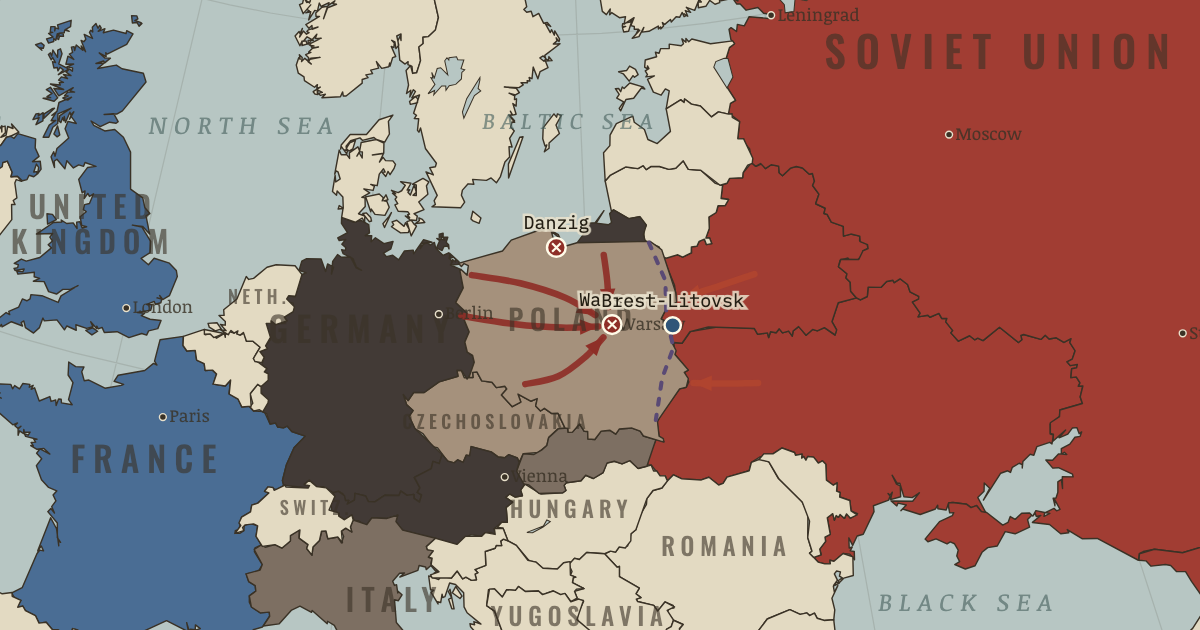
The map above is the world of OCT 1939 — Poland partitioned.
BRIEF EXPLANATION — THE ESSENTIAL ARGUMENT
The most startling diplomatic event of the prewar years was an agreement between two sworn enemies, and understanding why it happened explains how the war actually began. On 23 August 1939 Nazi Germany and the communist Soviet Union, each publicly committed to destroying the other, signed a pact promising not to go to war. A secret protocol attached to it divided much of Eastern Europe into spheres of influence, assigning western Poland to Germany and eastern Poland, the Baltic states, and Bessarabia to the Soviet Union. Each dictator expected to profit in the short term, and neither expected the arrangement to survive for long.
With the Soviet Union neutralized, Germany invaded Poland from the west on 1 September 1939, the act that opened the Second World War in Europe. Britain and France declared war two days later, honouring their guarantee, yet neither could deliver military help that reached Poland in time. The Soviet Union then invaded from the east on 17 September, and the country was overrun and partitioned between the two powers. The Polish state vanished from the map, but its government escaped into exile and its soldiers, airmen, and codebreakers carried on the war abroad.
GUIDED EXPLANATION
The pact was a temporary bargain between ideological enemies, and each side entered it for a concrete short-term gain. Hitler removed the danger of a war on two fronts and secured Soviet grain, oil, and metals that would blunt any British blockade. Stalin gained time to rebuild an army recently gutted by his own purges, together with territory that pushed the Soviet frontier westward as a buffer. The secret protocol drew a line through Eastern Europe, and the partition of Poland simply followed that line. Because the two regimes still meant to destroy each other, both treated the partnership as a pause rather than a peace.
Germany attacked Poland from several directions at once, and the speed of its victory came from method rather than from overwhelming numbers. Mobile armoured formations, aircraft, and radio communications concentrated force at chosen points and disrupted Polish command faster than reserves could react, a combination later called Blitzkrieg, or lightning war, although it was never a single formal doctrine. Britain and France declared war on 3 September but mounted no offensive capable of relieving Poland. When the Red Army crossed the eastern border on 17 September, sustained defence became impossible, and occupation divided the country between two violent regimes. The Polish state disappeared from this map, yet Polish soldiers, airmen, intelligence officers, and a government-in-exile fought on for the rest of the war.
Poland’s rapid defeat followed from strategy and geography rather than from any failure of will, and that distinction matters. Poland had long, exposed borders and was still mobilizing when the attack began, while its Western allies could pressure Germany only by attacking from France, which their limited advance into the Saar never seriously attempted. The Soviet invasion from the east then made any sustained defence within Poland impossible. German and Soviet authorities pursued different but overlapping programmes of deportation, imprisonment, and murder, so the pact mattered far beyond sparing its signatories a fight with each other. It gave both regimes a free hand to dismantle a neighbouring state. In the west it also opened the “Phoney War,” a period of formal hostilities without any Allied land offensive strong enough to seize the initiative.
DEEP EXPLANATION — EVIDENCE & INTERPRETATION
A pact of calculation
The agreement did not reconcile Nazism and communism; it suspended their conflict because each regime expected an immediate advantage. Hitler wanted a free hand to destroy Poland before turning against the West, and Soviet deliveries of oil, grain, and metals later softened the effect of the British naval blockade. Stalin faced collapsed negotiations with Britain and France, an officer corps recently shattered by his own purges, and danger in both Europe and Asia, so moving the Soviet frontier westward promised to delay an invasion, even as it placed millions of people under Soviet rule and removed the independent buffer states between the two powers. Historians debate how far the pact was defensive calculation and how far opportunistic expansion, and both were plainly present. A useful distinction separates motive from consequence, because Soviet security concerns were real, yet the secret protocol enabled aggression and partition. The bargain bought the Soviet Union twenty-two months of preparation, while allowing Germany to fight its enemies one at a time.
Why Poland fell so quickly
Poland did not collapse because horsemen charged tanks, a durable myth that hides the real problem its army faced. Poland had exposed borders, incomplete mobilization, and no defensible interior, and it was attacked from the west, north, and south before the Soviet Union struck from the east. German operational tempo did the rest, because radios let commanders redirect mobile units, aircraft attacked communications and movement, and armoured spearheads punched through the line rather than pushing evenly along it. Poland’s allies could declare war, yet geography prevented them from offering direct support in time, and French forces attempted only a cautious advance into the Saar. Polish resistance continued at Warsaw and on the coast, while organized units escaped through Romania and Hungary to fight again. The campaign therefore separates the defeat of a state from the surrender of a nation. It also exposes a hard truth about alliances, which is that a guarantee carries little deterrent weight if the promised military help cannot physically arrive when it is needed.
The WW2 atlas is free in full — no sign-up.
THE SITES
ON THIS DAY
WHY IT HAPPENED
Soviet distrust after Munich. Stalin doubted that Britain and France would form an effective anti-German alliance. A deal with Germany offered time, territory, and distance from a future front.
Hitler avoids two fronts. The pact neutralized the USSR during the Polish campaign and opened Soviet trade. Hitler expected Britain and France either to retreat again or to fight without decisive effect.
Danzig as pretext. The status of Danzig and the Polish Corridor supplied public demands. Hitler’s wider aim was Lebensraum, or living space, and the destruction of an independent Polish state.
THE TURN
First shots, 1 September, 04:47. The battleship Schleswig-Holstein fired on the Polish depot at Westerplatte. Its 182 defenders resisted for seven days. The local defense could not reverse the invasion, but it showed that rapid strategic defeat did not mean an absence of resistance.
WHAT IT CHANGED
The Phoney War begins. Britain and France were formally at war but remained largely inactive on the western land front for eight months. Germany gained time to prepare its next campaign.
Two systems of occupation. Nazi authorities targeted Polish elites, clergy, and Jews from the beginning. Soviet authorities deported hundreds of thousands and murdered about 22,000 Polish officers and prisoners at Katyn and related sites. Poland suffered the war’s highest proportional national loss.
The USSR expands its buffer. The Soviet Union absorbed eastern Poland and then attacked Finland. Finnish resistance exposed Soviet weaknesses and encouraged Hitler’s later, mistaken confidence that the USSR would collapse.
FIELD QUESTION — Why would two sworn ideological enemies — fascism and communism — sign a pact?
Short-term strategy overrode long-term ideology. Hitler gained a one-front war and raw materials. Stalin gained time, territory, and a wider buffer while Germany fought the Western powers. Both expected a later conflict. The pact shows that ideological enemies can cooperate when the immediate balance of risk rewards both.
AN INTERESTING FACT
Five weeks before the invasion, Polish military intelligence summoned British and French officers to a bunker hidden in the Kabaty woods south of Warsaw and handed each delegation a working replica of the German Enigma machine — a cipher Polish mathematicians had been quietly breaking since 1932. Bletchley Park’s wartime codebreaking was built directly on that gift. The Polish state was erased from the map within weeks; the mathematics it smuggled out that July helped destroy its occupier six years later.
THE DISPATCH
One short letter when a new atlas opens — and the printable study guide for WW2 is yours now, free.
NO TRACKING · YOUR ADDRESS IS USED FOR THE DISPATCH AND NOTHING ELSE · UNSUBSCRIBE ANYTIME