MAPS OF HISTORY · WW2 · ALL CHAPTERS · CHAPTER 14
CHAPTER 14 · FEB–SEP 1945 · AUG 1945
The Downfall of Imperial Japan
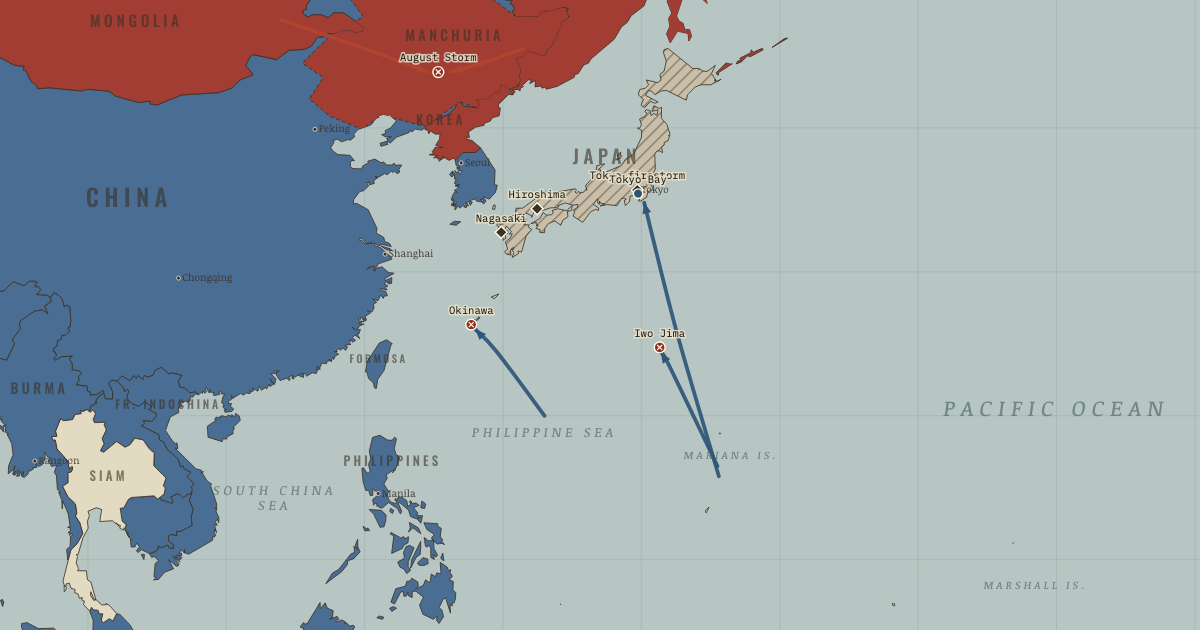
The map above is the world of AUG 1945 — Downfall.
BRIEF EXPLANATION — THE ESSENTIAL ARGUMENT
By 1945 Japan had been devastated by blockade and bombing, yet its government still had not agreed to surrender, and the question of how to end the war became one of the most consequential and most debated of the century. The naval blockade and the burning of Japan’s cities had wrecked its economy, while the battles for Iwo Jima and Okinawa showed how bloody an invasion of the home islands would be for both sides. American firebombing killed civilians in enormous numbers, including roughly 100,000 people in the single Tokyo raid of 9 and 10 March, a toll this atlas records as human loss to be mourned.
The war ended amid a cluster of shocks rather than through any single blow. The United States destroyed Hiroshima and Nagasaki with atomic bombs on 6 and 9 August, and between those two attacks the Soviet Union declared war and invaded Manchuria. Emperor Hirohito then broke a deadlocked cabinet and accepted surrender. Historians continue to argue over the relative weight of the atomic bombs, of Soviet entry, of the blockade, and of the uncertainty surrounding the emperor’s future, and the surrender is best understood as the product of all of them acting together.
GUIDED EXPLANATION
Long before the atomic bombs, blockade and submarine warfare had cut Japan off from food, fuel, and raw materials, and B-29 incendiary raids had begun to burn out its cities, with the Tokyo raid of 9 and 10 March killing around 100,000 people. The battles for Iwo Jima and Okinawa then showed, at fearful cost, what fighting near the home islands would mean. American casualty projections for a full invasion of Japan varied widely, and those uncertain estimates would later become central to the argument over whether the atomic bombs were necessary.
Hiroshima was destroyed by an atomic bomb on 6 August. The Soviet Union declared war on 8 August and invaded Manchuria during the night of 8–9 August, extinguishing Japan’s remaining hope that Moscow might broker a favourable peace, and Nagasaki was bombed on 9 August. Japan’s senior council remained divided even then, until Emperor Hirohito intervened to accept surrender, which was announced on 15 August and formally signed on 2 September. No single-cause account fits the sequence, because atomic destruction, Soviet intervention, the blockade, conventional bombing, the fear of invasion, and the hope of preserving the emperor all shaped the final decision.
Japan’s decision system explains why clear military defeat had not already produced surrender. Civilian leaders quietly explored mediation, while military leaders hoped that one costly battle on home soil would win better terms, and no one could break the deadlock from inside. The Allies demanded unconditional surrender but never clearly promised that the emperor could remain, and American planners weighed invasion, continued blockade, bombing, and the use of the new weapon against casualty estimates that were themselves uncertain. Historians therefore disagree about both necessity and relative weight, and the evidence points to interaction rather than a single trigger. Soviet entry removed Japan’s last diplomatic option and threatened occupation from another direction, the atomic bombs delivered unprecedented shock, and the existing blockade and destruction ensured that both shocks fell on a state already near collapse.
DEEP EXPLANATION — EVIDENCE & INTERPRETATION
What caused surrender?
Historians have long divided over what actually forced Japan to surrender, and the debate matters far beyond 1945. Traditional accounts stress the atomic bombs as the shocks that averted a bloody invasion, while revisionist histories give greater weight to Soviet entry, arguing that it destroyed both the mediation strategy and the army’s position on the continent, and still other historians emphasize the cumulative collapse produced by blockade and conventional bombing. Japanese records show that different leaders responded to different pressures. Hiroshima introduced destruction on a scale never seen from a single weapon, yet the Soviet declaration transformed the whole strategic picture and raised the fear of occupation or partition, and Hirohito cited the atomic bomb in public while pointing to Soviet entry in his message to the armed forces. The strongest reading is interactive, because existing defeat made the shocks effective, Soviet entry closed off diplomacy, and the atomic bombs offered both coercion and a public explanation for surrender. Each emphasis supports different conclusions about nuclear necessity, deterrence, and how states decide to stop fighting.
Decision, alternatives, and uncertainty
American leaders faced several options that were none of them clean or certain in their results, including invasion, continued blockade and bombing, a softening of the surrender terms, and a demonstration of the bomb. A demonstration might have failed or failed to compel surrender, a prolonged blockade would have deepened civilian suffering, invasion casualty estimates were uncertain, and easing the terms around the emperor might have helped yet looked politically risky at the time. The Manhattan Project also carried its own institutional momentum, while wartime racial hatred and the sheer desire to end the war shaped the environment in which the choice was made. Hiroshima and Nagasaki killed civilians on a vast scale, at once and over years through burns, injury, and radiation, so any honest evaluation must hold the military context and the moral consequence together. It should also resist hindsight certainty, because leaders did not know exactly how Japan or the Soviet Union would respond, and that uncertainty does not lift the responsibility for the choices they made.
The WW2 atlas is free in full — no sign-up.
THE SITES
ON THIS DAY
WHY IT HAPPENED
A government of two minds. By spring 1945 Japan’s civilians sought a mediated peace (hoping Moscow would broker it — not knowing Stalin had promised at Yalta to attack); the military faction demanded one apocalyptic homeland battle first to win better terms. The deadlock meant no one could choose surrender until something external broke it.
Unconditional surrender and the Emperor. The Allies’ Potsdam Declaration demanded unconditional surrender but stayed silent on the throne. To Tokyo that silence read as a threat to the national essence itself — the single condition that, once implicitly conceded after the surrender, made acceptance possible. Words unsaid prolonged the war.
The bomb’s momentum. The Manhattan Project — begun in fear of a German bomb — delivered its weapon after Germany died. With invasion casualty projections on his desk and a weapon of $2 billion already built, Truman later said the decision “was never a decision” — a lesson in how programs acquire inertia. The targets’ selection, and the absence of a demonstration option, remain morally debated.
THE TURN
Hiroshima, 08:15, 6 August. A single aircraft, a single bomb, a city gone — roughly 70,000 dead instantly, twice that by year’s end from burns and radiation. Whatever ended the war (see the question below), Hiroshima announced the new world: for the first time, the species could plausibly end itself. Every calculation of war and peace after 1945 happens in its shadow.
WHAT IT CHANGED
Surrender — and a preserved throne. Japan is occupied (solely by the US), demilitarized, and given a democratic constitution that renounces war — while keeping the Emperor as symbol. The enemy of 1945 becomes the ally of 1951: consider what that says about war aims achieved versus vengeance forgone.
The Soviet week. August Storm overruns Manchuria in eleven days and takes Korea north of the 38th parallel — a hurried American line on a map that becomes, and remains, the world’s most fortified border. The Korean and Vietnamese wars are already loaded in the 1945 map.
The nuclear age. Four years later the USSR tests its own bomb; deterrence, arms races and the strange peace of mutually assured destruction structure the next half-century. The war’s final weapon becomes the postwar world’s central fact.
FIELD QUESTION — What actually ended the Pacific war — the atomic bombs, the Soviet invasion, or the blockade? Why does the answer matter?
The best answer is a combination. Blockade and bombing created collapse; Soviet entry removed hope of mediation and threatened a second invasion; atomic bombs added unprecedented shock and a public reason for surrender. Weighting these causes differently changes judgments about nuclear necessity, deterrence, and why governments stop fighting.
AN INTERESTING FACT
Around 160 trees within two kilometers of the Hiroshima hypocenter survived and lived — ginkgos, camphors, a weeping willow — putting out green shoots the following spring, in a city where rumor said nothing would grow for seventy-five years. They are registered today as hibakujumoku, “survivor trees,” each with its own nameplate, and their seeds and saplings are sent to cities around the world as living memorials. Many still lean toward the hypocenter — the blast written permanently into their growth.
THE DISPATCH
One short letter when a new atlas opens — and the printable study guide for WW2 is yours now, free.
NO TRACKING · YOUR ADDRESS IS USED FOR THE DISPATCH AND NOTHING ELSE · UNSUBSCRIBE ANYTIME