ON THIS DAY ·
Hirohito broadcasts Japan’s surrender
For the first time, Japan hears its Emperor’s voice on the radio: the war is over. In the colonies, other struggles are already beginning.
WW2 is free — every chapter. No sign-up.
The moment in context
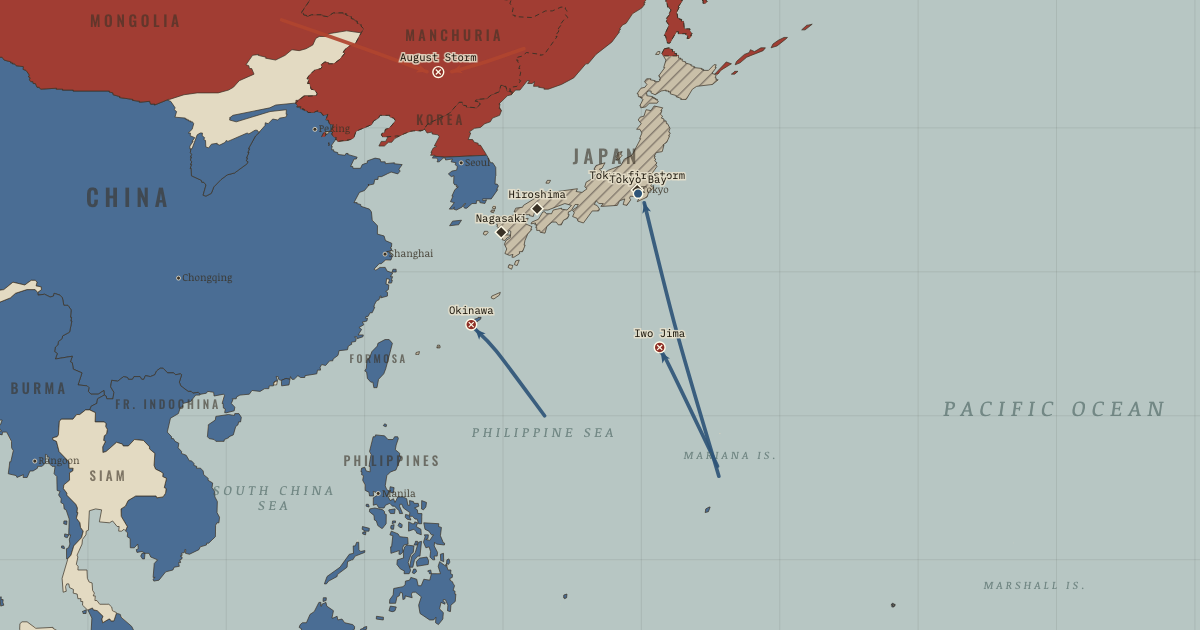
By the time American aircraft attacked Japan’s cities with atomic bombs, the country had already endured a devastating campaign. Submarine warfare and blockade cut off food, fuel, and raw materials. B-29 incendiary raids burned urban areas, killing around 100,000 people in Tokyo on 9–10 March alone. These were civilian deaths on an enormous scale.
From End of WW2 in the Pacific, chapter 14 of The War Room — WW2, 1936–1945 (AUG 1945).
Teach this in 5 minutes
- Why it happened — A government of two minds. Japan’s civilian leaders looked to Moscow to mediate a peace by spring 1945. They did not know that Stalin had promised at Yalta to attack Japan.…
- The turn — Hiroshima, 08:15, 6 August. At 08:15 on 6 August, one aircraft dropped one bomb on Hiroshima. Roughly 70,000 people died immediately. By the end of the year, deaths from burns…
- What it changed — Surrender — and a preserved throne. The postwar settlement transformed Japan’s institutions while retaining the throne. Under American-led occupation, Japan was demilitarized and given…
Then ask the room: What ended the Pacific war: the atomic bombs, Soviet invasion, or blockade? Why does the answer matter? The argued answer is on the chapter page →
The atlas that shows it
THE FREE PRINTABLE STUDY GUIDE
Get the printable study guide for WW2 free. I’ll send you a few short letters, then one when a new atlas opens. That’s all. — Paul
NO TRACKING · YOUR ADDRESS IS USED FOR THE DISPATCH AND NOTHING ELSE · UNSUBSCRIBE ANYTIME