MAPS OF HISTORY · ON THIS DAY · April 12 · 1945
ON THIS DAY · 12 APRIL 1945
Franklin Roosevelt dies at Warm Springs. Harry Truman, president for…
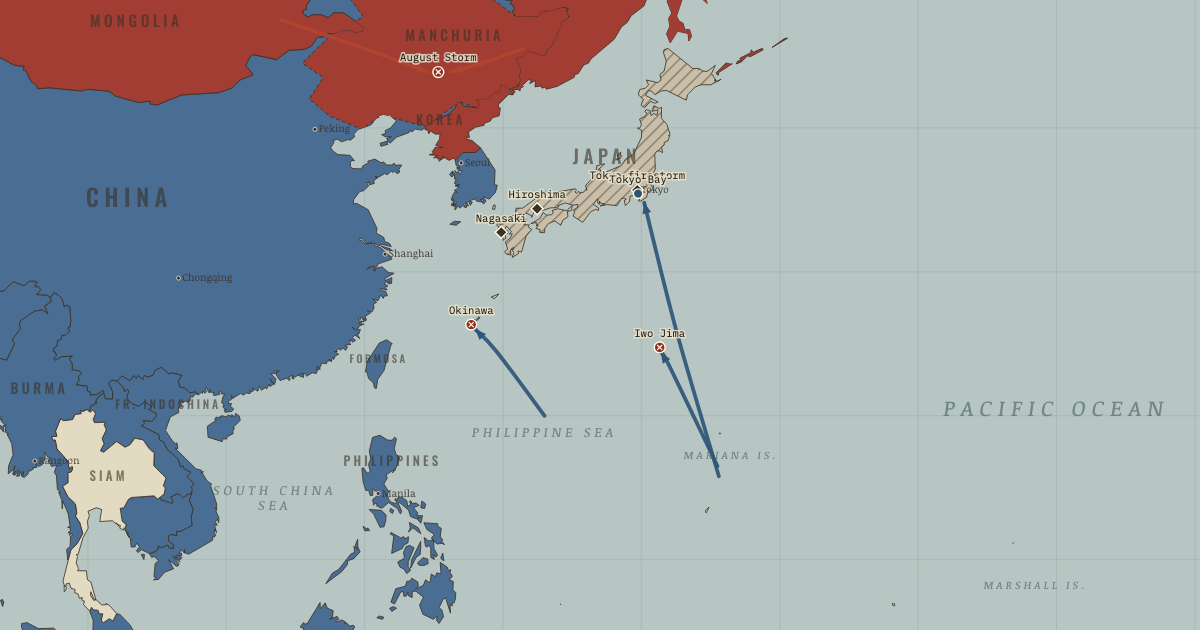
Franklin Roosevelt dies at Warm Springs. Harry Truman, president for minutes, is told for the first time about the atomic bomb.
THE MOMENT IN CONTEXT
Long before the atomic bombs, blockade and submarine warfare had cut Japan off from food, fuel, and raw materials, and B-29 incendiary raids had begun to burn out its cities, with the Tokyo raid of 9 and 10 March killing around 100,000 people. The battles for Iwo Jima and Okinawa then showed, at fearful cost, what fighting near the home islands would mean. American casualty projections for a full invasion of Japan varied widely, and those uncertain estimates would later become central to the argument over whether the atomic bombs were necessary.
From Chapter 14 — The Downfall of Imperial Japan of The War Room — WW2, 1936–1945 (AUG 1945).
OPEN THE INTERACTIVE MAP →TEACH THIS IN 5 MINUTES
- Why it happened — A government of two minds. By spring 1945 Japan’s civilians sought a mediated peace (hoping Moscow would broker it — not knowing Stalin had promised at Yalta to attack); the…
- The turn — Hiroshima, 08:15, 6 August. A single aircraft, a single bomb, a city gone — roughly 70,000 dead instantly, twice that by year’s end from burns and radiation. Whatever ended the…
- What it changed — Surrender — and a preserved throne. Japan is occupied (solely by the US), demilitarized, and given a democratic constitution that renounces war — while keeping the Emperor as symbol.…
Then ask the room: What actually ended the Pacific war — the atomic bombs, the Soviet invasion, or the blockade? Why does the answer matter? The argued answer is on the chapter page →
THE ATLAS THAT SHOWS IT
THE DISPATCH
One short letter when a new atlas opens — and the printable study guide for WW2 is yours now, free.
NO TRACKING · YOUR ADDRESS IS USED FOR THE DISPATCH AND NOTHING ELSE · UNSUBSCRIBE ANYTIME