Russian Revolution · CHAPTER 9 ·
Why the Reds won the Russian Civil War
Chapter 9 of The Russian Revolution, 1855–1924: “Why the Reds Won”
The Reds won the civil war of 1918–20 despite blockade and foreign-backed enemies because they held the Moscow–Petrograd core, with its arms factories, railway hub and two-thirds of the population. They fought on interior lines against White armies that never attacked together, and peasants feared the Whites’ landlords more.
Chapter 9 is included with every paid plan. WW2 is free in full, and chapter 1 of every atlas is free. A free account opens 3 more chapters a day. Starter, at $9 a month, opens all 21 with no daily limit — see the plans.
Free printable Russian Revolution study guide, sent by email ↓
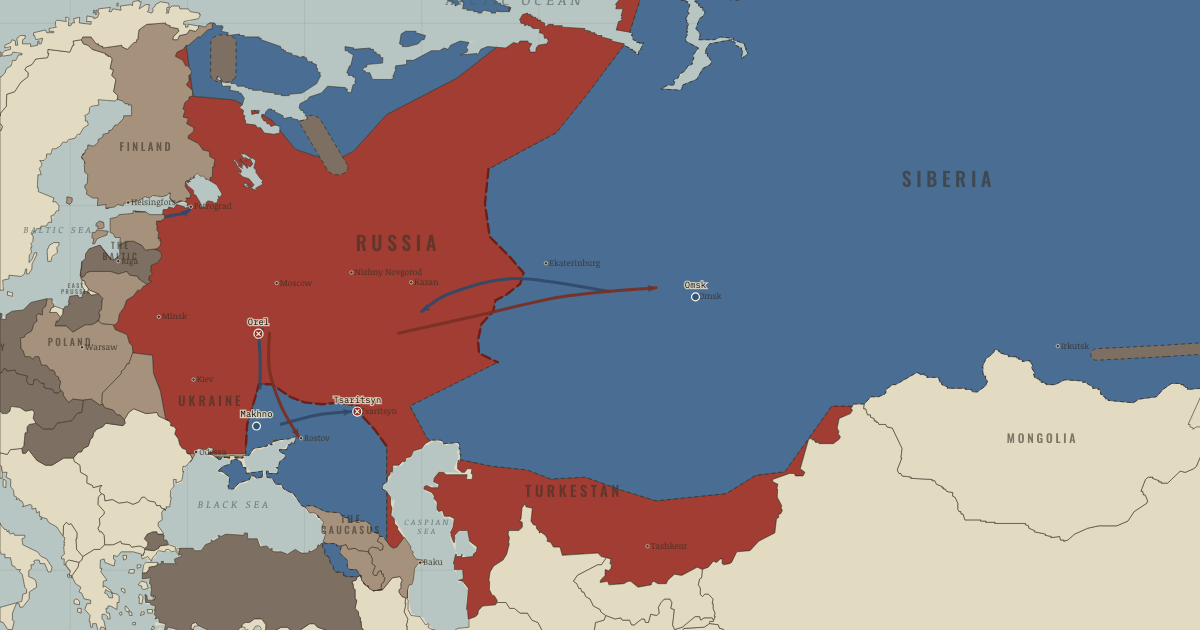
The map above is the world of Russia, June 1919 — Kolchak checked, Denikin rising.
Every state on the map that year: The world in 1920 · Europe in 1920.
Part of IB History: The Russian Revolution →
SHORT EXPLANATION
In October 1919 the Bolsheviks held little more than the old Muscovite core. Blockade had cut them off from the borderlands' grain, coal and oil; professional White officers had foreign support. Yet the territory remaining to the Reds contained Moscow and Petrograd, arms factories, the densest railway hub and two-thirds of the population. Their reserves could travel between threatened fronts in days, while White armies thousands of kilometers apart never attacked together.
The villages faced a different choice. Peasants hated having their grain taken, but many feared that a White victory would restore landlords to fields seized in 1917. The Reds also fought under one government, party and army. Their opponents included monarchists, liberals, Cossacks and nationalists united chiefly by hostility to Bolshevism. The Red position on land gave the villages a reason to tolerate a government they resented; that advantage mattered more than any single battle.
The full story
On the map the Red center looks small beside the territory occupied by its enemies. Its contents mattered more than its size. Here were the capital and government offices, the main arms factories, most of the population and the densest network of railways. These lines gave the Reds shorter routes between fronts inside the ring of White armies: a division could travel from the Siberian front to the southern front within a week.
Kolchak in Siberia, Denikin in the south and Yudenich before Petrograd were separated by thousands of kilometers. They never coordinated their offensives. The Reds could consequently gather forces against one opponent, then send them to meet another. Holding the center made such concentration possible; it did not make the decisions or move the trains for them.
Trotsky commanded one army for a Bolshevik party with a single ruthless purpose. Its organizers drew on an unlikely source of expertise: about fifty thousand former tsarist officers served under commissar guard. The workers' state relied on the Tsar's professionals. War Communism supplied the front by taking grain at gunpoint, militarizing labor and nationalizing the economy. It also devastated production, reducing it to a fraction of its prewar level. The Whites had no equivalent unity: their generals despised politics and one another, and their coalition shared little beyond opposition to the Reds.
The struggle for the countryside was no simple contest between loyal Reds and loyal Whites. Four in five Russians were peasants, and requisitioning gave them ample reason to resent Bolshevik rule. Some fought both sides: the Greens included Makhno’s anarchists in Ukraine, who wanted a revolution of the villages. But the land seized in 1917 was at stake. Many villagers feared that White victory would bring back its former owners, and the Whites' ties to the propertied classes sustained that fear.
The White commitment to a single indivisible Russia created another obstacle, alienating nationalities seeking independence. Peasants and nationalities were the country's two largest constituencies. The Reds' political advantage was therefore often conditional rather than affectionate: their opponents threatened gains and aspirations that many people wanted to protect. Military skill could not by itself overcome that resistance.
FULL EXPLANATION
Why interior lines helped but did not decide alone
The central railway junctions made it easier for the Reds to concentrate against Kolchak and then against Denikin and Yudenich. White forces around the circumference could not easily reinforce one another. But the advantage was an opportunity, not an automatic victory. Fuel, repairs, rolling stock and schedules were needed to move troops, as was political control over the workers and stations operating the lines. Sending men to one front also meant accepting danger on another. Trotsky's centralized command could set those priorities; competing White governments had no common political authority to do so. Geography reduced the difficulty of coordination, organization made the movement possible, and politics supplied conscripts and enough compliance to keep trains and armies running.
The peasant’s negative choice
Rural uprisings show how deeply peasants resented Bolshevik requisitioning. Why, then, did many tolerate the Reds against the Whites? The great estates had already been transferred in practice through the seizures of 1917. White officers' social ties, vague promises and scattered cases of landlord restoration gave villagers reason to fear that victory would undo that gain. The Reds formally accepted the destruction of landed estates, whatever else they took from the countryside. Once the main White threat receded, peasants rebelled against Soviet demands: their earlier tolerance had been conditional, not allegiance. White insistence on a Russia one and indivisible also shut out alliances with non-Russian national movements. Professional armies could not readily make up for a program that frightened the rural majority and alienated potential borderland partners.
Key places on the map
Why it happened
Interior lines and the railway hub. The railway hub let the Reds send a division from the Siberian front to the southern front in a week. White armies stationed around the circumference could not transfer troops between their fronts at all. In a continental war, the small central area gave the Reds a practical way to bring forces together where they were needed.
One command against three. Kolchak, Denikin and Yudenich did not launch a coordinated offensive. Their separation gave the Reds time to meet attacks in turn. A single party and army with a common command could exploit that opportunity; the White generals lacked the same unity.
The peasant fears the landlord more than the commissar. Requisitioning made the Reds hated in the villages, but the Whites were associated with landlords who might reclaim the land. Their commitment to “Russia one and indivisible” also threatened the hopes of nationalities seeking independence. These commitments cost the Whites support among two large constituencies.
War Communism and mass mobilization. The Reds used nationalization and ruthless requisitioning to direct a poor country's surplus toward the war, and conscripted an army of five million. Mobilization helped them win, but production fell to one fifth of its 1913 level. The consequences came due in 1921.
THE TURNING POINT
Orel, October 1919 — the high-water that broke. Denikin's advance reached Orel in October 1919, 400 km from the Kremlin: no White force came closer to Moscow. The spearhead had no reserves, while peasant and Makhnovist revolt threatened its rear. The Reds used their interior lines to gather forces for a counterstroke. The place marking the furthest White advance also marks the beginning of the Red advance outward; after Orel, the map only reddens.
What it changed
The Whites doomed by their politics, not their soldiers. White soldiers fought superbly, yet their leaders' answers to two political questions cost them support: who would hold the land, and what place would the empire's nations have? Cavalry and professional skill could not supply the alliances their cause had failed to secure.
A victorious but deformed state. The instruments of victory included War Communism, one-party rule, terror and a hostage officer corps. They shaped the victors as well as the war. By 1920 the party was more centralized, militarized and ruthless than it had been when it seized power in 1917.
The countryside pays and then revolts. The defeat of the Whites changed the choice facing the villages. Peasants still had to surrender grain, but the immediate danger of landlords returning had receded. In 1920–21 villages rose against Soviet demands, exposing how conditional their earlier tolerance had been.
DISCUSSION QUESTION — Blockaded, outnumbered in territory and faced by professional armies with foreign backing, the Reds won. Which mattered most — geography, organization, or politics?
The three advantages reinforced one another, but politics was the deepest. The industrial and demographic core and its railways gave the Reds interior lines; unified command and War Communism's mobilization let them use those routes to concentrate against separated enemies. Yet the armies also depended on people. Many peasants feared that White victory would take back the land gained in 1917, and nationalities seeking freedom had little reason to welcome the Whites' indivisible Russia. In villagers' eyes the White cause stood for the landlord. A favorable answer to who gets the land gives a side a great advantage; military skill alone cannot make a population embrace a cause it has rejected.
An interesting fact
After commanding tens of thousands across the Ukrainian steppe, Nestor Makhno left the war behind. He crossed the Dniester into Romania in 1921, passed through internment camps and a Polish prison, and reached Paris. There the peasant anarchist who had terrified Ukraine's landlords worked shifts at the Renault plant. He died of tuberculosis in 1934, and his ashes were placed in Père Lachaise, where the Paris Communards had been shot in 1871.
Related
THE FREE PRINTABLE STUDY GUIDE
Get the printable study guide for The Russian Revolution free. I’ll send you a few short letters, then one when a new atlas opens. That’s all. — Paul
NO TRACKING · YOUR ADDRESS IS USED FOR THE DISPATCH AND NOTHING ELSE · UNSUBSCRIBE ANYTIME