Ancient Rome · CHAPTER 7 ·
Pax Romana
Chapter 7 of The Rise and Fall of Rome, 264 BC – AD 476: “The Pax Romana”
During the Pax Romana the Roman Empire reached its greatest extent under Trajan around AD 117, ruling perhaps 60 to 70 million people with roughly 300,000 soldiers and a very small civil service. Local city elites collected taxes and ran courts, while revolts were crushed, as in Judaea, where the Temple was destroyed in AD 70.
Chapter 7 is included with every paid plan. WW2 is free in full, and chapter 1 of every atlas is free. A free account opens 3 more chapters a day. Starter, at $9 a month, opens all 21 with no daily limit — see the plans.
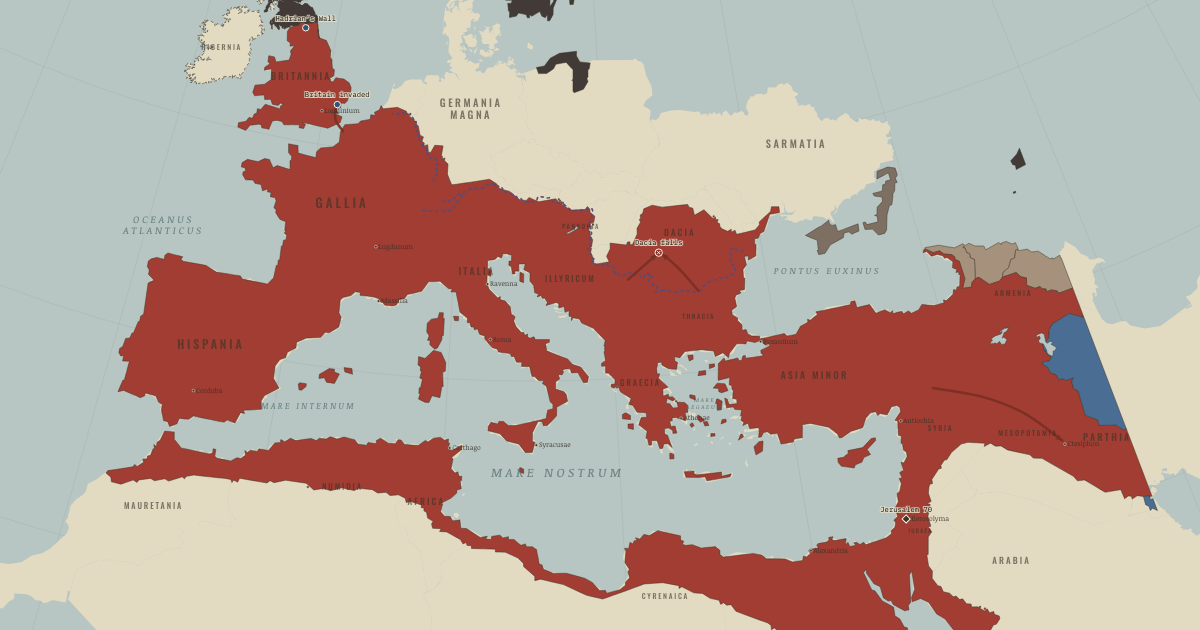
The map above is the world of The Roman Empire, AD 117 — The greatest extent.
SHORT EXPLANATION
At its greatest extent, around AD 117, Rome ruled perhaps sixty to seventy million people with remarkably few senior officials. Government depended on a bargain with the leading families of its cities. They collected taxes, ran courts and paid for buildings; Rome offered them office, prestige and citizenship. Roads, shared law, coinage and taxation linked their communities, while soldiers guarded frontiers and built infrastructure.
The bargain saved the imperial government money, but it depended on cooperation backed by force. Revolts in Britain and Judaea met violent repression, and plague from the 160s reduced population and revenue. Hadrian surrendered his predecessor’s eastern conquests and defined limits to Roman control, most famously in northern Britain. An empire with little in reserve could hold its territory for a long time, yet simultaneous shocks would be harder to meet.
The full story
By AD 117, Trajan’s empire reached from the Atlantic into Mesopotamia, and his armies had briefly reached the Persian Gulf. Its size was the result of very different campaigns. Claudius had invaded Britannia in AD 43; Trajan took Dacia in two difficult wars between 101 and 106, securing its gold and helping establish the Latin from which Romanian would develop. His eastern conquests were less lasting. After roughly two years Hadrian surrendered them.
The territory on the map, however, tells us little about how Rome governed it. Roughly 300,000 soldiers and a small senior civil service could not conduct the daily business of sixty to seventy million people from the capital. Instead, leading city families collected taxes, administered justice and paid for buildings. Office, prestige and citizenship gave them reasons to serve. Roads, safe sea lanes and common coinage linked their cities around mare nostrum, “our sea.” Local ambition thus helped maintain an imperial system.
That system rested on force as well as cooperation. The limes, or frontier, was a zone of patrols and customs controls, not an unbroken barrier. Rome also had to convince potential opponents that resistance would be costly. The Judaean revolt ended with the destruction of Jerusalem and its Temple in AD 70; the Bar Kokhba war of 132–135 killed, displaced or enslaved large numbers. These events belong on the map as memorials to the people who suffered, not as measures of imperial success.
Hadrian’s decision to limit expansion changed the demands on the empire. Hadrian’s Wall, begun in 122, channeled movement and supported patrols rather than sealing Britain with an impassable barrier. Earlier conquests had brought land, captives and prestige; holding territory now required steady tax revenue and local cooperation. Citizenship could reward provincial elites for their work, but Caracalla’s grant to nearly all free inhabitants in AD 212 made it less distinctive as a reward.
From about 165 the Antonine plague, probably smallpox, caused heavy mortality, though its scale is uncertain. Frontier pressure was increasing by Marcus Aurelius’s death in 180. Rome remained powerful for a long time, but its economical government had little central reserve. The same reliance on local resources that made the empire inexpensive to run also made a great shock harder to absorb.
FULL EXPLANATION
Cities as the Operating System
A visitor looking for Roman government might find it in a city council rather than in an office sent from the capital. Rome worked through chartered cities and existing communities. Local landowners competed for office, collected taxes and funded public buildings; legal privileges, citizenship and imperial careers made those duties attractive. The center could govern cheaply because provincial leaders did much of the work, and Roman identity offered them opportunities they valued. The arrangement had a condition: those leaders needed both the means and the desire to serve. If the costs rose while the prestige of office declined, a position once competed for could become a burden to avoid. Nor were cities distributed evenly. The eastern Mediterranean had a dense, ancient urban network; parts of the western frontier had far fewer cities. When central power weakened later, stronger cities and tax systems helped the east prove more resilient. Local government helps explain both the empire’s reach and the survival of its eastern half.
What the “Roman Peace” Conceals
The Pax Romana, the “Roman peace,” names a reduction of war within the Mediterranean core. To see how that peace was maintained, we have to look beyond the core. It followed conquest, fighting continued on the frontiers, and rebellion faced the prospect of overwhelming retaliation. Boudica’s revolt in Britain and the Judaean wars show what happened when resistance broke out. Ancient casualty figures are often inflated, and modern estimates vary widely, especially for the Bar Kokhba war. Yet large-scale destruction, enslavement and displacement are beyond doubt. These were not merely interruptions to an otherwise effortless partnership: they reveal the force behind it. Cities could gain from cooperation and see resistance as hopeless, so the arrangement could endure for generations without being a bargain between equals. A city magnate, a taxpayer, a frontier soldier and a community chosen for punishment would have experienced the same imperial peace differently.
Key places on the map
On this day
Why it happened
Cities as the operating system. Rome’s senior officials relied on thousands of local arrangements. In chartered towns and existing communities, landowners helped administer courts and taxes in return for status, citizenship and careers. Their work reduced the need for a large central bureaucracy. The Greek east had a denser network of cities than parts of the west, a difference that helps explain its later resilience in Chapter 12.
The legions as engineers and settlers. The legions connected provinces as well as conquering them. Between campaigns soldiers surveyed land and built roads, bridges and aqueducts. Veterans’ colonies helped establish Latin-speaking towns from Spain to Syria, carrying the army’s influence into civilian settlement.
A frontier held by reputation. Thirty legions could not form an unbroken barrier along 8,000 kilometers of frontier. The limes instead monitored movement and customs, while the prospect of retaliation helped discourage attacks and resistance. Sarmizegetusa and Jerusalem demonstrated Rome’s capacity to punish. This saved resources, but threats in several places at once could expose the limits of deterrence, as Chapter 8 shows.
Good luck wearing the costume of good government. The “Five Good Emperors” of 96–180 adopted successors, a sequence often praised as selection by merit. But each lacked a surviving son until Marcus Aurelius, who chose Commodus. Adoption provided rulers during this period; the circumstances do not establish a durable solution to succession. A fortunate run and a reliable institution are different things.
THE TURNING POINT
Hadrian’s Wall, AD 122. Hadrian inherited the greatest extent of Trajan’s empire and surrendered Mesopotamia. The wall begun in AD 122 across northern Britain made his approach visible: eighty Roman miles marked and controlled a frontier. This sat uneasily with imperium sine fine, the older ideal of empire without limit. Defining a boundary could spare Rome the cost of further conquest, but it also meant responding to pressure where opponents chose to apply it.
What it changed
Romanization becomes self-sustaining. Roman culture took root beyond Italy. By 180 Gaul, Spain and Africa had produced senators and authors; Trajan and Hadrian came from Spain, and the later emperor Septimius Severus from Africa. Generations spoke Latin as a native language from the Atlantic to the Danube. These connections outlasted the western state: languages, law and church institutions endured after the fall described in Chapter 11, as Chapter 12 follows.
The 212 citizenship: completion and hollowing at once. Caracalla’s grant in 212 extended citizenship to nearly all free inhabitants. It carried much further Rome’s practice of incorporating conquered peoples, while making citizenship less distinctive as a reward for provincial elites. As frontier pressure increased, military careers gained importance and civic office could become less attractive because of its costs.
Plague enters the ledger. The Antonine plague spread from 165 to about 180 through armies and communities across the empire. Egyptian tax records show depleted villages, while recruitment and prices were disturbed for years. Its exact toll is uncertain. Historians including Kyle Harper, in “Fate of Rome,” have weighed disease alongside politics in Rome’s trajectory. The Mediterranean connections that moved grain also gave infection routes across the empire.
DISCUSSION QUESTION — Rome governed a quarter of humanity with fewer administrators than a modern mid-sized city. How — and what was the hidden price of governing so cheaply?
Rome relied on work performed locally. Cities managed their affairs, elites collected taxes in exchange for status and opportunity, and soldiers built infrastructure as well as guarding frontiers. Deterrence reduced the need to station troops everywhere. One estimate puts state overhead at 5–7% of GDP. The savings depended on institutions with little spare capacity. There was no standing central army behind the frontier, and a force assembled by a usurper could leave that frontier exposed. Revenue collection relied on city elites, while soldiers could give their loyalty to a claimant as well as an emperor. These arrangements worked for long periods, but several shocks together could strain them, as Chapter 8 shows.
An interesting fact
The garrison at Vindolanda, near Hadrian’s Wall, left an unusually direct record of its life. Waterlogged, oxygen-poor soil preserved hundreds of thin wooden writing tablets, including strength reports and a note that the soldiers’ beer had run out. Around AD 100 Claudia Severa invited Sulpicia Lepidina, another officer’s wife, to a birthday party. Severa added the closing greeting in her own hand, among the earliest known examples of Latin handwriting by a woman. Another report calls local people Brittunculi — “wretched little Britons”.
Related
THE FREE PRINTABLE STUDY GUIDE
Get the printable study guide for Rome free. I’ll send you a few short letters, then one when a new atlas opens. That’s all. — Paul
NO TRACKING · YOUR ADDRESS IS USED FOR THE DISPATCH AND NOTHING ELSE · UNSUBSCRIBE ANYTIME