Ancient Rome · CHAPTER 6 · 44 BC–AD 14
Augustus and the Roman Principate
Chapter 6 of The Rise and Fall of Rome, 264 BC – AD 476: “Augustus”
Octavian and Antony defeated Caesar’s assassins at Philippi in 42 BC; Octavian then cast his war with Antony and Cleopatra as a defence of Rome. Victory at Actium in 31 BC gave him Egypt and every legion; named Augustus in 27 BC, he kept the Republic’s offices while concentrating power in his own hands.
Chapter 6 is included with every paid plan. WW2 is free in full, and chapter 1 of every atlas is free. A free account opens 3 more chapters a day. Starter, at $9 a month, opens all 21 with no daily limit — see the plans.
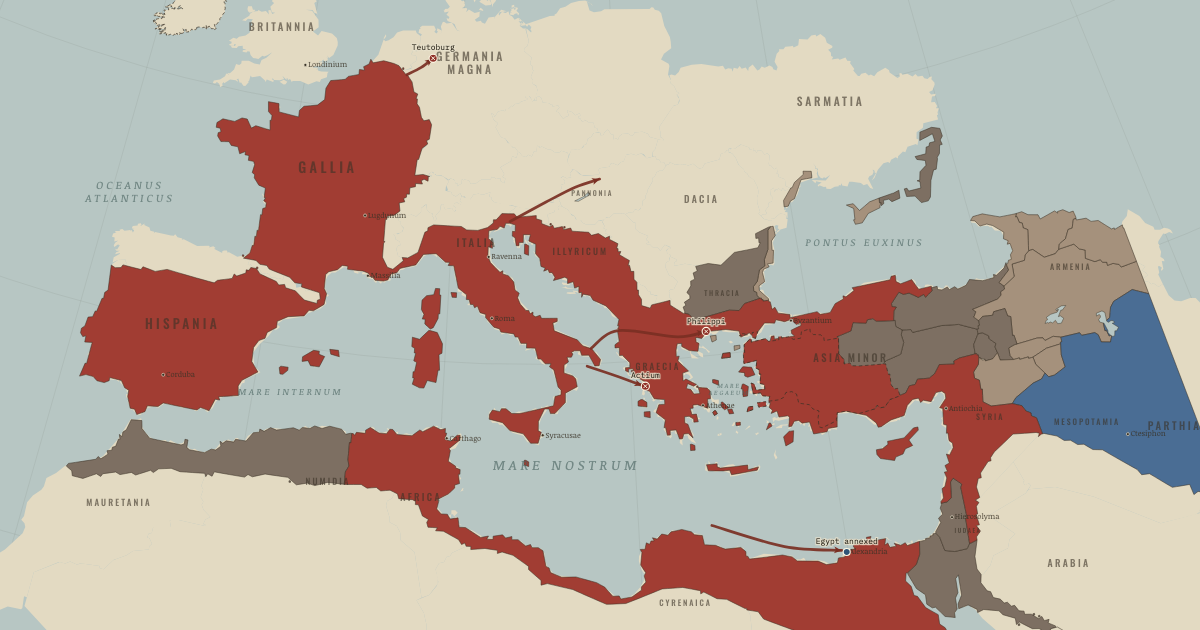
The map above is the world of The Roman Republic, 30 BC — Egypt annexed.
SHORT EXPLANATION
Caesar’s heir Octavian could use his name to attract soldiers and allies, but he had to defeat other Roman leaders before he could rule. He joined Antony against Caesar’s assassins at Philippi, then fought Antony himself. By presenting the latter conflict as a defense of Rome against Cleopatra of Egypt and her Roman ally, Octavian made a civil war look like a foreign one. Victory at Actium in 31 BC opened Egypt to him and left him commanding Rome’s legions.
As Augustus, Octavian kept republican offices while bringing military and political authority together in his own hands. Regular service, pay and pensions funded by the state made soldiers depend on the emperor instead of competing generals. This settlement brought lasting peace, but it left a difficult question: how should a successor be chosen when Rome avoided openly calling its ruler a monarch?
The full story
Caesar’s name gave Octavian a claim on loyalty, but it did not give him uncontested power. He needed allies and money as well as soldiers. He joined Antony against Caesar’s assassins, and fresh proscriptions supplied their armies with property taken from condemned men. Cicero was among those killed. At Philippi in 42 BC Octavian and Antony defeated Brutus and Cassius; the victors then divided the Roman world between them.
The alliance eventually became another contest for supremacy. Antony had tied his political and military future to Cleopatra’s Egypt, whose resources helped sustain his position. Octavian used that connection to tell Romans a different story about the coming war: Rome was fighting a foreign queen, rather than choosing between two Roman rivals. At Actium in 31 BC Agrippa’s fleet won. Egypt’s treasury, grain and taxes passed to Octavian, who now commanded every legion.
Command of the armies could win a civil war. Could it also support a lasting government? In 27 BC the Senate gave Octavian the name Augustus. Elections, courts and the Senate continued, and ambitious Romans still had public careers to pursue. Augustus nevertheless governed the frontier provinces containing nearly all the legions, held the powers of a tribune and outranked other magistrates. Republican institutions remained, while their most powerful offices and commands came together in one man.
He also changed what a soldier could expect from service. Terms, pay and pensions were regularized and funded through a state treasury. Soldiers had a permanent patron at the summit of the state, rather than competing generals upon whom they depended for rewards. That reduced a rivalry which had helped drive the civil wars.
The arrangement offered different groups reasons to accept it. Senators retained office and status; Italians gained relief from war and confiscation; provincial communities received steadier supervision; soldiers gained predictable rewards. The peace was real, and so was the concentration of authority that sustained it. Defeat in the Teutoburg Forest in AD 9 helped set limits to expansion along the Rhine and Danube.
In AD 14 Tiberius succeeded Augustus smoothly through family connection, adoption and control of the armies. A transfer had taken place, and personal rule had become an institution. But no fixed law had settled how the next ruler should be chosen. Rome had replaced rival military patrons with one supreme patron without resolving who would inherit that position.
FULL EXPLANATION
Why the Republican Fiction Worked
Augustus did not need to abolish republican offices in order to dominate them. Provincial commands, a tribune’s authority, repeated consulships and honors from the Senate all had precedents. Their lasting combination in one man gave them a different effect. The princeps, or “first citizen,” held decisive power while senators continued to hold office, enjoy standing and speak the language of lawful government. Italians, meanwhile, had relief from confiscation and civil war. These were reasons to accept the settlement, not merely evidence that its beneficiaries had been deceived. Its language carried a cost. To define the ruler’s limits and succession openly would have meant acknowledging the monarchy. Personal management and the army’s loyalty sustained the arrangement, while later crises brought the unanswered questions back.
Why Egypt Decided the Peace
Antony’s partnership with Cleopatra gave him access to resources with which he could compete. Ptolemaic Egypt had agricultural taxes, trade through Alexandria and grain that fed Rome. Octavian’s propaganda turned Antony’s dependence on those resources into a story of foreign corruption: a struggle between Romans could be presented as a defense of Roman identity. Once Octavian won, Egypt helped him solve a problem Antony had also faced. Hundreds of thousands of soldiers expected payment and settlement; Egypt’s treasure helped meet those obligations without another sweeping confiscation of Italian land. Octavian treated the country as an imperial domain and kept senators from governing it. Actium depended on ships, allegiance and money, and the resources gained after victory helped make peace possible.
Key places on the map
Why it happened
War-weariness as a political resource. For two generations Italians had lived with proscriptions, land confiscations for veterans and wars in which kin killed kin. Against memories of the 40s BC, order under concentrated authority had an evident appeal. Augustus’ regime could survive scandals and defeats that might have ruined a politician in the Republic partly because people had experienced the alternative.
Cleopatra’s Egypt: the last independent treasury. The Nile’s grain surplus, royal monopolies and Alexandria’s trade made the Ptolemaic kingdom wealthy. Antony could draw on that treasury in his contest with Octavian. After taking Egypt, Octavian could pay some 300,000 demobilized soldiers without another confiscation of Italian land. The same resources that financed a rival helped the victor settle his army.
The propaganda war was the war. Octavian urged Italians and provincial elites to see his opponent as “the Egyptian queen.” Cleopatra’s foreignness and her relationship with Antony let him present himself as Rome’s champion instead of one Roman claimant among two. Antony had a larger fleet and a strong military reputation, yet allegiances weakened during the two years before Actium. The battle followed an extended struggle for support.
A monarchy the political class could pretend not to see. Caesar’s apparent kingship had alarmed his assassins. Augustus accumulated offices and honors with republican precedents, while senators continued to hold provinces, consulships and other positions. The political class could find a place for itself within those familiar forms. They helped sustain the Principate for roughly two centuries, even as they made its concentration of power difficult to discuss openly.
THE TURNING POINT
Actium, 2 September 31 BC. Antony’s fleet tried to break out at Actium on 2 September 31 BC. Its ships were under-crewed and worn by plague. Cleopatra’s squadron escaped with the treasury, Antony followed, and within a week his abandoned army negotiated its transfer to Octavian. The result decided the contest between the rivals and confirmed Rome rather than Alexandria as the empire’s center. Chapter 9 follows the later change in that geography under Constantine’s eastern capital.
What it changed
The Pax Romana opens. The Mediterranean interior enjoyed long stretches of peace between Actium and the death of Marcus Aurelius in AD 180. Romans expressed that peace in ceremonies, closing the doors of the temple of Janus that were traditionally open in wartime. A poet wrote that “the sea is safe,” capturing the security associated with the suppression of piracy. Chapter 7 examines the order that supported it.
The frontier becomes a philosophy. After the defeat in the Teutoburg Forest, expansion beyond the Rhine met a limit. Augustus advised keeping the empire within its bounds, although later rulers, notably Trajan, undertook further conquests. A limit was not the end of military work: frontiers had to be held and administered. Chapters 7 and 8 follow the resources and strains involved.
One office, no rules for filling it. Augustus established no settled law for choosing an emperor. Adoption, family inheritance and the army’s acclamation could each help a claimant, but they could also favor different people. In AD 69 four emperors followed one another; succession disputes also marked 193 and the crises of the third century. Authority under one ruler had reduced rivalry among generals, yet the choice of the next ruler could revive it.
DISCUSSION QUESTION — Augustus claimed, on his own monument, to have “transferred the Republic back to the Senate and People of Rome.” Was the Principate a lie — and did its being a lie matter?
Augustus could point to real republican institutions: offices, elections and courts continued. His powers also had precedents, including Pompey’s exceptional commands and the sacrosanct authority of tribunes. What changed was their continuous combination in one person, giving Augustus’ wishes decisive weight in practice. The forms mattered because they gave elites a place in the settlement, helped prevent a Hellenistic-style court from forming for a century and preserved an ideal of lawful, accountable rule that could be invoked against emperors. They also made it difficult to define openly the ruler’s limits, the army’s political role and succession. Both the settlement’s long stability and the crises left to later generations belong in its assessment.
An interesting fact
The location of the Teutoburg disaster remained uncertain for centuries. In 1987 Tony Clunn, a British Army major serving in Germany, began finding Augustan silver near Kalkriese with a metal detector. Excavators later found sling bullets, mule remains, pits of weathered human bone and an iron cavalry parade mask with its silver covering torn away. No coin found at the site postdates AD 9. Most scholars, though not all, accept Kalkriese as the place where Varus’ legions met disaster.
Related
THE FREE PRINTABLE STUDY GUIDE
Get the printable study guide for Rome free. I’ll send you a few short letters, then one when a new atlas opens. That’s all. — Paul
NO TRACKING · YOUR ADDRESS IS USED FOR THE DISPATCH AND NOTHING ELSE · UNSUBSCRIBE ANYTIME