MAPS OF HISTORY · ON THIS DAY · January 24 · 41
ON THIS DAY · 24 JANUARY 41
The emperor Caligula is assassinated by his own Praetorian Guard,…
The emperor Caligula is assassinated by his own Praetorian Guard, who then find Claudius hiding behind a curtain and make him emperor.
THE MOMENT IN CONTEXT
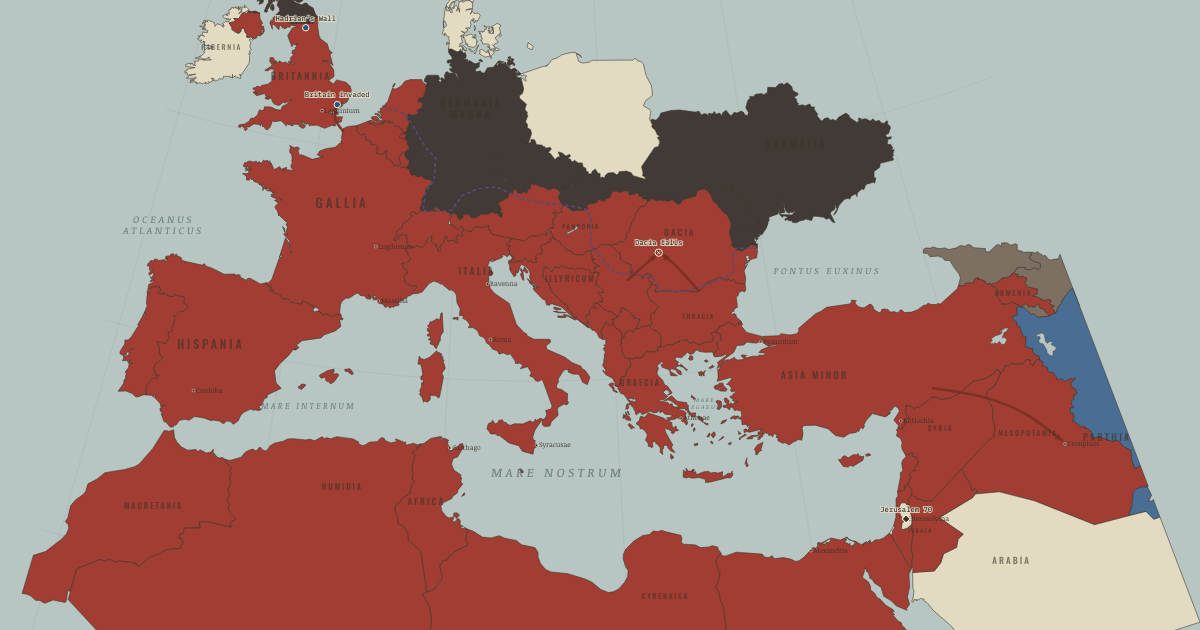
The map reached its greatest extent under Trajan around AD 117, stretching from the Atlantic into Mesopotamia, but the more telling fact is how lightly it was governed. Britannia had been invaded under Claudius in AD 43, and Dacia, north of the Danube, was taken in two hard wars between 101 and 106 for its gold, seeding the Latin that would grow into Romanian. Trajan’s final conquests in the east reached the Persian Gulf but were held for only about two years before Hadrian handed them back. Roughly 300,000 soldiers and a very small senior civil service ruled sixty to seventy million people, and they could do so because the real work of government was local. The leading families of each city collected taxes, funded public buildings and administered justice in return for citizenship, office and prestige, and roads, safe sea lanes and a common coinage bound those cities into one system that Romans could call, without irony, mare nostrum, “our sea.”
From Chapter 7 — The Pax Romana of The Rise and Fall of Rome, 264 BC – AD 476 (AD 117).
OPEN THE INTERACTIVE MAP →New here? Chapters 1–2 of every atlas are free to sample, and the WW2 atlas is free in full. One membership opens all thirteen — the Cartographer’s Circle.
TEACH THIS IN 5 MINUTES
- Why it happened — Cities as the operating system. Rome didn’t administer people; it franchised elites. A conquered region got a charter town, and its landowners got citizenship, careers and status…
- The turn — Hadrian’s Wall, AD 122. Eighty Roman miles of stone across Britain’s neck — militarily modest, symbolically seismic. Hadrian, inheriting Trajan’s overstretched maximum,…
- What it changed — Romanization becomes self-sustaining. By 180, Gaul, Spain and Africa are producing senators, authors and emperors (Trajan and Hadrian are Spanish, Septimius Severus African); Latin has…
Then ask the room: Rome governed a quarter of humanity with fewer administrators than a modern mid-sized city. How — and what was the hidden price of governing so cheaply? The argued answer is on the chapter page →
THE ATLAS THAT SHOWS IT
THE DISPATCH
One short letter when a new atlas opens — and the printable study guide for Rome is yours now, free.
NO TRACKING · YOUR ADDRESS IS USED FOR THE DISPATCH AND NOTHING ELSE · UNSUBSCRIBE ANYTIME