Ancient Rome · CHAPTER 5 · 58–44 BC
Julius Caesar and the civil war
Chapter 5 of The Rise and Fall of Rome, 264 BC – AD 476: “Caesar”
Julius Caesar used his command in Gaul from 58 BC to gather wealth, prestige and a devoted army, defeating Vercingetorix’s coalition at Alesia in 52 BC. Ordered to give up his command, he crossed the Rubicon on 10 January 49 BC and began a civil war, which his veterans won at Pharsalus in 48 BC.
Chapter 5 is included with every paid plan. WW2 is free in full, and chapter 1 of every atlas is free. A free account opens 3 more chapters a day. Starter, at $9 a month, opens all 21 with no daily limit — see the plans.
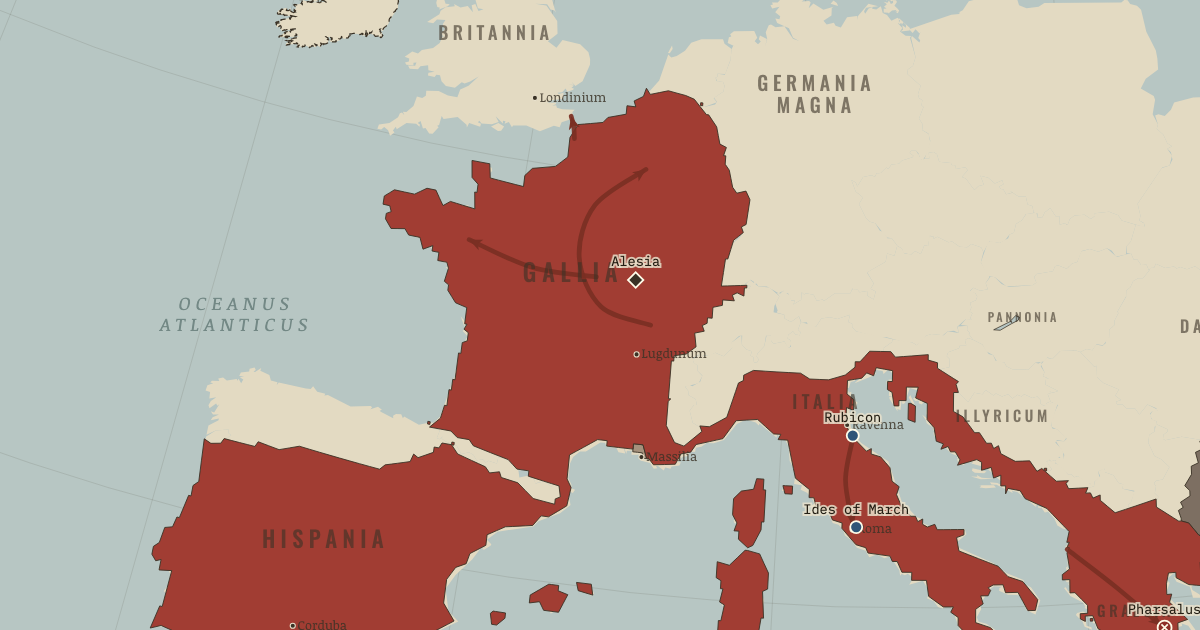
The map above is the world of The Roman Republic, 50 BC — Gaul conquered.
SHORT EXPLANATION
Caesar went to Gaul in 58 BC burdened by debt and looking for the standing that victory could bring. Its rival peoples gave him opportunities to intervene, and conquest brought him wealth, prestige and an army devoted to him. Many Gallic peoples finally united under Vercingetorix in 52 BC, but Caesar defeated them at Alesia. Ancient totals for the dead and enslaved are uncertain; the devastation was immense.
That army made Caesar powerful, yet surrendering command exposed him to enemies who threatened prosecution. In 49 BC he crossed the Rubicon and chose civil war. He defeated Pompey and became dictator for life, governing with speed but leaving no settled way to transfer his personal power. Senators killed him in 44 BC; the armies and rivalries that had brought him to power remained, and civil war continued.
The full story
In 58 BC Caesar needed a success large enough to answer his debts and match the prestige Pompey had won in the east. His governorship in Gaul gave him the means to seek it. The peoples of Gaul were divided by their own quarrels, and he could enter a dispute as an ally, then present further campaigns as defense or prevention. Much of the conquest was a war of choice. His Commentaries, written in a plain and persuasive style for Roman readers, gave his own account of those choices.
The people who paid for those victories were not confined to Caesar’s armies. Ancient writers put the number of Gauls killed at roughly a million and those enslaved at another million. Modern historians doubt the precision of those totals, while accepting that violence and displacement were vast; some describe particular episodes as genocide. Only in 52 BC did Vercingetorix bring a wider resistance together. At Alesia, Caesar surrounded the town and starved it, while a second ring of siege works faced an army coming to its relief. He defeated both forces.
Victory left Caesar with a problem of his own. His soldiers looked to him for their future, while enemies in Rome intended to prosecute him as soon as he became a private citizen. The Senate demanded that he surrender his command; keeping the army against that demand was illegal, but giving it up threatened his standing. Negotiated alternatives still existed. Caesar chose war, crossing the Rubicon with one legion on 10 January 49 BC.
The opposing commanders had resources spread across the Roman world. Pompey could call on the eastern settlement he had built, with provinces supplying taxes, grain, fleets and recruits. Caesar moved first through Italy and Spain, then crossed to Greece. His speed kept his opponents from bringing their advantages together. At Pharsalus in 48 BC his veterans defeated Pompey’s larger army.
Caesar eventually became dictator for life. He pardoned many opponents, reducing immediate resistance, and acted quickly on the calendar, colonies and extensions of citizenship. These measures showed administrative skill, but his pardoned rivals still had to live under permanent one-man rule. How could such power be limited or lawfully passed on? On 15 March 44 BC senators led by Brutus and Cassius killed him without providing an answer. The armies, debts and violent rivalries that had made his position possible survived him.
FULL EXPLANATION
Reading Caesar Against Caesar
To read Caesar’s Commentaries is to encounter both a principal source for the Gallic War and a defense of its author before the Roman public. Caesar’s calm narrative repeatedly gives him a reason to act: an ally seeks help, a migration threatens danger, an enemy breaks faith. The account is effective partly because its decisions appear to follow from events. Yet Caesar himself helped decide what counted as a threat and how far a response should go. Romans could judge his conduct harshly. Cato reportedly proposed surrendering him to the German peoples after the killing of the Usipetes and Tencteri during a truce. The Senate nevertheless voted Caesar extraordinary public thanksgivings. Victory earned honors even where Romans had grounds to condemn the conduct of the war. Modern arguments about genocide involve intent and ancient figures that cannot be verified. The conquest advanced Caesar’s career and brought catastrophe to many Gallic communities.
The Republic’s Retirement Trap
Sulla had demonstrated that a commander could march on Rome and succeed. By Caesar’s time another feature of the Republic made that precedent especially dangerous: his enemies wanted him to give up his command before seeking office again. Once disarmed and a private citizen, he faced prosecution, exile and the loss of his standing. To retain his army against the demand was illegal. Neither choice was safe for him. This predicament does not remove Caesar’s responsibility; negotiated alternatives remained, and he chose civil war. It does help us see why an appeal to obedience was unlikely to settle the dispute. Caesar believed that compliance threatened ruin, while defiance offered a chance of safety and power. The Rubicon exposed a weakness that had grown over decades.
Key places on the map
On this day
Why it happened
A war chosen as a career move. Pompey’s eastern victories had set a high standard for Roman prestige, and Caesar had colossal debts. A five-year command in nearby Gaul offered money, veterans and fame together. The migration of the Helvetii gave him an occasion to act; Cicero privately questioned whether it posed the danger claimed. The rewards available to a successful commander made expansion attractive.
Gaul’s division was Caesar’s best weapon. Some sixty peoples made up Gaul, and many had longstanding feuds. Caesar could support one against another, so that for much of the war only part of the opposition faced him at a time. In 52 BC Vercingetorix brought a wider coalition together, including Arverni and Aedui. That was a considerable achievement, seven years into the war.
The trap set in 88. In 88 BC Sulla had shown that an armed commander could march on Rome. Caesar invoked his dignitas, or standing, against enemies who could use the law against him once he disarmed. When a successful commander could not safely return to private life, the struggle over his next office became dangerous for the Republic itself.
Pompey’s fatal respectability. Pompey possessed formidable resources: the eastern provinces, naval strength and support in Italy. He left Italy to assemble a stronger force with the senatorial coalition, invoking Sulla’s example. Those resources had to be gathered before they could be used together. The delay gave Caesar the initiative and time to move into Spain.
THE TURNING POINT
The Rubicon, 10 January 49 BC. The Rubicon was a small stream marking a provincial boundary; its exact course is still disputed. Caesar crossed it with his legion on 10 January 49 BC. Ancient accounts have him pause on the bank and quote a favorite playwright. The decision behind the scene was stark: surrender his command and face prosecution and exile, or lead soldiers across the boundary in defiance of the Senate. He chose the latter, beginning civil war. The phrase “crossing the Rubicon” came to mean an irrevocable decision.
What it changed
Gaul: a province that changes the empire’s shape. After eight years of conquest, Gaul became part of a Roman world that lasted there for roughly four centuries. Lyon served as an administrative hub; Roman cities, villas and Latin culture shaped the province, and Latin became an ancestor of French. The frontier lay at the Rhine rather than the Alps, with Germania Magna beyond it. Chapter 6 follows Rome’s efforts to establish that boundary.
The dictatorship shows its face too soon. The calendar, colonies, debt and citizenship for Cisalpine Gaul were problems on which Caesar could act rapidly. His dictatorship also made the difficulty of concentrated power visible: force and favor supported his position, his safety depended on that power, and no succession was established. His eighteen-year-old heir Octavian would later keep decisive authority while carefully presenting republican forms.
The assassins prove the assassination pointless. Removing Caesar did not remove the conditions that had enabled his rule. Within twenty months new proscriptions claimed Cicero, and his head was displayed on the speaker’s platform. Another civil war followed within three years, and a new monarch within seventeen. From 44 to 31 BC Rome continued to live with the consequences of the Republic’s breakdown.
DISCUSSION QUESTION — Was Caesar’s Gallic War aggressive, and how did Romans judge it?
Caesar described his campaigns as defense of allies or prevention of danger, but intervention also opened the way to further conquest. Roman judgments differed. Cato reportedly urged the Senate to surrender Caesar to the Germans for killing the Usipetes and Tencteri during a truce, applying Roman standards to his conduct. The Senate also voted extraordinary thanksgivings, and the assemblies welcomed his victories. Glory and plunder won support despite objections. The expansion of Roman power and the immense suffering it caused are both part of the war’s history.
An interesting fact
The Roman calendar had drifted months out of season, partly because the priests who managed its adjustments could use them for political convenience. In 46 BC Caesar, advised by the Alexandrian astronomer Sosigenes, brought it back into alignment by making that year 445 days long. Romans called it the “year of confusion.” His replacement averaged 365¼ days a year; the Gregorian reform of 1582 corrected an error of about eleven minutes annually. July, Caesar’s birth month, was named for Julius Caesar in 44 BC.
Related
THE FREE PRINTABLE STUDY GUIDE
Get the printable study guide for Rome free. I’ll send you a few short letters, then one when a new atlas opens. That’s all. — Paul
NO TRACKING · YOUR ADDRESS IS USED FOR THE DISPATCH AND NOTHING ELSE · UNSUBSCRIBE ANYTIME