ON THIS DAY · 10 JANUARY 49 BC
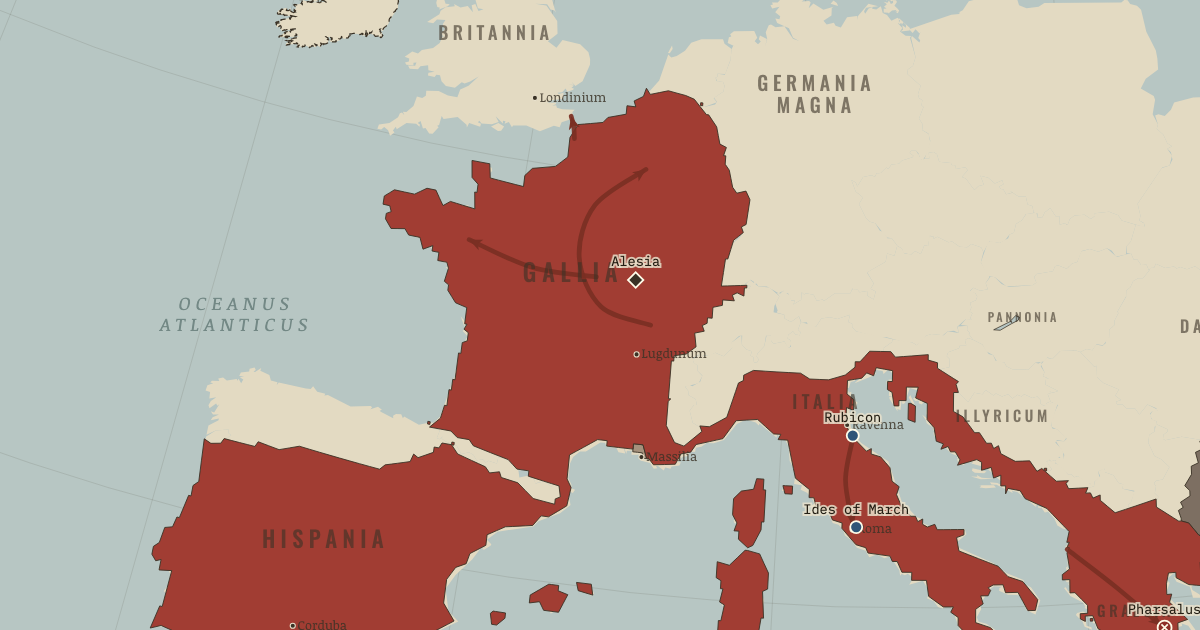
Caesar crosses the Rubicon
Julius Caesar leads a single legion across the Rubicon. “The die is cast” — and the Roman Republic enters its final decade.
WW2 is free in full, and chapter 1 of every atlas is free. A free account opens 3 more chapters a day. Starter, at $9 a month, opens all 21 with no daily limit — see the plans.
The moment in context
In 58 BC Caesar needed a success large enough to answer his debts and match the prestige Pompey had won in the east. His governorship in Gaul gave him the means to seek it. The peoples of Gaul were divided by their own quarrels, and he could enter a dispute as an ally, then present further campaigns as defense or prevention. Much of the conquest was a war of choice. His Commentaries, written in a plain and persuasive style for Roman readers, gave his own account of those choices.
From Julius Caesar and the civil war, chapter 5 of The Rise and Fall of Rome, 264 BC – AD 476 (52 BC).
Teach this in 5 minutes
- Why it happened — A war chosen as a career move. Pompey’s eastern victories had set a high standard for Roman prestige, and Caesar had colossal debts. A five-year command in nearby Gaul offered…
- The turn — The Rubicon, 10 January 49 BC. The Rubicon was a small stream marking a provincial boundary; its exact course is still disputed. Caesar crossed it with his legion on 10 January 49…
- What it changed — Gaul: a province that changes the empire’s shape. After eight years of conquest, Gaul became part of a Roman world that lasted there for roughly four centuries. Lyon served as an administrative hub;…
Then ask the room: Was Caesar’s Gallic War aggressive, and how did Romans judge it? The argued answer is on the chapter page →
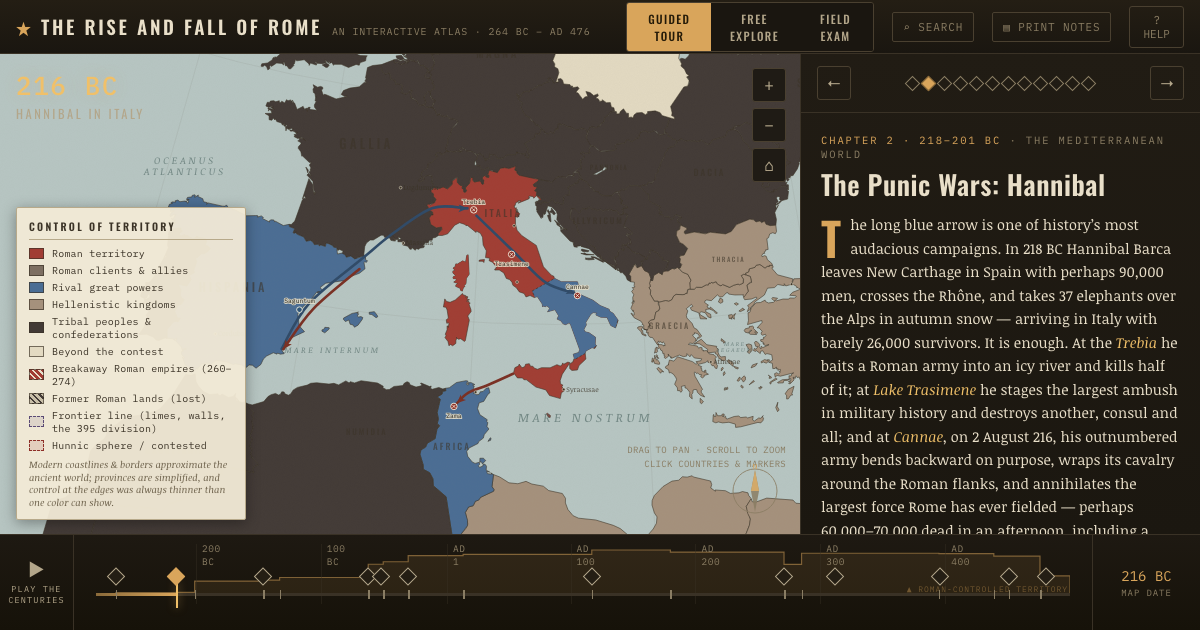
The atlas that shows it
THE FREE PRINTABLE STUDY GUIDE
Get the printable study guide for Rome free. I’ll send you a few short letters, then one when a new atlas opens. That’s all. — Paul
NO TRACKING · YOUR ADDRESS IS USED FOR THE DISPATCH AND NOTHING ELSE · UNSUBSCRIBE ANYTIME