MAPS OF HISTORY · Rome · ALL CHAPTERS · CHAPTER 5
CHAPTER 5 · 58–44 BC · 52 BC
Caesar
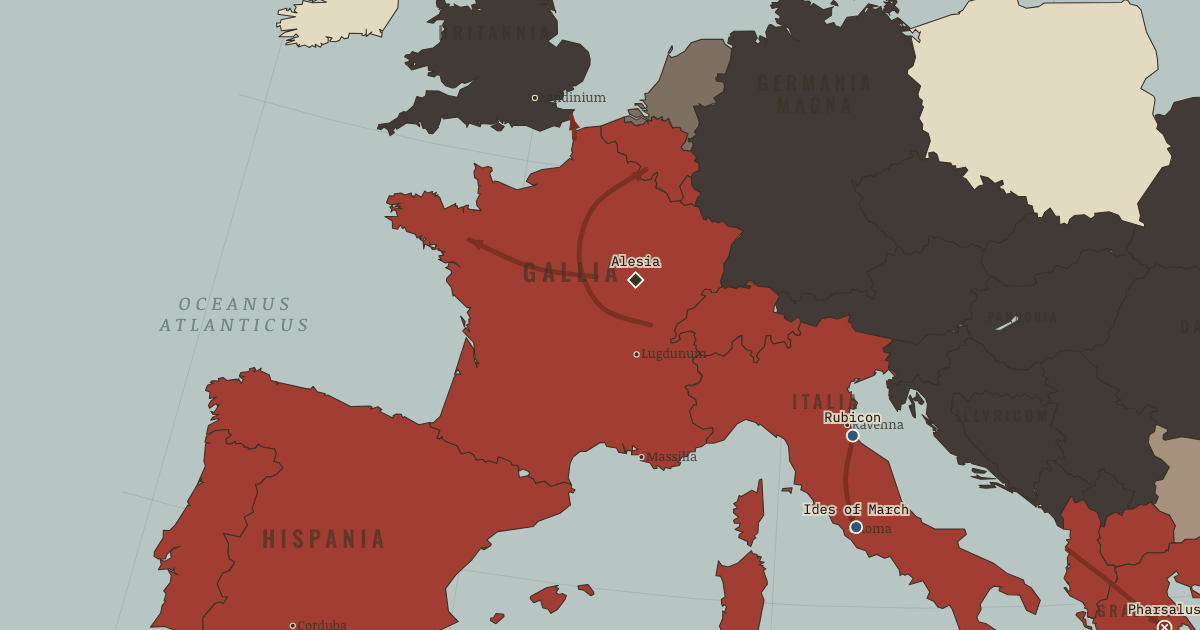
The map above is the world of 50 BC — Gaul conquered.
BRIEF EXPLANATION — THE ESSENTIAL ARGUMENT
Caesar’s career shows how the incentives described in the last chapter turned a provincial governor into the master of the state. He used his command in Gaul to gather the three things an ambitious Roman needed, which were wealth, prestige and a devoted veteran army. Gaul itself was a patchwork of rival peoples who resisted him separately and so were beaten one at a time, until the Arvernian noble Vercingetorix finally united many of them in 52 BC. Caesar’s victory over that coalition at Alesia completed a conquest marked by mass killing and enslavement on a scale the ancient totals cannot fix precisely, though the devastation was beyond doubt immense.
The war that made Caesar also trapped him, and that trap is the heart of the chapter. When the Senate ordered him to give up his command, obedience would have meant prosecution and the ruin of everything he had built, so in 49 BC he led his army across the Rubicon and into civil war, defeating Pompey and making himself dictator for life. His rule solved many long-standing problems quickly, but it rested entirely on his personal power and offered no lawful way to pass that power on. When senators murdered him in 44 BC, they removed the man but left in place the system that had produced him, and so the civil wars simply continued.
GUIDED EXPLANATION
Caesar’s conquest of Gaul was in large part a war of choice, undertaken to build a career, and reading it honestly means holding its achievement and its brutality in view together. He arrived in 58 BC as a governor with heavy debts and a name to make. He intervened in the quarrels of a divided Gaul, presented each new campaign as defence or prevention, and reported his own version of events to readers in Rome through his Commentaries, a plain and hugely effective piece of political writing. Ancient authors claim roughly a million Gauls killed and a million enslaved across the decade. Modern historians distrust the exact figures while accepting that the violence and displacement were vast, and some apply the word genocide to particular episodes. Organised resistance came together only in 52 BC under Vercingetorix. It ended at Alesia, where Caesar built two rings of siege works, one facing the town he was starving and one facing the army marching to relieve it, and defeated both.
The command that made Caesar also left him no safe way to put it down. His soldiers depended on him for their future, and his enemies meant to prosecute him the moment he became a private citizen. Keeping his army was illegal, yet giving it up would have been personally ruinous. So on 10 January 49 BC he crossed the Rubicon with a single legion and began a civil war. At Pharsalus in 48 BC his veterans beat Pompey’s larger army, and Caesar became dictator for life. He combined rapid reform with unmistakable one-man rule and pardoned many of his opponents. Senators led by Brutus and Cassius killed him on 15 March 44 BC, but they restored no stable Republic, because the armies, debts and violent rivalries all remained. The murder changed the contender, not the structure that had produced him.
The map explains why the civil war reached the scale it did. Pompey could draw on the eastern settlement he had built, while Caesar moved first through Italy and Spain before crossing to Greece. Control of provinces now meant control of taxes, grain, fleets and recruiting grounds. Caesar’s speed kept his opponents from combining those advantages, and his famous clemency reduced immediate resistance. That mercy also left pardoned rivals alive inside a system with no accepted place for a permanent dictator. Reforming the calendar, founding colonies and extending citizenship all showed real administrative skill. None of it answered the question at the heart of the crisis, which was how the power of one man could ever be made lawful, limited and able to be handed on. His death exposed that missing institution rather than supplying it.
DEEP EXPLANATION — EVIDENCE & INTERPRETATION
Reading Caesar Against Caesar
Caesar’s Commentaries are at once our main evidence for the war and a work of political communication, and the two roles pull against each other. Their calm, plain style makes every decision look forced upon him: an ally asks for help, a migration threatens danger, an enemy breaks faith, and Caesar merely responds. That sequence quietly hides how often he was the one who defined the threat and widened the war. Romans of his own day noticed. Cato reportedly argued that Caesar should be handed over to the German peoples for killing the Usipetes and Tencteri during a truce, yet the same Senate also voted him extraordinary public thanksgivings. This mixed reaction matters, because it shows that Romans had the moral and legal language to condemn the campaign, but that fear, prestige and reward usually drowned it out. Modern debates over whether parts of the conquest amounted to genocide turn on questions of intent and on ancient numbers that cannot be verified. The safest conclusion avoids both hero-worship and slogan: the war was aggressive, politically useful to Caesar, and catastrophic for many Gallic communities.
The Republic’s Retirement Trap
Caesar’s crossing of the Rubicon is often explained by boundless ambition alone, but an institutional trap is what made that ambition so dangerous. His enemies insisted that he give up his command before standing for office again, and as a private citizen he could be prosecuted, exiled and stripped of his rank. Holding on to the army was illegal, while surrendering it invited personal destruction, and the Republic offered no safe path by which a great commander could return to ordinary political life. Sulla had already shown that marching on Rome could actually succeed. None of this excuses Caesar, who chose civil war when negotiated alternatives still existed, but it does explain why appeals to law and morality failed to stop him. Constitutional systems grow fragile when obedience carries concentrated personal ruin while defiance offers both survival and power. The crossing of the Rubicon did not create that failure so much as publish it, after it had been accumulating for decades.
New here? Chapters 1–2 of every atlas are free to sample, and the WW2 atlas is free in full. One membership opens all thirteen — the Cartographer’s Circle.
THE SITES
ON THIS DAY
WHY IT HAPPENED
A war chosen as a career move. Caesar needed conquest the way a modern politician needs funding: his debts were colossal, his rivals’ glory (Pompey’s east) needed answering, and Gaul was the nearest theater where a five-year command could mint money, veterans and fame. The migration of the Helvetii was an occasion, not a threat — Cicero said as much privately. Wars of choice by indebted ambition: mark the pattern; the Republic’s incentives manufactured them.
Gaul’s division was Caesar’s best weapon. “Gaul” was sixty-odd tribes with generations of feuds; Caesar entered as one tribe’s ally against another and was never opposed by more than a fraction at once until Vercingetorix — whose achievement in uniting Arverni and Aedui at all was extraordinary, and seven years too late. Every empire in this atlas advances through other people’s divisions before it advances through anything else.
The trap set in 88. The Rubicon is Sulla’s march with better prose. Caesar stated his motive plainly: to defend his dignitas — his standing — against enemies who would destroy him by law once he disarmed. The Republic had built a system in which its most successful servants could not safely stop serving; a constitution that makes retirement lethal will be overthrown by men who would rather rule than die.
Pompey’s fatal respectability. Pompey held the stronger hand — the east, the seas, Italy’s sympathy — and played it as a senatorial coalition partner rather than a warlord, abandoning Italy to gather overwhelming force “like Sulla.” The delay gave Caesar Spain and the initiative. Note the asymmetry that decides most civil wars: the revolutionary needs only to act; the establishment must first agree on what acting means.
THE TURN
The Rubicon, 10 January 49 BC. A provincial boundary stream so small its exact course is still disputed — crossed in armor, it was constitutional death. Caesar reportedly hesitated on the bank, quoting his favorite playwright before the plunge. The theatrics matter less than the arithmetic he had already done: prosecution and exile if he obeyed, against civil war he believed he would win if he did not. When a state’s legal order offers its strongest man ruin as the price of compliance, the law has already lost; the river crossing merely published the result. “Crossing the Rubicon” has meant exactly this, in every language, for two thousand years.
WHAT IT CHANGED
Gaul: a province that changes the empire’s shape. Eight years of blood buy four centuries of Roman Gaul — which becomes, as you’ll see by Chapter 7, the empire’s western engine: Lyon its administrative hub, its cities and villas thoroughly Latin, its language the ancestor of French. The Rhine, not the Alps, is now the frontier, with Germania Magna charcoal beyond it — a border Chapter 6 will fix in place for good.
The dictatorship shows its face too soon. Caesar solved problems at a speed no assembly could match — calendar, colonies, debt, citizenship for Cisalpine Gaul — and made the cost of one-man rule equally visible: no succession plan, no legitimacy but force and favor, no safety for the ruler except more power. His murder taught his 18-year-old heir the whole curriculum in one lesson: Octavian will hold Caesar’s substance while performing, meticulously, the Republic the assassins died for.
The assassins prove the assassination pointless. The Ides changed the emperor, not the trajectory: within twenty months Rome had new proscriptions (Cicero’s head nailed to the speaker’s platform), within three years a new civil war, within seventeen a new monarch. When a collapse is structural, removing a person is a personnel decision. The Republic did not die on the Ides; it had died at some unmarked earlier moment, and Rome spent 44–31 BC discovering the fact.
FIELD QUESTION — Was the Gallic War a war of aggression — and did Romans themselves think so?
The evidence for “yes” is Roman: Cato the Younger proposed in the Senate that Caesar be handed over to the Germans for the massacre of the Usipetes and Tencteri during a truce — an extraordinary suggestion that the war’s conduct was criminal by Rome’s own lights. Caesar’s Commentaries work hard to frame each campaign as defense of allies or pre-emption, which tells you what Roman opinion needed to hear. Yet the same Senate voted him unprecedented thanksgivings, and the assemblies loved the war: moral qualms lost to glory and plunder every time they were polled. So: aggressive by our categories, contested but tolerated by theirs — and the honest discomfort is that the atlas you are enjoying was drawn by such wars. Keeping both facts in view at once — achievement and atrocity, without letting either erase the other — is the historian’s core discipline, and this chapter is a deliberate exercise in it.
AN INTERESTING FACT
You live inside one of Caesar’s reforms. In 46 BC, advised by the Alexandrian astronomer Sosigenes, he scrapped the Republic’s broken calendar — the priests who managed it had let it drift months out of season, sometimes for political convenience — by making that single year 445 days long (Romans called it the “year of confusion”) and then imposing the 365¼-day year the West still keeps. The Gregorian reform of 1582 corrected his arithmetic by about eleven minutes per year; the month of his birth has answered to his family name — July, for Julius — since 44 BC.
THE DISPATCH
One short letter when a new atlas opens — and the printable study guide for Rome is yours now, free.
NO TRACKING · YOUR ADDRESS IS USED FOR THE DISPATCH AND NOTHING ELSE · UNSUBSCRIBE ANYTIME