MAPS OF HISTORY · Rome · ALL CHAPTERS · CHAPTER 4
CHAPTER 4 · 133–60 BC · 62 BC
The Republic Breaks
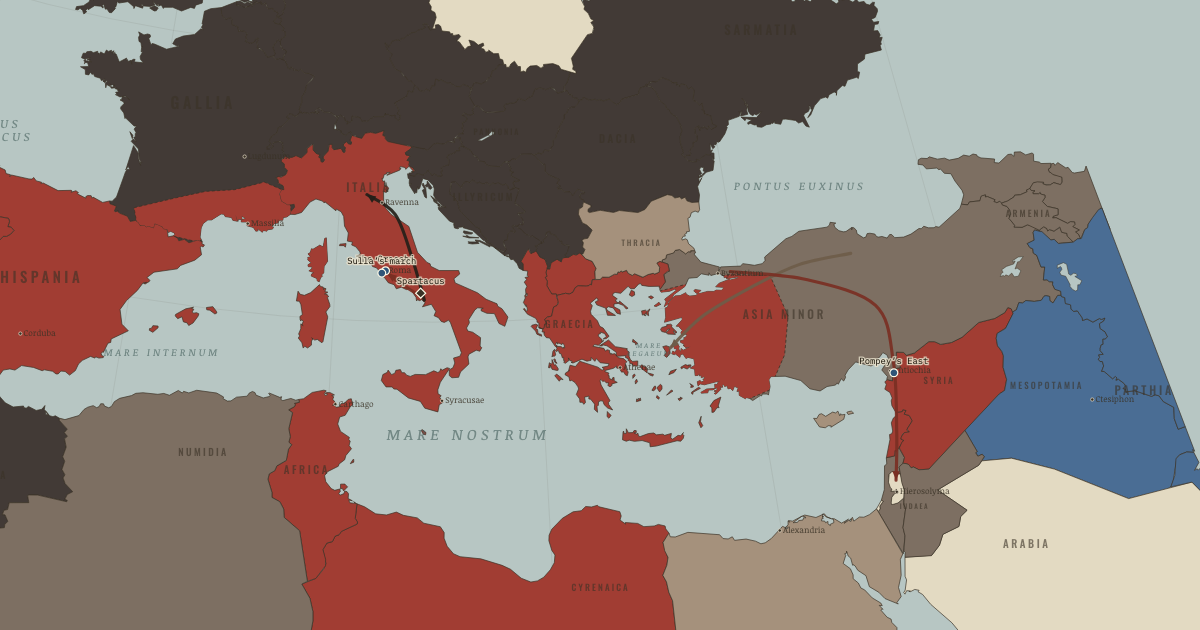
The map above is the world of 62 BC — Pompey’s East.
BRIEF EXPLANATION — THE ESSENTIAL ARGUMENT
The Republic began to break under the weight of its own success, and the mechanism was economic before it was political. The conquests of the previous chapters enriched a narrow elite, while years of distant military service and the spread of slave-worked estates ruined the small farmers who had always filled the legions. When the reforming tribunes Tiberius and Gaius Gracchus tried to resettle the poor on public land, the Senate had them and their followers killed, which showed that the constitution had no peaceful way to divide the profits of empire. The general Marius then solved the army’s shortage of recruits by opening the legions to the landless, an answer that worked immediately but changed what an army was, because these new soldiers served for pay and for a grant of land that only their commander could wring from the Senate.
That dependence turned military commands into political weapons, and the rest of the chapter follows the consequence. Because soldiers now looked to their general rather than to the state for their future, a commander with a loyal army could bend the Republic to his will. Sulla did exactly this in 88 BC when he marched his legions on Rome itself and then used proscriptions, published lists that made it lawful to kill named citizens and seize their property, to destroy his enemies and reward his troops. A generation later Pompey reorganised the entire eastern Mediterranean on his own authority. The old offices and elections continued, but real limits were increasingly set by armed patrons rather than by law.
GUIDED EXPLANATION
The first rupture came through an attempt at reform, which is what makes it so revealing. In 133 BC Tiberius Gracchus proposed returning illegally occupied public land to poorer citizens, and the response of the Senate and its supporters was to kill him along with hundreds of his followers; his brother Gaius and thousands more died the same way in 121 BC. This political murder demonstrated that the Republic had no accepted method for settling a dispute over the profits of empire, and that force would decide such questions instead. Marius later opened recruitment to the poorest citizens, which solved an urgent shortage of soldiers but created a new dependency, because veterans now relied on their commander, rather than on the state, to obtain the land they had been promised on discharge.
The full danger of that dependency became visible in 88 BC. When a popular assembly transferred the lucrative command against Mithridates, the king of Pontus then at war with Rome, from Sulla to Marius, Sulla responded by marching his own legions on the city, and civil war followed. His proscriptions made it lawful to kill listed citizens and confiscate their estates, with the dead numbered by ancient sources at anywhere from about 1,500 to 9,000. The later revolt led by the enslaved gladiator Spartacus was crushed with equal harshness, and 6,000 captives were crucified along the road from Capua to Rome. By 62 BC Pompey had reorganised the eastern provinces on his personal authority, and it was now armed patrons, not republican procedure, who set the real limits of politics.
The reddening map and the failing constitution were two sides of one process. The provinces offered exceptional commands, tax contracts and plunder, and these rewards handed ambitious men resources far larger than any ordinary magistracy could match. At the same time Rome’s own Italian allies had to fight the Social War of 91 to 88 BC to force the grant of the citizenship their service had long earned. Rome won that war partly by conceding the demand, but the sequence taught a corrosive lesson, which was that organised violence could deliver reforms that debate had blocked. The Republic still held its elections and passed its laws. What it had lost was any trusted way to enforce an outcome against a commander whose soldiers valued his promises more than they valued civilian authority.
DEEP EXPLANATION — EVIDENCE & INTERPRETATION
The Soldier–Patron Loop
The changes usually called the “Marian reforms” were not a single law passed on one day, and scholars still debate how sharply Marius altered recruitment, but the broader shift is not in doubt. Prolonged wars overseas came to rely on poorer volunteers who expected pay, plunder and, above all, land on discharge, and the Republic had no dependable state pension to give them. A successful general therefore had to press the Senate for land settlements, while his soldiers had every reason to back the one man who could deliver them. This produced a self-reinforcing loop. Victories created loyal veterans, loyal veterans increased a commander’s political leverage, that leverage won him larger commands, and larger commands produced still more victories and dependents. Sulla, Pompey, Caesar and Octavian each worked this loop in their own way, but none of them invented it. Personal ambition was real, yet the fact that the same pattern recurred points to an institutional cause: a state that leaves its veterans’ welfare to their commanders should expect those commanders to acquire private political armies.
How Political Violence Became Normal
The killings of the Gracchi did not make civil war inevitable, but they changed what Romans expected of one another. Once a faction had used lethal violence successfully and escaped any legal penalty, its rivals had to weigh whether restraint would simply leave them defenceless. The Social War then showed Italy’s allies that citizenship could be won by armed revolt after peaceful demands had failed. Sulla broke a deeper taboo still when he brought his legions into Rome for his own sake, and his proscriptions added a bureaucracy to terror by publishing names, rewards and confiscations. Each escalation became both a precedent and a resource, since confiscated estates paid the supporters who then protected the new order. This is the pattern of a ratchet, in which the actors can climb to a higher level of violence together but none can safely step back down alone. The Republic possessed no independent force able to hold every faction to the rules, so its laws survived on paper while obedience to them became conditional on power.
New here? Chapters 1–2 of every atlas are free to sample, and the WW2 atlas is free in full. One membership opens all thirteen — the Cartographer’s Circle.
THE SITES
WHY IT HAPPENED
Victory’s losers: the smallholder crisis. The legionary was a farmer who could afford his own arms; but decades of overseas service ruined farms, and conquest’s slave-flood let the rich replace free labor entirely. The recruiting base literally died of the empire it had won. Every reformer from the Gracchi onward was trying to solve this circle; every solution threatened someone’s property; and property, in the Senate, always had the votes — and eventually the clubs.
The Marian reform: THE structural cause. Arm the poor and their loyalty follows their livelihood — which the state, refusing to fund veteran pensions systematically, left in the hands of individual generals. From 107 BC onward, every Roman army is a potential political party with weapons, and every successful general must extort land from the Senate or betray his men. Sulla, Pompey, Caesar, Octavian: each is this one incentive structure wearing a different face. When you reach Chapter 6, note that Augustus’ first permanent fix is a state military treasury.
Empire’s profits, concentrated; empire’s costs, socialized. Provincial extortion, tax-farming syndicates, and slave-worked estates concentrated fantastic wealth in a few hundred families while the urban poor multiplied. Politics became the art of buying the poor with grain and games — or mobilizing their desperation. The Republic’s institutions, designed for a city-state of farmers, had no answer to inequality on an imperial scale. Consider what institutions ever do.
No monopoly on violence. Rome had no police, no standing army in Italy, no legal force between a magistrate’s bodyguard and a legion. When politics turned murderous in 133, there was nothing between debate and street gangs — and nothing between street gangs and Sulla’s legions. States that cannot referee their internal conflicts eventually hold auditions for a referee. The Republic’s last fifty years are those auditions.
THE TURN
Sulla marches on Rome, 88 BC. When Sulla asked his officers to march on the city, all but one refused — but the soldiers followed him to a man: Marius’ landless legionaries, choosing their general and their promised farms over a constitution that had never fed them. Every safeguard — religious, legal, customary — failed at once, because none had ever contemplated the question. Rome’s walls, it turned out, were defended only by the assumption that no Roman would attack them. Assumptions are load-bearing; watch what happens to every state in this atlas when one snaps.
WHAT IT CHANGED
The east acquires an architecture. Pompey’s settlement (66–62) — Syria annexed, Judea and Armenia made clients, cities founded, Mithridates dead — organizes the eastern map you now see: red provinces on the coast, a grey-tan buffer of client kings behind, and Parthia’s blue looming across the Euphrates. It is the Republic’s greatest administrative achievement, done entirely by one man’s decree: the empire is learning to prefer a monarch before it admits it.
The First Triumvirate. In 60 BC Pompey (glory and veterans), Crassus (money) and Caesar (ambition and debts) form a private syndicate to divide the state’s decisions among themselves. Caesar takes a five-year command in Gaul as his share. The Republic’s remaining history is the mathematics of three reducing to one.
Violence ratchets, never resets. Each escalation — Gracchan clubs, Sullan proscriptions, gang-run elections in the 50s — became the floor for the next. Political scientists call it a broken equilibrium; Romans called it the anger of the gods. Either way, note the ratchet’s direction: no actor could unilaterally de-escalate without being destroyed by one who didn’t. The only exits were collapse or a monopolist.
FIELD QUESTION — Marius’ army reform looks like a technical fix — a recruiting rule. Make the case that it, and not any villain’s ambition, killed the Republic.
Run the counterfactual discipline. Before 107: armies of propertied men who returned to their farms — Sulla’s march is unimaginable, because his soldiers would not have followed. After 107: every army’s pension depended on its general’s political muscle, so soldiers rationally backed their patron against the state — the same incentive produced Sulla, Pompey’s threats, Caesar’s crossing, and Octavian’s entire career; four different personalities, one structure. Against this, the “great villain” reading must explain why the Republic produced an unbroken supply of villains precisely after the reform, and none of comparable success before. The strongest reply is that Marius merely formalized a rot already begun (land crisis, Gracchan violence) — the reform was a symptom that became a cause. Both can be true: structures load the gun; individuals pull triggers. Distinguishing the two is most of what political history is for.
AN INTERESTING FACT
Mithridates left his name to a medical idea: convinced Rome would poison him, he dosed himself with small amounts of toxins for years — “mithridatism,” acquired immunity, still carries his name. The ancient historians supply the bitter coda: cornered by a rebellion in 63 BC, the old king took his poison at last, found it would not work, and had to ask a bodyguard for the sword. Pliny says Pompey found the antidote recipe, in the king’s own hand, among the spoils — and European pharmacies were still compounding “mithridatium” from its supposed descendants into the eighteenth century.
THE DISPATCH
One short letter when a new atlas opens — and the printable study guide for Rome is yours now, free.
NO TRACKING · YOUR ADDRESS IS USED FOR THE DISPATCH AND NOTHING ELSE · UNSUBSCRIBE ANYTIME