MAPS OF HISTORY · Rome · ALL CHAPTERS · CHAPTER 6
CHAPTER 6 · 44 BC–AD 14 · 30 BC
Augustus
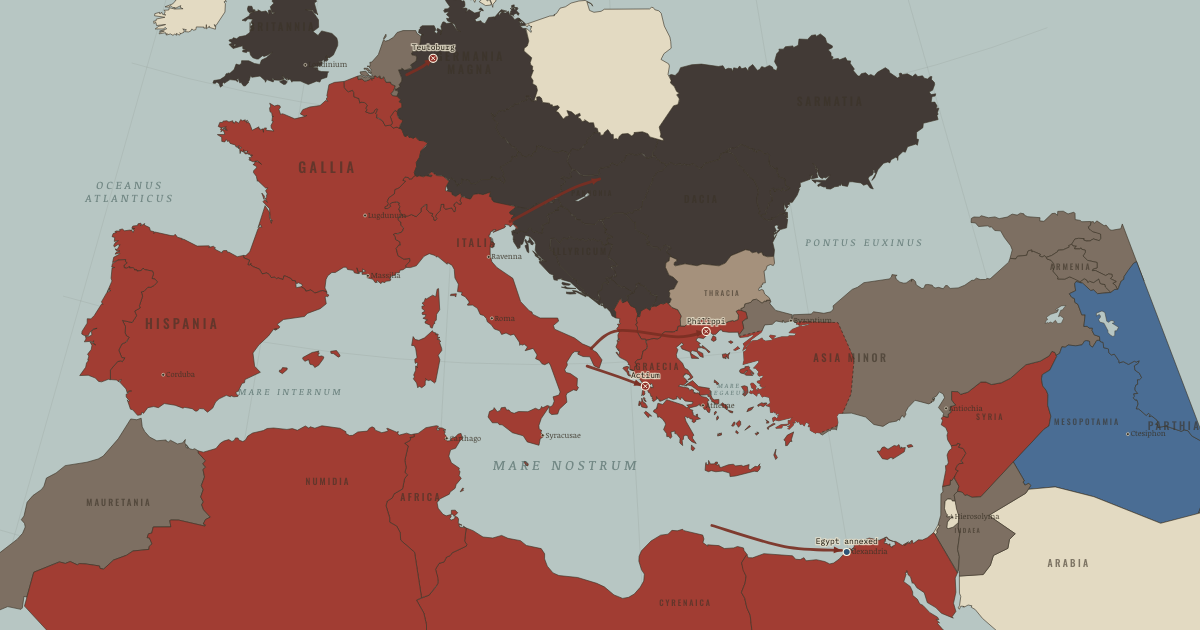
The map above is the world of 30 BC — Egypt annexed.
BRIEF EXPLANATION — THE ESSENTIAL ARGUMENT
Augustus succeeded where Caesar failed because he solved the problem that had killed the Republic, which was how to hold supreme power without provoking the men who would kill to prevent a king. He began with almost nothing but Caesar’s name, and used it to raise armies and build alliances. Together with Antony he defeated Caesar’s assassins at Philippi, and when that partnership in turn broke into civil war, he presented the struggle to Romans as a foreign one, a defence of Rome against the Egyptian queen Cleopatra and her Roman consort Antony. His victory at Actium in 31 BC gave him Egypt and left him in command of every legion in the Roman world.
What he did with that unrivalled power is the reason his settlement lasted. Taking the name Augustus, he kept the Republic’s offices and forms while quietly concentrating military and political authority in his own hands. He also fixed soldiers’ terms of service, pay and pensions and funded them from the state, which ended the ruinous competition among generals by making the army depend on the emperor instead of on rival patrons. The result was a genuine and lasting peace. Its unsolved weakness was the succession, because a state that refused to admit it had become a monarchy could not openly write the rules for choosing its next monarch.
GUIDED EXPLANATION
Octavian won the final civil war as much by controlling the story as by winning battles, and that skill defined his whole regime. With Antony he defeated Brutus and Cassius at Philippi in 42 BC, after fresh proscriptions, including the killing of Cicero, had financed their armies from the estates of the condemned. The victors then divided the Roman world between them, and Antony tied his political and military future to Cleopatra’s Egypt. Octavian described the coming conflict as a war of Rome against a foreign queen rather than another struggle between Romans. When Agrippa’s fleet won at Actium in 31 BC, the prize was Egypt’s treasury, grain and taxes, and with them sole command of every legion. One man now held the whole armed force of the state.
In 27 BC the Senate gave Octavian the name Augustus, and the arrangement he built behind that title is what turned victory into a stable system. Elections, courts and the Senate all continued, yet Augustus personally governed the frontier provinces that contained nearly all the legions, held the powers of a tribune, and outranked every other magistrate. He also put military service, pay and pensions on a regular footing funded through a state treasury. That reform removed the old rivalry among generals by making the emperor the army’s single permanent patron. The peace this produced was real, and so was the monarchy underneath it. When defeat in the Teutoburg Forest in AD 9 fixed the frontier along the Rhine and Danube, and when Tiberius succeeded smoothly in AD 14, the calm transfer of power showed that personal rule had hardened into an institution.
The durability of the settlement came from pairing force with careful presentation. Augustus did not abolish senatorial careers; he controlled the conditions under which they were pursued, and after decades of confiscation and civil war that bargain suited many people at once. The elite kept their status, ordinary Italians gained order, the provinces received steadier supervision, and soldiers gained predictable rewards. The price of all this was the concentration of power in one office. Because that office was never openly defined as a crown, Rome created no fixed law of succession, and Tiberius followed not by any constitutional rule but through family connection, adoption and control of the armies. The system solved the competition among generals by raising a single patron above them all, yet it only postponed, rather than settled, the struggle over who could next become that patron.
DEEP EXPLANATION — EVIDENCE & INTERPRETATION
Why the Republican Fiction Worked
Augustus avoided Caesar’s fatal mistake of displaying kingship openly, and the disguise he chose instead was the secret of his success. Each of his powers had a genuine republican precedent, from provincial command to the authority of a tribune, from repeated consulships to honours granted by the Senate; only their permanent combination in a single man was new. The fiction worked because senators kept their offices, their standing and a language of lawful government, while ordinary Italians gained relief from confiscation and civil war. Augustus did not merely deceive these groups, then, but offered a settlement in which each preserved something it valued. The cost of the arrangement was an enforced silence, because Rome could not openly define either the emperor’s limits or the rules for his succession without admitting that it had a monarchy. Stability therefore rested on personal management and on the loyalty of the army. Rule by the princeps, meaning the “first citizen,” endured in part because its very disguise handed dignity to so many, and its later crises grew out of the questions that disguise forbade Romans to answer in law.
Why Egypt Decided the Peace
Egypt mattered far beyond the personal drama of Antony and Cleopatra. The old Ptolemaic monarchy controlled a rich agricultural tax base, a hub of Mediterranean trade, and the grain that fed the city of Rome. Octavian treated Egypt as his own imperial domain and kept senators from governing it, and its treasure allowed him to pay and settle hundreds of thousands of soldiers after the civil war without another sweeping round of confiscations in Italy. This links the battlefield to the political settlement, because demobilisation is often harder than victory, since armed supporters expect to be rewarded and can turn dangerous if they are not. Antony had needed Egypt for exactly the same reason, as Cleopatra’s resources were what made his eastern command competitive in the first place. Octavian’s propaganda recast that financial dependence as foreign corruption, and the story worked because it turned a contest between Romans into a defence of Roman identity. Actium was thus won with ships, with money and with a story at once, and Octavian prevailed in all three contests.
New here? Chapters 1–2 of every atlas are free to sample, and the WW2 atlas is free in full. One membership opens all thirteen — the Cartographer’s Circle.
THE SITES
WHY IT HAPPENED
War-weariness as a political resource. Two generations of proscription lists, land confiscations for veterans, and kin killing kin left Italy desperate for order at nearly any constitutional price. Augustus’ regime survived scandals and disasters that would have destroyed a Republic-era politician because the alternative on everyone’s mind was not liberty but the 40s BC. Exhaustion is an under-modeled force in history: peoples, like people, will trade rights for sleep.
Cleopatra’s Egypt: the last independent treasury. The Ptolemaic kingdom was the Mediterranean’s richest state — the Nile’s grain surplus, royal monopolies, Alexandria’s trade. For Antony it was the war chest that made him competitive; for Octavian, seizing it meant paying 300,000 demobilized soldiers without touching Italian land. The civil war’s finance explains its geography: the last war of the Republic was fought over the means to end all future ones.
The propaganda war was the war. Octavian’s campaign against “the Egyptian queen” — foreign, female, bewitching — let Italian and provincial elites choose him as the Roman option rather than pick a side in yet another civil war. Antony, the better general with the larger fleet, lost allegiances for two years before losing a battle. Note the mechanism, not just the outcome: legitimacy is a supply chain, and Octavian cut Antony’s.
A monarchy the political class could pretend not to see. Caesar was murdered for looking like a king; Augustus ruled longer than any king by never looking like one. Every honor was technically republican, renewable, voted; senators kept careers, provinces, consulships — the forms that structured their identity. The disguise wasn’t cynicism alone: it was a negotiated fiction both sides needed, and it bought the system two centuries of stability. Ask the field question below whether that made it a lie.
THE TURN
Actium, 2 September 31 BC. As a battle, almost an anticlimax — Antony’s under-crewed, plague-worn fleet tries to break out, Cleopatra’s squadron escapes with the treasury, Antony follows, and his abandoned army negotiates its transfer to the winner within a week. As a hinge, absolute: it is the last time two Roman armies contest the rule of the world for 300 years, and its result decides that the empire’s center will be Rome and the west, not Alexandria and the Greek east — a decision Constantine will quietly reverse in Chapter 9. Watch this map long enough and Actium looks less like an ending than a very long postponement.
WHAT IT CHANGED
The Pax Romana opens. From Actium to Marcus Aurelius’ death in AD 180 — two centuries — the Mediterranean interior sees almost no war. The doors of the temple of Janus, open in wartime, are ceremonially closed; “the sea is safe,” writes a poet, and means it literally: piracy, endemic for millennia, vanishes. Chapter 7 asks how the machine actually ran; run it forward on the timeline and watch the red simply… hold.
The frontier becomes a philosophy. Teutoburg ended expansion as a default policy. Augustus’ testament advised keeping the empire within its bounds — advice all but Trajan took. The limes on your map is therefore a choice, not an exhaustion: Rome decided that beyond certain rivers, conquest cost more than it paid. Empires that stop growing must learn a new skill — administration — and Chapter 7 shows Rome learning it brilliantly. Chapter 8 shows the mortgage.
One office, no rules for filling it. The Principate’s fiction had one unfixable bug: an office that officially didn’t exist couldn’t have a law of succession. Adoption, inheritance, and the army’s acclamation competed forever after; the year 69 alone burned through four emperors. The system’s worst crises — 69, 193, the entire third century — are all succession crises. Augustus built a superb engine with no procedure for changing drivers at speed.
FIELD QUESTION — Augustus claimed, on his own monument, to have “transferred the Republic back to the Senate and People of Rome.” Was the Principate a lie — and did its being a lie matter?
Define the terms and the question sharpens. Legally, much of the claim was true: offices, elections and courts continued; Augustus held powers each of which had republican precedent (Pompey’s commands, the tribunes’ sacrosanctity) — only their permanent combination in one man was new. Functionally, it was false: no outcome he opposed ever stood. Did the fiction matter? Enormously, and in both directions. It reconciled the elite, prevented a Hellenistic-style court from forming for a century, and kept alive the ideal of lawful, accountable rule — which is why emperors were still assassinated in its name. But it also forbade honest institutional design: succession, the army’s political role, the emperor’s legal limits all went unwritten because writing them would name the monarchy. States often run on such useful hypocrisies; the cost comes due when a crisis demands the truth. Weigh Rome’s two stable centuries against its third; then ask what fictions your own political order runs on, and what invoice is accruing.
AN INTERESTING FACT
For centuries Teutoburg was a battle without a battlefield — until 1987, when Tony Clunn, a British Army major posted to Germany with a metal detector and time on his hands, began pulling Augustan silver out of a farm field at Kalkriese. Excavation found sling bullets, butchered mules, pits of weathered human bone — and an iron cavalry parade mask, its silver sheathing torn away, that has become the face of the disaster. Not one coin at the site postdates AD 9, and most (though not all) scholars accept it as the place Varus’ legions ended.
THE DISPATCH
One short letter when a new atlas opens — and the printable study guide for Rome is yours now, free.
NO TRACKING · YOUR ADDRESS IS USED FOR THE DISPATCH AND NOTHING ELSE · UNSUBSCRIBE ANYTIME