MAPS OF HISTORY · Rome · ALL CHAPTERS · CHAPTER 3
CHAPTER 3 · 200–129 BC · 146 BC
The Greek East Falls
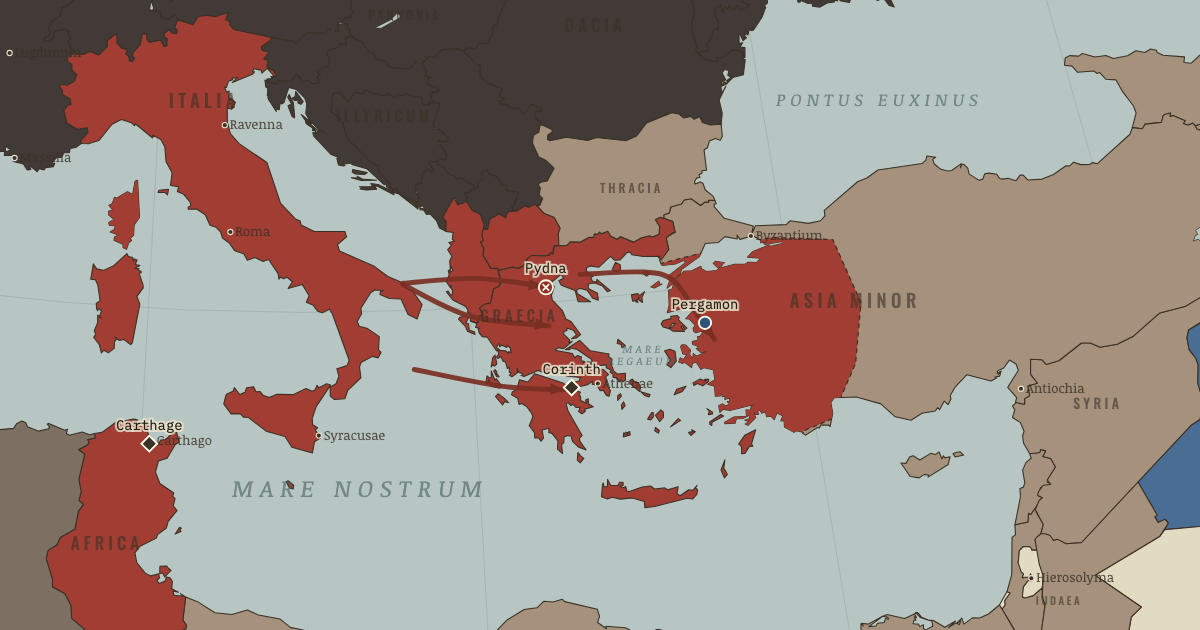
The map above is the world of 133 BC — The Pergamon bequest.
BRIEF EXPLANATION — THE ESSENTIAL ARGUMENT
The striking thing about Rome’s conquest of the Greek east is how quickly it happened once it began, and the reason lies in a difference of political style. The kingdoms that had divided Alexander’s empire, chiefly Macedon and the Seleucids of Syria, were used to wars that ended in negotiated settlements among near-equals. Rome fought to a conclusion instead. It entered the region as an ally and a referee for smaller states frightened of their neighbours, but each intervention left it the final judge of the next quarrel, and its armies broke Macedon at Cynoscephalae and again at Pydna and drove the Seleucid king Antiochus III back out of Greece. Step by step the temporary settlements hardened into direct rule.
What that rule cost, and what it brought home, is the second half of the story. In 146 BC Rome destroyed both Carthage and Corinth, killing or enslaving their people as a deliberate warning to others, and in 133 BC the king of Pergamon simply left his wealthy realm to Rome in his will. Conquest and inheritance together poured tribute, enslaved labour and Greek art and learning into Italy. That wealth reshaped Roman culture and made warfare itself profitable, which gave the ambitious every reason to seek more of it. It also concentrated riches in a few hands and widened the social divisions that would, within a century, begin to tear the Republic apart.
GUIDED EXPLANATION
Rome first arrived in the Greek east wearing the mask of a liberator, and the gap between that role and what it became is the real subject of this chapter. It presented itself as the protector of Greek states against the power of Macedon, but each time it settled a dispute it acquired new clients and new obligations that drew it back into the next one. Its military advantage made the outcome hard to resist. The legion fought in small, separately led units that could keep their order on broken ground, where the Macedonian phalanx, a dense hedge of long pikes that was formidable only while its line stayed unbroken, fell apart once the ground or its own casualties opened gaps. That difference decided the battles of Cynoscephalae and Pydna, and after Pydna in 168 BC Macedon was carved up and a thousand leading Greeks, among them the historian Polybius, were carried off to Italy as hostages.
The violence of 146 BC shows how Rome converted dominance into obedience. In that year it destroyed Carthage after a long siege and burned Corinth, killing or enslaving the inhabitants of both. These were exemplary punishments, meant to frighten many other cities into compliance by making an example of two, and the atlas marks them as memorials rather than triumphs. Control could also arrive without a war, as it did in 133 BC when the last king of Pergamon bequeathed his realm to Rome, which turned it into the province of Asia. Through tribute, tax contracts, plundered art and enslaved labour, the wealth of the east now flowed west, and while Greek learning enriched the culture of the Roman elite, the profits and the slave-worked estates steadily undercut Italy’s small farmers. The empire was beginning to change the people who had built it.
The sequence of these conquests reveals something easy to miss, which is that real power arrived well before the map changed colour. Rome held the decisions of the east through treaties, hostages and the standing threat of intervention long before it bothered to annex the region formally. After the victory at Pydna removed the strongest counterweight in the region, a Roman envoy could often command obedience without a battle, because every ruler now understood the force behind his words. Provinces were created later, when indirect control failed or when direct revenue became too attractive to refuse. Empire, in other words, can exist as a web of obligations and fear long before it looks like ownership on a map, and recognising that gap is part of understanding how Rome actually ruled.
DEEP EXPLANATION — EVIDENCE & INTERPRETATION
Did Rome Mean to Build an Empire?
Rome rarely began a war with a stated plan to annex the enemy’s land, and this has led some historians to speak of “defensive imperialism,” the idea that its expansion was driven by fear, alliance duties and one crisis after another rather than by design. Greek cities did invite Roman intervention against Macedon or against each other, and Roman armies sometimes imposed terms and then withdrew. Critics of the idea answer that Rome’s own institutions rewarded conquest at every turn, since consuls needed victories, soldiers expected plunder, and the treasury profited from indemnities. The destruction of 146 BC is especially hard to describe as reluctant self-defence, because neither Corinth nor a disarmed Carthage posed any immediate threat to Rome. A more useful way to hold both views is to separate blueprint from mechanism. Rome may never have planned a Mediterranean empire, yet it had built a political and military system that turned disputes into commands, commands into victories, and victories into fresh obligations, and the steady output of that machine tells us more than any statement of intention.
Violence as a Message
The destruction of Carthage and Corinth should not be flattened into a splash of new colour on the map, because it meant killing, enslavement and the erasure of whole communities. Ancient accounts disagree over the totals and the details, and the famous story that Rome sowed Carthage’s fields with salt is a modern invention with no ancient evidence behind it. The verified destruction was severe enough without that embellishment. As strategy, both attacks worked as exemplary punishment, in which the fate of one city was designed to change the calculations of many others. That could reduce the need for permanent garrisons, but it also made terror a routine instrument of government, and it moved enormous quantities of people and treasure to Italy. The less obvious point is that intimidation can secure obedience while quietly storing up resentment, and the same policy that cowed the east also prepared the anger that Mithridates would later turn against Roman tax collectors. Deterrence and resistance were two results of a single method.
New here? Chapters 1–2 of every atlas are free to sample, and the WW2 atlas is free in full. One membership opens all thirteen — the Cartographer’s Circle.
THE SITES
WHY IT HAPPENED
A power vacuum with an invitation. The Hellenistic balance ran on three great monarchies checking each other; by 200 BC Egypt had a child king and Macedon and Syria were carving up its holdings — while Greek states (Pergamon, Rhodes, Athens) begged the new western power to intervene. Rome rarely burst in; it was invited in, repeatedly, by easterners playing Rome against their neighbors. Empires often enter through open doors.
The phalanx meets the maniple. The Macedonian phalanx was invincible on flat ground and helpless the moment terrain or casualties broke its wall of pikes: at Cynoscephalae and Pydna the legion’s small, independently-officered blocks flowed into the gaps like water into a cracked pot. At Pydna 20,000 phalangites died against about 100 Romans (so Roman sources claim — inflate at will). Tactical systems, like political ones, are tested at their joints.
Fear, honor, and the Hannibal reflex. Rome’s eastern wars were sold at home as pre-emption: never again would a great power arm a Hannibal (Antiochus sheltering the exiled Carthaginian confirmed every anxiety). Historians debate whether this fear was sincere strategy or convenient cover for glory-hunting aristocrats — the “defensive imperialism” debate below — but note that both readings produce the same arrows.
Plunder as fiscal policy. The eastern wars paid so spectacularly — Aemilius Paullus brought home enough in 167 to abolish direct taxation of Roman citizens forever — that peace became fiscally irrational. When conquest funds the treasury, the treasury votes for conquest: an incentive structure, not a conspiracy.
THE TURN
Pydna, 22 June 168 BC. One hour of battle ends the 150-year-old kingdom of Alexander’s homeland — but the deeper turn happens weeks later at Eleusis, near Alexandria, where a Roman envoy meets the Seleucid king invading Egypt, draws a circle around him in the sand, and demands his answer before he steps out of it. Antiochus IV, master of Asia, withdraws his whole army on a single Roman’s word. No battle, no treaty: after Pydna, the entire eastern Mediterranean understands that Roman displeasure is a sufficient instrument of war.
WHAT IT CHANGED
A slave society hardens. Conquest’s human plunder — 150,000 Epirotes enslaved in one day in 167, whole cities sold after 146 — industrialized Italian agriculture into slave-run estates (latifundia) and detonated the servile wars: Sicily twice, then Spartacus. The dispossessed free poor drifted to Rome. Every element of the Republic’s coming crisis is now on the board.
Asia: the province that corrupts. The Pergamene bequest was farmed out to private tax syndicates (publicani) whose extraction rates beggared Anatolia and enriched the equestrian class that bid for the contracts. Provincial misgovernment became a currency of Roman politics — and eastern hatred of the tax farmers would soon hand Mithridates 80,000 Italian victims in a single day.
Greek culture conquers its conqueror. Greek became the second language of the Roman elite; Greek philosophy, historiography, medicine, art and urbanism became Rome’s own high culture, transmitted onward with Roman roads and law. When this atlas ends, the Roman east endures precisely because it is Greek-speaking and city-dense — a survival seeded here.
FIELD QUESTION — Did Rome plan a Mediterranean empire, or stumble into one? What would count as evidence either way?
The classic seminar fight. The “defensive imperialism” school points out that Rome annexed almost nothing for fifty years — it fought, settled, and went home, leaving client arrangements; empire-as-real-estate came late and reluctantly (Macedon became a province only after four wars). The aggression school (Harris and successors) counters that annual consuls needed wars, the plunder economy needed victims, and Rome’s “defensive” fears were remarkably productive of other people’s territory. Test with 146: destroying Carthage and Corinth defended nothing — both were exemplary terror, empire by deterrence. Perhaps the honest answer: Rome had no blueprint but had built a machine — political careers, army, treasury — that converted every crisis into expansion, and a machine’s output is its purpose. Ask the same question of any modern power’s “reluctant” growth.
AN INTERESTING FACT
One thing Rome did not do in 146: sow Carthage’s soil with salt. No ancient source mentions it — the detail is a modern embellishment that seeped into textbooks in the nineteenth and twentieth centuries and was only run to ground by a historian in 1986. Rome cursed the site, yes — and then, a century later, planted a colony on it that grew into one of the empire’s greatest cities, the same Carthage whose loss in AD 439 breaks the West in Chapter 11. The destruction was real and total; the salt is a legend about how badly later ages wanted annihilation to come with a ritual.
THE DISPATCH
One short letter when a new atlas opens — and the printable study guide for Rome is yours now, free.
NO TRACKING · YOUR ADDRESS IS USED FOR THE DISPATCH AND NOTHING ELSE · UNSUBSCRIBE ANYTIME