Age of Revolutions · CHAPTER 2 ·
American Revolutionary War
Chapter 2 of The Age of Revolutions, 1775–1848: “The American Revolution”
The American Revolutionary War began at Lexington and Concord on 19 April 1775. The rebels needed only to keep an army and coalition alive; Burgoyne’s surrender at Saratoga in 1777 brought France in openly, and French troops and de Grasse’s fleet enabled the Yorktown trap in 1781. The 1783 peace recognized a new republic.
WW2 is free in full, and chapter 1 of every atlas is free. A free account opens 3 more chapters a day. Starter, at $9 a month, opens all 21 with no daily limit — see the plans.
Free printable Age of Revolutions study guide, sent by email ↓
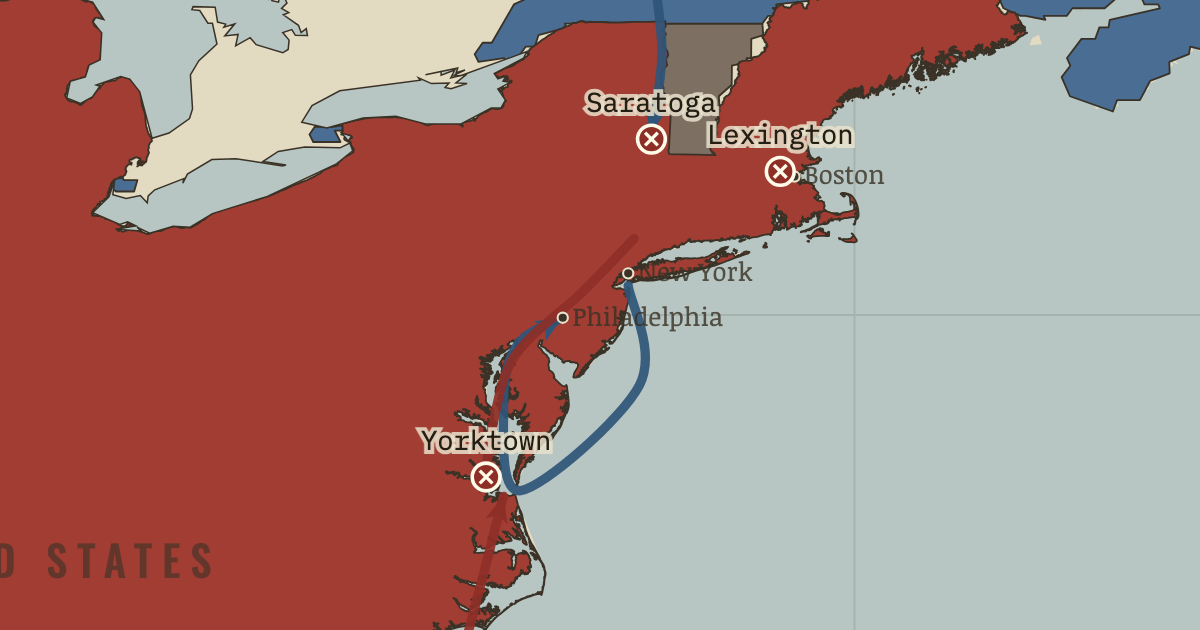
The map above is the world of The Atlantic world, September 1783 — A republic among empires.
Every state on the map that year: The world in 1789 · Europe in 1789.
Part of IB History: The Age of Revolutions →
SHORT EXPLANATION
Britain entered the war in 1775 with a powerful army and navy, but occupying a city and governing a colony were different achievements. The rebels needed to keep an army and a political coalition alive until reconquest became more costly than Britain would bear. A century of local self-government helped sustain resistance, while distance made the British task harder.
The surrender at Saratoga in 1777 helped persuade France to join the Americans openly. Britain now faced a wider war, with interests to defend in Europe, the Caribbean and India as well as North America. French troops and de Grasse’s fleet made the victory at Yorktown possible in 1781. Independence followed, but slavery and Native dispossession remained unresolved.
The full story
British troops left Boston on 19 April 1775 to seize colonial military stores. At Lexington and Concord they encountered militia, and on the return march they suffered heavy losses. The fighting began a war in which the opponents had different things to accomplish. Britain could take a city, but the rebels could continue fighting elsewhere. Washington had to keep the Continental Army from being destroyed in a decisive battle; as long as it survived, Congress could sustain the struggle and foreign governments could see a rebellion worth supporting.
The British campaign of 1777 aimed to isolate New England. Burgoyne moved south from Canada, but the forces meant to cooperate with him failed to coordinate, and his army surrendered at Saratoga. The news mattered in Paris. French ministers could now judge that the Americans might remain in the field as allies. In 1778 France entered the war with money, soldiers and a navy; Spain and the Dutch helped turn the struggle into a wider war.
Look at the two final arrows on the map. In 1781 Washington and Rochambeau marched south toward Cornwallis, while Admiral de Grasse controlled Chesapeake Bay. Cornwallis faced allied troops on land and a French fleet blocking escape or relief by sea. Neither movement alone explains the trap. Their combination brought his surrender at Yorktown, a victory made possible by the alliance.
The peace of 1783 recognized a republic extending to the Mississippi. That settlement changed imperial sovereignty, but it left other questions of power open. Most enslaved people were not freed. Native nations were not consulted when the treaty assigned their lands to the republic on paper, although they had never surrendered them and the negotiators did not control them. The new boundary would become the scene of further struggles over who could govern and occupy the land.
FULL EXPLANATION
A city could be taken; a country had to be governed
British troops held New York for most of the war and also occupied Philadelphia and Charleston. Yet their authority weakened beyond the garrisons. Colonial assemblies, committees and militias could sustain or rebuild political authority locally, so Britain faced an insurgency as well as an opposing field army. To restore rule it needed to identify supporters, protect supply routes and make its authority credible across a large population. The rebels had the more limited task of preventing their movement from collapsing. That was difficult enough: Washington’s army nearly dissolved in 1776, and British victory remained possible. The Atlantic increased transport costs and slowed decisions, while local institutions kept resistance alive. After 1778 Britain had to meet those difficulties while a foreign coalition competed for its ships and troops.
From Saratoga to a global coalition
France had already supplied covert aid to Britain’s colonial opponents. Its defeat in 1763 gave it reason to welcome a chance against its rival, but an open alliance would expose French colonies and finances. Before taking that risk, ministers wanted evidence that the Americans could continue fighting. Burgoyne’s surrender at Saratoga supplied it. French entry changed the demands on Britain. Ships and troops were needed in the Channel, the Caribbean sugar islands, Gibraltar and India as well as North America. At Yorktown the allies brought forces together for a local purpose: de Grasse’s Caribbean fleet prevented evacuation while French and American troops closed the siege on land. The victory depended on this temporary concentration within a much wider war. France won revenge and strategic advantage, while the money spent deepened its fiscal crisis at home.
Key places on the map
On this day
Why it happened
The Atlantic and the cost of reconquest. An army fighting 3,000 miles from Britain depended on men and supplies sent by sail; an order and its answer could take three months. Distance raised costs and slowed decisions, but it became a serious burden because resistance continued. The rebels needed to keep their army and movement alive until the expense of reconquest weakened London’s will and credit.
The French decision. Vergennes arranged covert arms for the rebels from 1776, and most of the gunpowder at Saratoga was French. France wanted revenge for its defeat in 1763, yet open war exposed its own resources and possessions. The alliance of February 1778 brought a French fleet and army into the struggle and stretched British resources across a global war. France’s estimated expenditure of 1.3 billion livres would add to the debt behind its own crisis.
Resistance beyond the garrison. Colonial armed communities and self-governing institutions had a century of experience. Britain captured New York, Philadelphia and Charleston, but its garrisons could not exercise the same power everywhere beyond them. Assemblies, committees and militias could sustain or rebuild local resistance. A captured city gave Britain a foothold; it did not by itself restore rule over the surrounding population.
THE TURNING POINT
Saratoga, 17 October 1777. The British plan called for three columns to converge on Albany. They did not meet: Howe went to Philadelphia, while Burgoyne advanced south and became isolated. On 17 October 1777 he surrendered 5,800 men at Saratoga. French ministers considering an alliance needed reason to believe that the rebellion could endure. The surrender supplied evidence, and within four months France signed the alliance. Britain now faced a wider coalition.
What it changed
Written constitutions as examples. American state constitutions, followed by the federal Constitution of 1787, offered a working precedent for government under written, ratified and amendable rules. Revolutionaries from Paris to Caracas could take up that example, whether they adopted its provisions or argued against them.
Slavery and the new republic. Independence left about half a million people enslaved. The Constitution counted enslaved people as three-fifths for representation and taxation and protected the slave trade for twenty years. Northern states began gradual abolition. Tens of thousands of Black Loyalists left with the British, many having looked to them for freedom. The change of government did not give freedom to everyone living under it.
A peace made over Native lands. Many Native nations had fought with Britain to resist settler expansion. The Treaty of Paris assigned their lands to the republic on paper without consulting them. Native peoples continued to occupy and defend those lands, and frontier wars followed as settlers and the new state sought control.
The cost of French victory. France gained revenge against Britain, but paid an estimated 1.3 billion livres, raised through borrowing. Interest consumed about half the royal budget. The burden of victory helped bring the monarchy to the Estates-General.
DISCUSSION QUESTION — Britain had a powerful navy, great resources and a professional army. Could it ever have won?
Yes. Washington’s army nearly dissolved in 1776, and Britain could have defeated it. Even then, Britain would have faced the task of establishing durable rule over self-governing communities along a vast coast. Occupying cities did not remove the political networks that sustained resistance. After France entered, British ships and troops were also needed to defend valuable positions elsewhere. Together, Atlantic distance, local resistance and the global coalition made reconquest too costly for Britain to accept.
An interesting fact
Perhaps 11,000 Americans died aboard British prison hulks in New York’s Wallabout Bay, although estimates run higher. That exceeds the roughly 6,800 killed in all the war’s battles combined. Survivors called the worst ship, the Jersey, “Hell afloat.” For decades bones washed out of the Brooklyn shoreline; a crypt at Fort Greene gathered the dead in 1908.
Related
THE FREE PRINTABLE STUDY GUIDE
Get the printable study guide for The Age of Revolutions free. I’ll send you a few short letters, then one when a new atlas opens. That’s all. — Paul
NO TRACKING · YOUR ADDRESS IS USED FOR THE DISPATCH AND NOTHING ELSE · UNSUBSCRIBE ANYTIME