Age of Revolutions · CHAPTER 4 ·
Reign of Terror
Chapter 4 of The Age of Revolutions, 1775–1848: “The Republic in the Balance”
In 1793 the French Republic faced invasion, civil war, inflation and political division. Mass conscription built an army of roughly 750,000 by 1794, while the Terror brought revolutionary courts, about 17,000 executions after legal sentence and devastating repression in the Vendée. Robespierre fell in July 1794.
Chapter 4 is included with every paid plan. WW2 is free in full, and chapter 1 of every atlas is free. A free account opens 3 more chapters a day. Starter, at $9 a month, opens all 21 with no daily limit — see the plans.
Free printable Age of Revolutions study guide, sent by email ↓
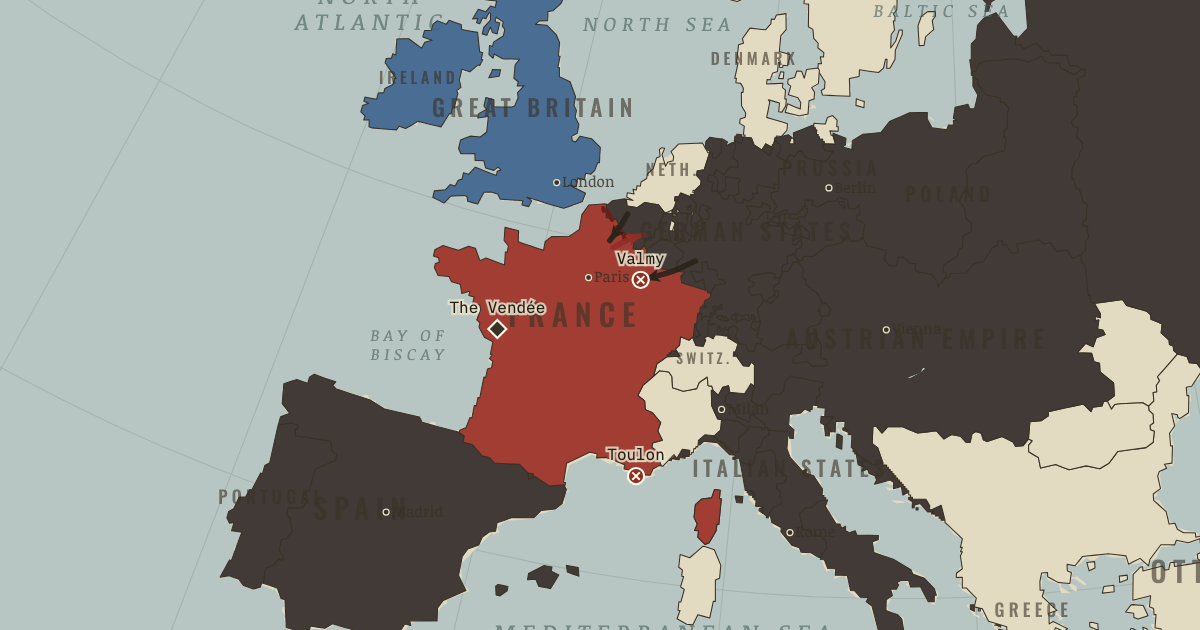
The map above is the world of Europe, February 1793 — The Republic against Europe.
Every state on the map that year: The world in 1789 · Europe in 1789.
Part of IB History: The Age of Revolutions →
SHORT EXPLANATION
In 1793 the French Republic had to fight foreign armies while confronting civil war, inflation and political division at home. Mass conscription, promotion by ability and centralized supply gave it a national army capable of turning military crisis toward victory.
The government also used revolutionary courts and executions against suspected enemies; people died in prison, and repression devastated the Vendée. The danger was real, but emergency power gathered momentum of its own. In July 1794 deputies overthrew Robespierre, afraid they might be next. The Republic survived with deep moral and political wounds.
The full story
At Valmy in September 1792, French regulars and volunteers held their ground against a Prussian advance. The engagement was limited, but it showed that revolutionary troops could stand against a professional army. Within days the new Convention abolished the monarchy, and early in 1793 it executed Louis XVI. By midyear the Republic faced a much wider struggle: war with much of Europe, revolt at home and economic collapse.
The government sought to put the resources of the country behind the war. The levée en masse, or mass call-up, mobilized the population and economy; by 1794 France fielded roughly 750,000 troops. Emergency committees regulated prices, requisitioned food and prosecuted suspected enemies. These powers helped the Republic mobilize, but they also reached deeply into civilian life. About 17,000 people were executed after legal sentence, and many more died in prison, local reprisals and civil war.
In the Vendée, opposition to conscription and measures against the Church grew into a royalist war. Republican “infernal columns” devastated communities there. Estimates of 170,000–250,000 deaths include many civilians and remain debated in detail. The map separates the Vendée from the foreign fronts, but leaders in 1793–94 could see revolt, shortage and military defeat as parts of the same threat. Once criticism could be treated as sabotage and local violence defended as national security, limits on repression became hard to enforce.
Victory at Fleurus in June 1794 improved France’s military position. Yet the Great Terror intensified as that pressure began to ease. Fear and political momentum had acquired force within the institutions created to meet the emergency. In Thermidor deputies overthrew Robespierre, fearing that the machinery of repression would reach them too.
FULL EXPLANATION
Why emergency power continued
A government at war had urgent reasons to concentrate power. It needed recruits, grain and weapons, and officials wanted to deal quickly with desertion or sabotage. Central institutions could help assemble those resources. They also gave officials positions to protect and created fears about who might be accused next. A local agent could denounce a rival as a counter-revolutionary; leaders could read a military setback as treason. Each purge gave survivors a reason to strike first. The Great Terror grew even after the strategic position had begun to improve. Neither irrational bloodlust nor efficient defense accounts for the whole process. The emergency explains why these powers arose, while the absence of a trusted stopping rule helps explain how fear within government kept them in motion. Their origin does not justify everything done in their name.
The Vendée: violence and its meaning
The Vendée rising combined several causes: resistance to conscription, defense of non-juring priests, local grievances and royalism. Republican forces encountered armed resistance and sometimes brutal insurgent violence. Their response included village burning, summary killing and mass executions, with civilians struck on a far greater scale. State forces deliberately devastated the region and killed noncombatants during pacification. Historians debate whether “genocide” is the right term, disagreeing over intent, command and legal categories. That dispute leaves the documented acts in view. A range of estimates conveys the scale without claiming more precision than the evidence permits, and the dead should not become a score in a contest over whether the Revolution was good or bad.
Key places on the map
On this day
Why it happened
War and suspicion. A military defeat could be taken as evidence that someone had betrayed the Republic. The fear was not always groundless: a commanding general defected in April 1793. Leaders used the war to justify centralized authority and punishment of enemies; within the Convention’s logic, even the guillotine became an instrument of defense. Chapter 11 shows a related connection between danger and repression when restored kings purged liberals.
Faith, conscription and war in the Vendée. Measures against priests had already angered western peasants when conscription helped bring their grievances into revolt. Riots became a counter-revolutionary war. The Republic’s “infernal columns” passed through the Vendée in 1794, devastating communities. The contested estimate of 170,000–250,000 deaths includes many civilians. Both the war and its suppression left a deep wound.
Wartime control of the economy. The assignat lost value as inflation and shortages threatened households and the war effort. The authorities tried to secure supplies through requisition and imposed price controls backed by severe penalties. Repression had an economic purpose as well as military and political ones. Its institutions weakened after France’s military position improved, though the Great Terror had intensified as that improvement began.
THE TURNING POINT
Valmy, 20 September 1792. On 20 September 1792 the armies largely fought an artillery exchange at Valmy; roughly 300 died on both sides. Brunswick withdrew with his Prussian force outnumbered, sick and distant from supply. French troops, including citizen volunteers, had held against the professional invaders. Goethe, who was present with the Prussians, later called the encounter the beginning of a new era in world history. Valmy displayed a revolutionary army’s capacity; the later levée would mobilize still greater power, carrying France from mass enlistment to Austerlitz.
What it changed
The army and its generals. The Republic built successful armies through mass conscription and promotion by ability. Their victories also gave generals authority that rested on their own achievements. At Toulon, Napoleon is directing cannon (see the ✕ marker). The Republic that armed the nation would eventually give way to his rule.
Emancipation under pressure. The Convention abolished slavery in all French colonies in February 1794. In Saint-Domingue, enslaved people had already fought for freedom, and the decree offered France a way to retain the colony against Britain and Spain. Principle and military need both shaped the decision. Napoleon later restored slavery in French territories where abolition had taken effect.
A model and a warning. Later revolutionaries could look to mass mobilization, public-safety committees and revolutionary tribunals as ways to defend a revolution. Opponents could point to the same institutions as a warning about the destination of the “rights of man”. The revolutions of 1848 provide another opportunity to test those readings.
DISCUSSION QUESTION — Was the Terror the Revolution’s betrayal, or its self-defense? Choose, then argue the other side.
The Republic was in danger, and centralized mobilization helped it survive militarily. That is a serious case for self-defense. The case for betrayal rests on indiscriminate repression, the devastation of the Vendée and the Great Terror’s acceleration as immediate danger eased. The distinction between the origin and development of emergency institutions helps us judge both claims. War helped bring them into existence; fear and political incentives helped sustain them. Their defensive purpose explains their rise without justifying every act or establishing that terror was necessary for victory.
An interesting fact
The revolution reached even into the calendar. From late 1793 France dated years from the Republic’s beginning and used ten-day weeks that displaced Sunday. The poet Fabre d’Églantine named the months, including Thermidor, associated with heat; Robespierre’s fall took its name from that month. Fabre himself was guillotined before the calendar was a year old, and Napoleon ended its use on 1 January 1806. A companion reform lasted: the metre was defined as one ten-millionth of the distance from pole to equator, and surveyors worked on its measurement through the Terror.
Related
THE FREE PRINTABLE STUDY GUIDE
Get the printable study guide for The Age of Revolutions free. I’ll send you a few short letters, then one when a new atlas opens. That’s all. — Paul
NO TRACKING · YOUR ADDRESS IS USED FOR THE DISPATCH AND NOTHING ELSE · UNSUBSCRIBE ANYTIME