Age of Revolutions · CHAPTER 5 ·
Haitian Revolution
Chapter 5 of The Age of Revolutions, 1775–1848: “The Haitian Revolution”
In Saint-Domingue, the world’s richest plantation colony, the enslaved outnumbered the free about ten to one and rose in 1791. Toussaint Louverture built an emancipated but still French order. Napoleon’s 1802 expedition captured him but was destroyed by Dessalines’ resistance and yellow fever; Haiti became independent in 1804.
Chapter 5 is included with every paid plan. WW2 is free in full, and chapter 1 of every atlas is free. A free account opens 3 more chapters a day. Starter, at $9 a month, opens all 21 with no daily limit — see the plans.
Free printable Age of Revolutions study guide, sent by email ↓
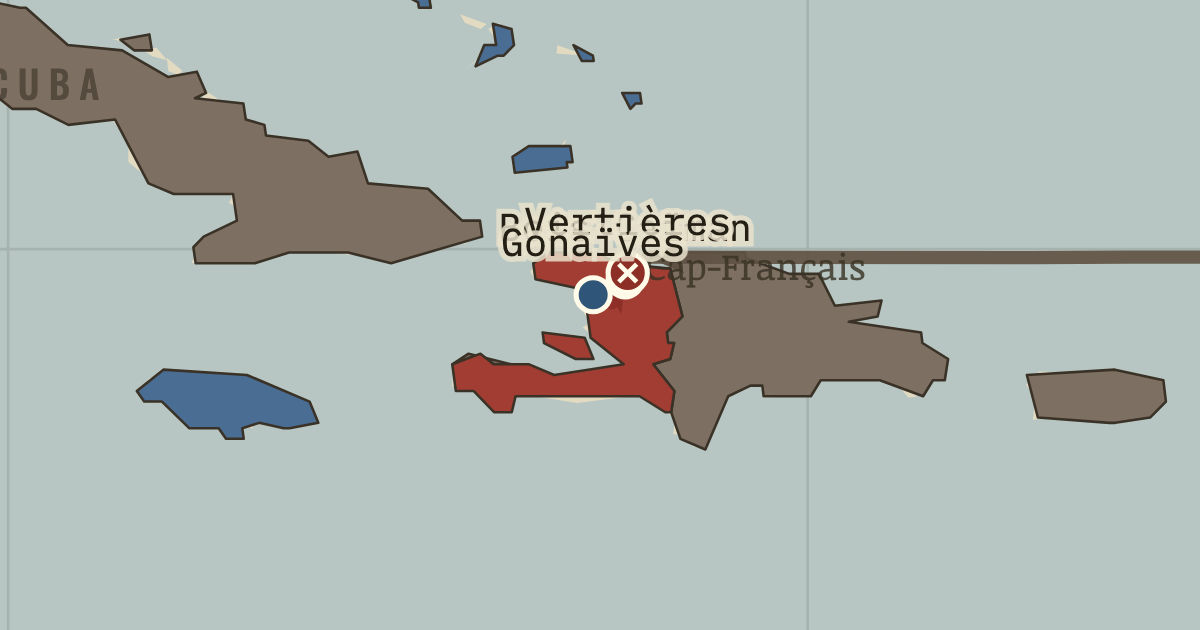
The map above is the world of The Atlantic world, January 1804 — Haiti.
Every state on the map that year: The world in 1800 · Europe in 1800.
Part of IB History: The Age of Revolutions →
SHORT EXPLANATION
Saint-Domingue's sugar and coffee made it immensely wealthy, at a terrible cost in enslaved lives. Enslaved people outnumbered the free population about ten to one, and many were born in Africa. The French Revolution divided the colony's free groups over citizenship and authority. In 1791 enslaved organizers turned that struggle into a major rising.
Toussaint Louverture established emancipation while retaining a connection to France. Napoleon's expedition seized him in 1802, and the restoration of slavery in Guadeloupe showed what renewed French rule might bring. Resistance under Dessalines, aided by yellow fever, defeated the expedition at Vertières. Haiti declared independence in 1804, then faced isolation and economic punishment.
The full story
The wealth of Saint-Domingue depended on sugar and coffee grown by enslaved people whose mortality was extraordinarily high. When revolution in France raised questions about citizenship, the colony's planters, poorer whites and free people of color fought over who should exercise authority. Their quarrel opened a different question: whether plantation slavery itself would survive. Enslaved organizers rose in August 1791, and the revolt spread across the northern plain. Restoring the old order would now require a major war.
Toussaint Louverture dealt with Spain, France and local rivals in turn, changing alliances while insisting on emancipation. By 1801 he governed under a constitution that kept Saint-Domingue within France. Napoleon sent General Leclerc with tens of thousands of troops in 1802; Toussaint was captured during negotiations and deported. French assurances became harder to accept when news came that slavery had been restored in Guadeloupe. Black officers returned to resistance under Dessalines, for the freedom at stake could be lost under renewed French control. Haitian forces prolonged the fighting into the disease season, and yellow fever killed more soldiers than battle. The last major French force lost at Vertières in November 1803. Haiti declared independence on 1 January 1804; slaveholding powers withheld recognition, and France later imposed a vast indemnity benefiting former enslavers.
The markers trace the making of that state. Bois Caïman represents the networks of organization that planters had insisted enslaved people could not build; Vertières marks the military defeat of France's last major force; and Gonaïves is where independence was declared under the Indigenous name Haiti. Colonial restoration had been rejected. The new country still faced coercion and internal conflict, but its sovereignty rested on permanent abolition. For neighboring slaveholding powers, that achievement was itself a threat.
FULL EXPLANATION
Freedom and the power to govern
The French commissioners who proclaimed emancipation locally in 1793 were trying to retain the colony against Britain and Spain. The Convention's abolition throughout the empire followed in 1794. Freedom was both a revolutionary principle and a means of fighting a war. Toussaint then had to defend and govern the society emancipation had created. Defense required revenue, and revenue depended on exports from an economy organized around sugar plantations. His answer included coercive labor rules, which many former slaves resisted. They were no longer legally owned, yet his government was neither socially equal nor fully democratic. Napoleon exploited conflicts around that rule. When France restored slavery elsewhere, however, the danger of renewed French control became much greater: accepting it could mean surrendering freedom itself.
Disease and the length of the war
Leclerc knew that yellow fever threatened newly arrived Europeans, who lacked acquired immunity. He expected the expedition to finish quickly. Haitian resistance frustrated that timetable, keeping French troops dispersed and in the field into the rainy season. Supply failures and brutal command further weakened the expedition. Disease killed more French troops than battle, but it did not act alone. Organizers, soldiers and civilians made occupation prolonged and costly, giving fever time to take its toll. The disease environment shaped the conditions of the war; resistance shaped how long the French had to endure them.
Key places on the map
On this day
Why it happened
A plantation society in revolt. About ten enslaved people lived in Saint-Domingue for every free person, and many had been born in Africa. The plantation system produced immense wealth while killing its workers at a high rate. Its survival depended on the continued subjection of the majority. Whereas the American Revolution compromised with slavery and French governments equivocated, the people who sustained Saint-Domingue's plantations fought to end their own enslavement. Emancipation became the foundation of their new state.
An opening in a divided colony. The French Revolution left competing groups claiming authority in the colony. By 1791 royalist planters, republican small whites and free people of color seeking citizenship were fighting one another. Their divisions weakened plantation rule just as enslaved people organized a rising of their own. A dispute over who belonged in the French political community became a war over slavery.
Emancipation and the war. Sonthonax, the republican commissioner, proclaimed emancipation in the north in 1793 as he tried to hold the colony against Britain and Spain. The Convention extended abolition throughout the French empire in 1794. Military necessity and revolutionary principle thus worked together, and Toussaint made emancipation central to his government. Once Napoleon restored slavery elsewhere, French promises offered little security to people who stood to lose their freedom.
The fever season. European expeditions faced a danger that could grow worse with time. British deaths in the Caribbean islands in the 1790s are estimated at about 45,000, and deaths in Leclerc's expedition at more than 40,000; these totals include deaths from causes other than yellow fever. Dessalines' strategy counted on “the rainy season and its fevers.” Continued resistance kept French troops exposed long enough for disease to erode their strength.
THE TURNING POINT
Vertières, 18 November 1803. On 18 November 1803, at Vertières, former enslaved people fought the army of a power that had abolished slavery and restored it elsewhere. Capois-la-Mort's column reportedly re-formed four times under fire. Rochambeau evacuated Cap-Français within days, ending France's hopes of holding Saint-Domingue. The struggle had already weakened Napoleon's plans for an American empire: in April he sold Louisiana to the United States. The purchase approximately doubled the republic that withheld recognition from Haiti.
What it changed
The price of independence. Independence brought costly pressure from abroad. The United States embargoed trade in 1806. In 1825 French warships accompanied a demand for 150 million francs to compensate former enslavers for property lost through emancipation. Haiti was required to pay those who had claimed ownership of its people. The burden of the indemnity and the loans taken to pay it lasted until 1947, while isolation added to the new state's difficulties.
Fear and possibility. Slaveholders from Virginia to Brazil tightened restrictions and tried to limit news of Haiti. Enslaved people nevertheless learned from its example: Haiti figured in accounts of Gabriel's conspiracy in 1800 and the German Coast rising in 1811. The same events prompted fear among slaveholders and offered evidence to the enslaved that their condition could be overthrown.
Haiti and Bolívar. When Bolívar was defeated, President Pétion supplied him in 1816 with ships, muskets, a printing press and men. Pétion asked him to abolish slavery in the territories he liberated, and Bolívar issued emancipation decrees. Haitian leaders supported independence elsewhere while pressing its champions to extend freedom to enslaved people.
Napoleon turns from the Atlantic. Napoleon reportedly said, “Damn sugar, damn coffee, damn colonies.” The costly campaign helped bring his American ambitions to an end, and the Louisiana sale brought money to France. As his attention shifted increasingly to Europe, the soldiers lost in the Caribbean were unavailable for later campaigns.
DISCUSSION QUESTION — What made Haiti a demanding test of the revolutionary claim to universal freedom?
Universal freedom had a severe material consequence in Saint-Domingue: it destroyed claims to the plantation property that supported French wealth and white power. American leaders preserved slavery, and French revolutionaries abolished it under pressure before Napoleon restored it where he could. Haitians made emancipation a condition of their state's survival. Other slaveholding powers responded by isolating the country whose revolution had put freedom into effect.
An interesting fact
As Toussaint Louverture boarded the ship taking him to France, his captors recorded his warning: “In overthrowing me, you have cut down in Saint-Domingue only the trunk of the tree of liberty. It will spring back from the roots, for they are numerous and deep.” He died of pneumonia on 7 April 1803 in an unheated cell at the Fort de Joux, nine hundred metres up in the Jura mountains, far from the sea and Saint-Domingue. Seven months later the resistance defeated France at Vertières.
Related
THE FREE PRINTABLE STUDY GUIDE
Get the printable study guide for The Age of Revolutions free. I’ll send you a few short letters, then one when a new atlas opens. That’s all. — Paul
NO TRACKING · YOUR ADDRESS IS USED FOR THE DISPATCH AND NOTHING ELSE · UNSUBSCRIBE ANYTIME