Age of Revolutions · CHAPTER 3 ·
French Revolution
Chapter 3 of The Age of Revolutions, 1775–1848: “The French Revolution”
France entered 1789 with an insolvent state: war debt consumed revenue, the privileged resisted equal taxes and poor harvests raised bread prices. The Estates-General became a National Assembly, crowds stormed the Bastille on 14 July 1789 and privileges were abolished; the king’s flight to Varennes in 1791 deepened distrust.
Chapter 3 is included with every paid plan. WW2 is free in full, and chapter 1 of every atlas is free. A free account opens 3 more chapters a day. Starter, at $9 a month, opens all 21 with no daily limit — see the plans.
Free printable Age of Revolutions study guide, sent by email ↓
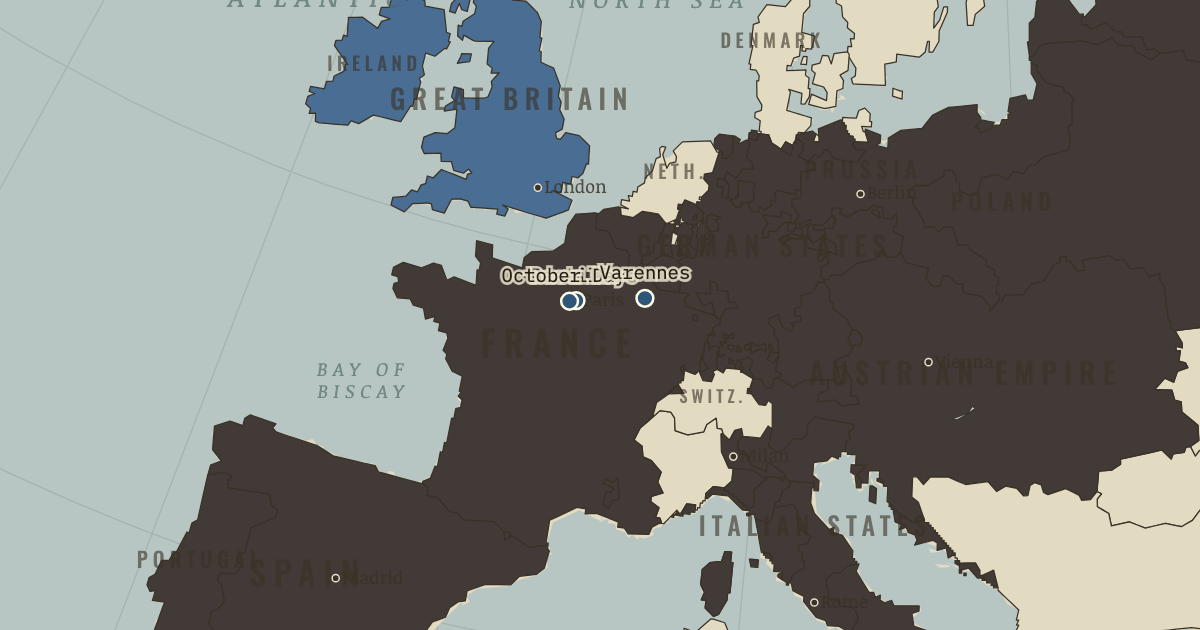
The map above is the world of Europe, July 1789 — The old regime, shaken.
Every state on the map that year: The world in 1789 · Europe in 1789.
Part of IB History: The Age of Revolutions →
SHORT EXPLANATION
In 1789 the French crown needed money from a society whose wealth it could not reliably tax. War debts, protected privileges and expensive bread brought different grievances together. Calling the Estates-General gave those grievances a national forum and made revenue inseparable from the question of representation.
The National Assembly challenged the old order, while crowds took the Bastille and peasants attacked feudal privileges. Many still hoped to retain a king under a constitution. Louis XVI’s resistance and attempted flight in 1791 damaged that hope; war in 1792 deepened suspicion and helped republicanism gain support.
The full story
The French Revolution began with a government asking how to pay its bills. France had considerable wealth, but noble and Church privileges restricted the taxes the crown could collect, and interest on war debts consumed much of its budget. The harvest failure of 1788 made bread more expensive just as ministers needed new revenue. Louis XVI summoned the Estates-General, which had not met since 1614. Elections and written grievance lists gave millions a way to bring their complaints into a national debate. The search for money had opened a larger question: who spoke for France?
In June 1789 the Third Estate answered by declaring itself the National Assembly. Its claim gained force from events outside the meeting hall. On 14 July Parisians took the Bastille in search of weapons and gunpowder. The fortress had little military value, but its capture showed that the crown could not simply use force to make the capital obey. Peasants attacked feudal records, helping to press the Assembly into abolishing privileges on 4 August; the Declaration of Rights followed. That October women marched to Versailles and brought the royal family to Paris. Authority was contested in villages and streets as well as in the Assembly.
Many still supported a constitutional settlement with Louis as king. Such an arrangement depended on his willingness to accept limits, and his attempted flight in June 1791 made that willingness hard to believe. Caught at Varennes, Louis gave people reason to think that the king who publicly accepted the constitution was seeking a way to undo it. War from April 1792 sharpened the distrust. Each side had more reason to fear that the other would overturn a compromise when it had the chance.
The map’s Bastille, Versailles and Varennes show different stages of this change. At the first, the crown lost control of armed force in Paris; at the second, citizens compelled the court to move; at the third, the king’s flight exposed the limits of his cooperation. None made a republic inevitable by itself. Together they help explain why the revolution moved so quickly: hunger and ideas brought people into politics, while the loss of trust made a durable settlement increasingly difficult.
FULL EXPLANATION
A wealthy country and a troubled treasury
The French crown’s financial weakness was not simply a measure of the country’s wealth. The government collected taxes through fragmented arrangements, protected exemptions limited what it could ask of privileged groups, and lenders charged for uncertainty. Ministers proposed broader taxation before 1789, but privileged bodies resisted. The crown also lacked a representative institution that could authorize new burdens in a way people would regard as legitimate. Britain carried comparable or greater debt, yet enjoyed steadier credit: Parliament authorized taxes, while the Bank of England helped organize borrowing. The difference lay in institutions, not national character. Enlightenment writers did not make the deficit. They gave critics a language in which to challenge privilege as injustice. Once the Estates-General assembled, the financial question could no longer be separated from who represented the nation. The map records an outcome produced by institutions, material pressure and political choices acting together.
Varennes and a promise hard to believe
A constitution could leave Louis on the throne only if people believed he would observe its limits when they restrained him. His earlier resistance had weakened that belief. The attempted flight in 1791 made the problem sharper: the royal family apparently hoped to reach a loyal military position and negotiate from strength, but they were recognized at Varennes and returned to Paris under guard. A public promise to cooperate now had to be weighed against that attempt. The flight did not by itself end the monarchy. Republicans remained a minority for a time, and the king retained his formal position until August 1792. What changed was the meaning people could attach to later events. A royal veto, a military setback or a threat from émigrés could seem evidence of a plan to reverse the revolution. Louis had lost the ability to make a credible commitment to his own constitution. War and subsequent choices worked on that loss of trust; Varennes was a turning point within a longer sequence.
Key places on the map
On this day
Why it happened
The cost of war and credit. France’s long struggle with Britain, followed by its support for American independence, left the crown with heavy debts. Chapter 1 traced a similar chain from war to debt, taxation and a dispute over representation; in France it operated on a much larger scale. Britain could authorize taxes through Parliament and organize cheaper borrowing with the Bank of England. France lacked those equivalents. By summoning the Estates-General, the crown brought its own version of “no taxation without representation” into the effort to solve the debt crisis.
The problem of privilege. Versailles had concentrated political power around the crown, while nobles retained honors and exemptions from taxes. Lawyers, merchants and philosophes who helped support the state could see a mismatch between its burdens and its privileges. Enlightenment arguments gave that mismatch a political meaning: the deficit became evidence of an unjust order. The writers did not create the shortage of money; they helped explain why its distribution mattered.
Bread and the harvest. Hail and drought damaged the 1788 harvest. In 1789, the hungriest year in a generation, bread reached around fourteen sous and peaked in price during the week the Bastille fell. The pressure on households gave urgency to the political crisis. Ideas helped people identify privileges to challenge; hunger helped bring crowds into the streets.
The American example. French officers had seen another revolution at close range. Lafayette, especially, returned from America with the example of rights set down in writing and citizen armies winning a war. In Paris, Jefferson was consulted as the Declaration of 1789 took shape. People and correspondence carried the American experience into the French debate.
THE TURNING POINT
The Bastille, 14 July 1789. The Bastille contained seven prisoners when the crowd attacked it, and about a hundred people died. Its military importance was small, but the outcome answered a political question: the king’s soldiers had not prevented Paris from taking the fortress. Louis later appeared at the Hôtel de Ville wearing the tricolor cockade, acknowledging the changed balance. The fall of a prison had shown how uncertain royal force had become.
What it changed
Sovereignty in the nation. Article 3 put authority in a new place: “The principle of all sovereignty resides essentially in the nation”. That claim invited a question beyond France: if the nation was sovereign, what authorized a monarch to rule? European powers would go to war with revolutionary France as the crisis developed.
The Church and the revolution. To support a new paper currency, the revolutionary state confiscated Church lands; it then required clergy to swear loyalty to the state. Parish communities had to confront these decisions in their own religious lives. Divisions over the Church helped feed counter-revolution, particularly in the Vendée, alongside the wider opposition described in Chapter 4.
From Varennes to the Tuileries. Louis’s flight made republicanism more persuasive. War and foreign threats added to the suspicion that he sought help against the revolution. After the Brunswick Manifesto threatened Paris with “exemplary vengeance”, a crowd stormed the Tuileries on 10 August 1792. The monarchy fell.
Rights across the Atlantic. The Declaration’s language reached Saint-Domingue quickly. Within months, free men of color petitioned for the Rights of Man; by 1791 enslaved people were making claims of their own through revolt. France would spend years confronting whom its universal words were meant to include.
DISCUSSION QUESTION — Could Louis XVI have saved the monarchy — and when might compromise still have worked?
There were opportunities to preserve a monarchy, but they required concessions early enough to make cooperation believable. Fiscal equality in 1787–88 might have reduced the need for the Estates-General; acceptance of the National Assembly in 1789 could have given constitutional monarchy a stronger foundation. Varennes was the last practical exit in this account because Louis’s flight supplied visible evidence against his promises. The monarchy survived until August 1792, yet royal vetoes and war deepened suspicion. Its fall was not fixed at the outset: resistance and events steadily narrowed the room for compromise.
An interesting fact
Pierre-François Palloy found a market for the fallen Bastille. The demolition contractor had its stones carved into miniature fortresses and sent one to each of the eighty-three new départements within the year. Another piece traveled across the Atlantic: in 1790 Lafayette sent the prison’s great key to George Washington as “a tribute … from a missionary of liberty to its patriarch,” and it still hangs at Mount Vernon.
Related
THE FREE PRINTABLE STUDY GUIDE
Get the printable study guide for The Age of Revolutions free. I’ll send you a few short letters, then one when a new atlas opens. That’s all. — Paul
NO TRACKING · YOUR ADDRESS IS USED FOR THE DISPATCH AND NOTHING ELSE · UNSUBSCRIBE ANYTIME