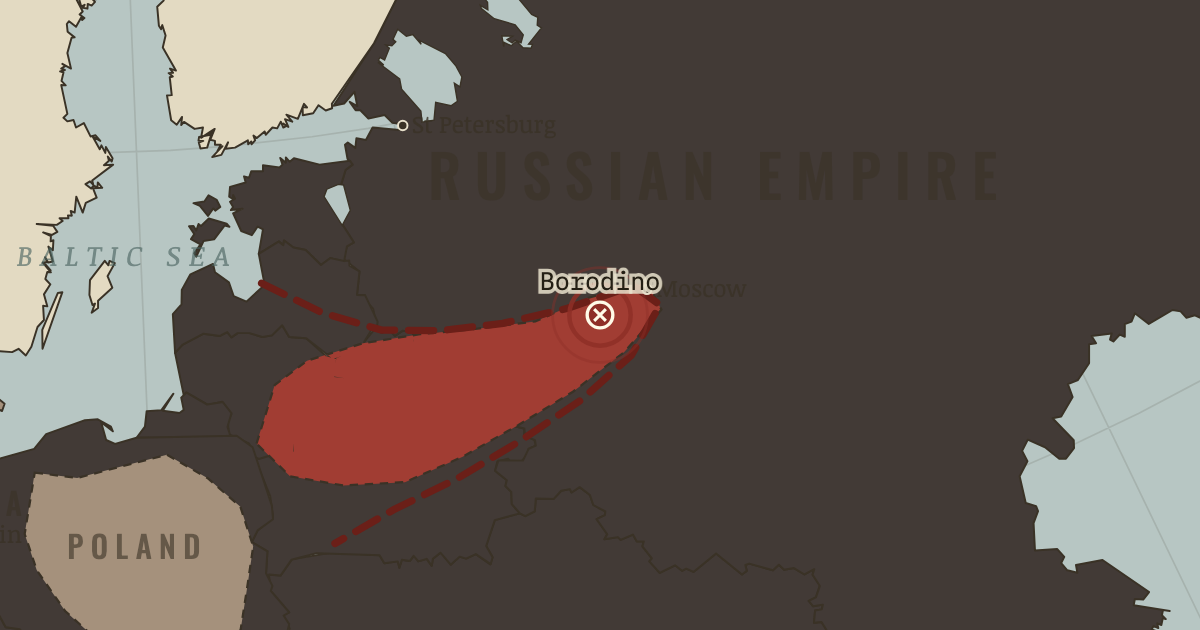
7 Sep 1812 — Some 250,000 men fought at Borodino, and more than 70,000 became casualties. It was the bloodiest single day of war until 1916. Napoleon held the field, but the Russian army survived; holding the field had not destroyed his opponent.
WW2 is free in full, and chapter 1 of every atlas is free. A free account opens 3 more chapters a day. Starter, at $9 a month, opens all 21 with no daily limit — see the plans.
7 SEPTEMBER 1812 · THE AGE OF REVOLUTIONS, 1775–1848
The moment in context
Napoleon crossed the Niemen on 24 June 1812 with a plan for a short war. Around 600,000 men took part in the campaign, many supplied by allied or subject states. A battle near the frontier would allow him to defeat the Russian armies before distance and supply became overwhelming, then seek peace. But the Russians withdrew. Whether this was deliberate or resulted from the difficulties of divided command, the effect was the same: Napoleon had to march east to reach them. His supply lines lengthened, forage grew scarcer, and typhus, dysentery, heat and desertion took large numbers before the first major battle.
Why it happened — Logistics against arithmetic. Napoleon's familiar way of war joined rapid movement, local forage and a decisive battle. In the comparatively rich, densely settled regions of…
The turn — Moscow, September–October 1812. Moscow was supposed to give Napoleon leverage over Alexander. Occupying an enemy capital had helped secure settlements in earlier wars, and he hoped…
What it changed — The spell breaks in public. France learned of the disaster through the 29th Bulletin, which nevertheless assured readers that the Emperor's health “has never been better”.…
Then ask the room: Napoleon had studied Charles XII’s 1709 disaster in Russia. Why did knowledge of that precedent not save him? The argued answer is on the chapter page →