MAPS OF HISTORY · WWI · ALL CHAPTERS · CHAPTER 11
CHAPTER 11 · NOVEMBER 1918 · NOV 1918
Armistice
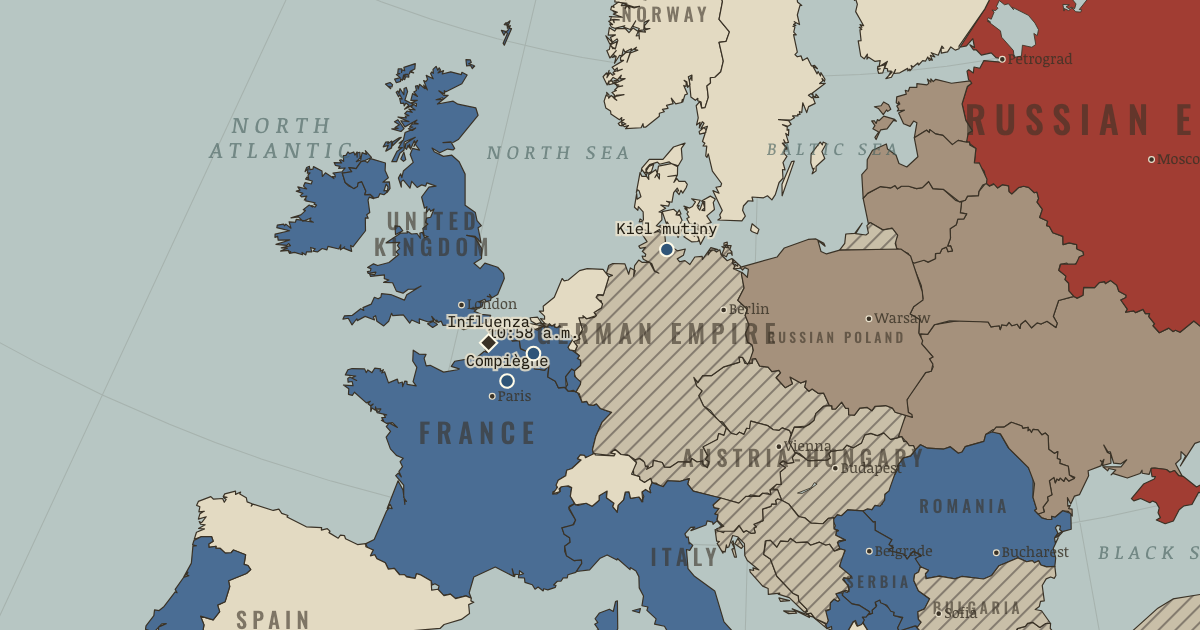
The map above is the world of NOV 1918 — Armistice.
BRIEF EXPLANATION — THE ESSENTIAL ARGUMENT
Germany did not simply lose on the battlefield in November 1918, because its military position, its economy and its political order all failed together and dragged one another down. The immediate collapse began at sea, where sailors refused an order to sail on a final, hopeless attack against the British fleet, and their mutiny spread rapidly into a general revolution. The Kaiser abdicated as workers’ and soldiers’ councils took control of the cities. Civilian delegates then signed an armistice at Compiègne, while the generals who had actually demanded the negotiations arranged for others to bear the blame for defeat.
The fighting stopped at eleven in the morning on 11 November, though men went on dying until the very last minutes. By then four empires, the German, Austro-Hungarian, Russian and Ottoman, had all collapsed. As the armies dispersed, an influenza pandemic moved along the crowded camps, troopships and demobilization routes and killed tens of millions of people around the world. The armistice ended organized battle, but it left entirely unresolved the far harder question of how each society would explain the war to itself.
GUIDED EXPLANATION
The leaders of the German fleet ordered a final sortie in late October, and the sailors at Kiel refused to die in a battle that could no longer change the war. Their mutiny spread into revolution as workers’ and soldiers’ councils appeared across Germany, and the Kaiser abdicated on 9 November. A republic was proclaimed almost in passing.
Civilian delegates signed the armistice at Compiègne early on 11 November, yet the fighting continued until eleven o’clock and men died in its final minutes. The map also shows four imperial systems collapsing at once. Influenza moved through the camps, ships and demobilization routes and killed at least fifty million people worldwide, with estimates for India alone reaching twelve to eighteen million. The pandemic was not caused by the war, but wartime crowding, hunger and constant movement sped its spread across the globe.
Germany’s defeat brought front, home and regime down together. Its armies still stood outside much of German territory, yet they were retreating, surrendering in larger numbers and losing their allies. Hunger and unrest at home grew out of the blockade and years of sacrifice, and the sailors rebelled because the war was visibly lost rather than because they had betrayed an army still winning it. Ludendorff had demanded negotiations in September, then left civilians to sign the actual instrument. The armistice evacuated occupied land, surrendered weapons and kept the blockade in place, which made a renewal of the war nearly impossible. It spared the casualties of an invasion, but German civilians never saw Allied armies occupy Berlin. That gap between the military reality and the public experience later fed the false stab-in-the-back claim that republicans, socialists and Jews had betrayed an unbeaten army.
DEEP EXPLANATION — EVIDENCE & INTERPRETATION
Defeat as the failure of a whole system
The later claim that Germany was undefeated in the field depends on separating failures that were in fact bound tightly together. Its armies still stood on foreign soil, yet they were retreating, their surrender rates had climbed, their reserves were spent, their allies had left the war, and their commanders no longer believed the front could hold for long. The hunger and unrest at home did not stab a victorious army in the back, because they had grown steadily out of the blockade, the endless casualties and the visible loss of any military option. The naval mutiny hastened the revolution precisely because the sailors understood that the proposed sortie could change nothing. Front, economy and regime formed a single feedback loop, in which battlefield retreat weakened political authority, domestic collapse cut away military support, and each made further resistance less credible. Treating either the front or the home front as the sole cause produces a political myth rather than a genuine explanation.
The armistice and the problem of legitimacy
The Allies accepted an armistice rather than fighting on because its terms stripped Germany of the ability to resume the war without demanding another costly campaign to enforce them. Germany surrendered its weapons, evacuated the occupied territories and accepted the occupation of the Rhineland while the blockade continued in force, so that in military terms the armistice achieved most of what a formal surrender would have. Politically, however, it left a dangerous ambiguity, because Allied armies had not entered Berlin and German commanders had arranged for civilians to sign. Nationalists later exploited the distance between this material defeat and the public’s experience of it. Fighting on might have made the defeat more visible, yet the commanders expected heavy casualties, influenza was spreading through every army, and the Allied populations were themselves exhausted. The choice therefore weighed a certain and immediate human cost against an uncertain future gain in legitimacy, and hindsight reveals the danger of the myth without making an invasion of Germany in 1919 obviously proportionate or feasible.
New here? Chapters 1–2 of every atlas are free to sample, and the WW2 atlas is free in full. One membership opens all thirteen — the Cartographer’s Circle.
THE SITES
ON THIS DAY
WHY IT HAPPENED
Collapse from the rear, forced from the front. Hold both truths against the myths: the German army was beaten in the field — retreating, surrendering in mass, its allies gone, its front weeks from rupture — and the final push came from home: mutiny, hunger, revolution. The sailors rebelled because the war was visibly lost, not the reverse. Any account that keeps only one half becomes a lie with a politics: “undefeated in the field” fed the stab-in-the-back; “mere internal collapse” flatters the blockade into a bloodless win. Defeat was a system failure — front, economy and regime failing together, each accelerating the others.
Why an armistice, not a surrender. Ludendorff demanded an armistice in September to save the army; the Allies granted one in November partly from their own exhaustion, partly because Wilson would negotiate with a German democracy — so Germany hastily became one. But the terms (fleet interned, Rhineland occupied, guns surrendered, blockade continued) made resumption impossible: an armistice in name, capitulation in content — signed without Allied boots on German soil. That final detail, meant to spare lives, would cost the peace dearly: Germans never saw the instrument of their defeat.
The pandemic’s war logistics. Influenza was not caused by the war, but the war chose its scale and victims: million-man camps and troopships were ideal amplifiers, wartime censorship suppressed warnings (neutral Spain reported honestly — hence “Spanish” flu), malnourished populations had no reserves, and empire carried it up every rail line and river on this world map. The twentieth century’s deadliest single event is a footnote in most war histories. It should not be: total war remade disease ecology, and public health has planned against this precedent ever since.
THE TURN
The eleventh hour, 11 November 1918. Matthias Erzberger, Catholic politician, signs for Germany — because the generals arranged for civilians to own the defeat; he will be assassinated for it by nationalists in 1921. The carriage itself becomes an argument: Hitler stages France’s 1940 surrender in it, then has it destroyed. Even the war’s full stop was loaded — the armistice ended the fighting and, in the same gesture, began the fight over what the fighting had meant.
WHAT IT CHANGED
Four empires, one map of hatching. Scrub to 1919 and watch the successor world assemble: republics in Vienna and Berlin, Soviet power in the red east, new states from Helsinki to Belgrade — and civil wars, border wars and pogroms across the whole span, because empires do not end cleanly. The “postwar” in Eastern Europe is a euphemism: fighting continues somewhere on this map every month until 1923.
Demobilization into turmoil. Sixty-five million men go home — to influenza, unemployment, and politics learned in trenches. Veterans’ leagues and freikorps make street violence a governing style in half of Europe; two Austrian-born corporals of this war, and one Italian editor invalided out, will build careers on the demobilized. The war’s emotional demobilization never quite happened; the interwar era is its symptom.
Remembrance is invented. The scale of unburied, unlocatable death — half of Britain’s dead have no known grave — creates new civic forms: the Unknown Soldier (1920), the two-minute silence, the poppy, the Menin Gate’s 54,000 names. For the first time, states memorialize every common soldier by name. The Tombs of the Unknown are this war’s most universal legacy — visit any capital on this map and you will find one.
FIELD QUESTION — Should the Allies have fought on to Berlin in 1919 instead of granting an armistice?
The case for continuing (made at the time by Pershing, later by many Germans’ enemies): occupation would have made defeat undeniable, forestalling the stab-in-the-back myth and perhaps the next war. The case against is what commanders saw in November 1918: another year of casualties (projected in the hundreds of thousands) against a still-cohesive retreating army, war-weary home fronts, influenza burning through every unit, revolution spreading — to achieve terms the armistice already secured in substance. Foch judged the armistice “the conditions of victory without the losses of storming Germany,” and most historians find that defensible on 1918’s information. The harder retrospective truth: legitimacy is also a war aim. The Allies won the war materially and lost the narrative inside Germany within five years — a warning that how a war ends politically can matter as much as that it ends. Weigh it against a million more graves, and notice the question has no comfortable answer.
AN INTERESTING FACT
America celebrated the armistice four days early. On 7 November a garbled United Press cable from Brest declared the war over, and within hours ticker tape was falling on New York and factories stood empty — a “false armistice” whose celebrations, by some accounts, outdid the real day’s. The real morning had a grimmer American epilogue: some commanders attacked until the final minutes — Henry Gunther of Baltimore, killed at 10:59, is generally reckoned the war’s last combat death — and in 1919–20 a Congressional subcommittee investigated why lives had been spent on ground the armistice was hours from handing over. No one was censured.
THE DISPATCH
One short letter when a new atlas opens — and the printable study guide for WWI is yours now, free.
NO TRACKING · YOUR ADDRESS IS USED FOR THE DISPATCH AND NOTHING ELSE · UNSUBSCRIBE ANYTIME