ON THIS DAY ·
Armistice ends the First World War
At the eleventh hour of the eleventh day of the eleventh month, the guns of the First World War fall silent.
WW2 is free in full, and chapter 1 of every atlas is free. A free account opens 3 more chapters a day. Starter, at $9 a month, opens all 21 with no daily limit — see the plans.
The moment in context
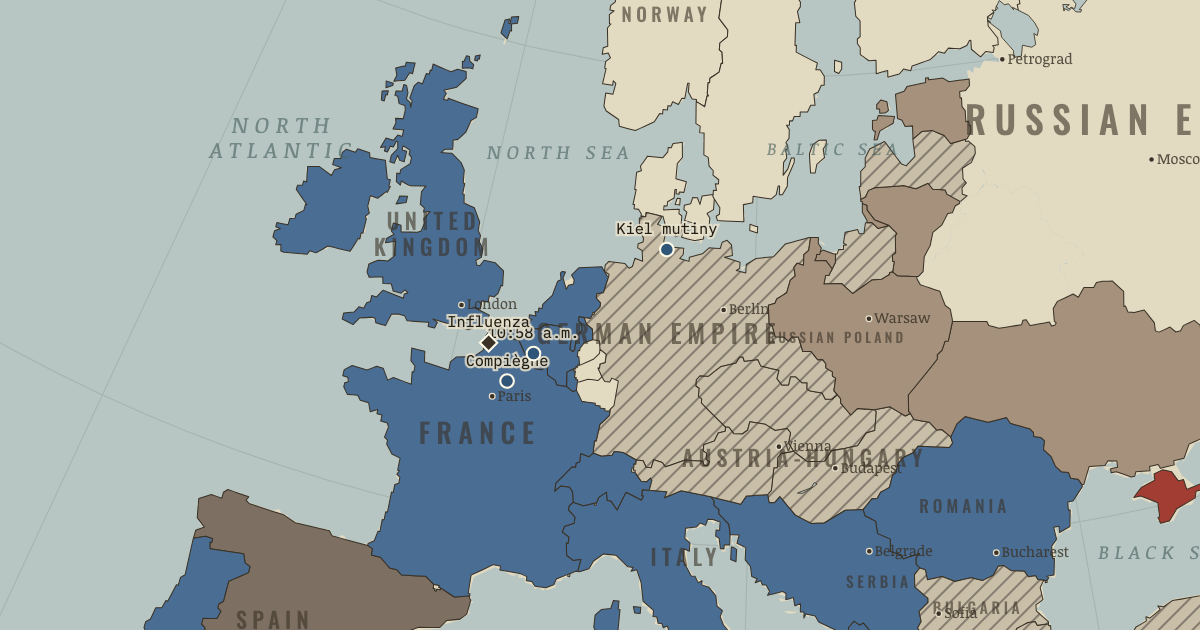
The German fleet’s leaders ordered a last sortie in late October 1918. For the sailors at Kiel, the prospect was clear: they were being asked to risk their lives against the British fleet when a victory at sea could no longer change the outcome of the war. They refused. Their mutiny became a revolution, as workers’ and soldiers’ councils appeared across Germany. On 9 November the Kaiser abdicated, and a republic was proclaimed almost in passing.
From Armistice and the end of WWI, chapter 13 of The Great War, 1871–1923 (NOV 1918).
Teach this in 5 minutes
- Why it happened — Collapse from the rear, forced from the front. The military and domestic crises reinforced each other. Germany’s army was retreating, surrendering in mass, losing its allies and facing a front…
- The turn — The eleventh hour, 11 November 1918. At Compiègne, Catholic politician Matthias Erzberger signs for Germany. The generals have arranged for civilians to take responsibility for defeat;…
- What it changed — Four empires, one map of hatching. Scrub to 1919 to see what replaces the empires: republics in Vienna and Berlin, Soviet power in the red east, and new states from Helsinki to…
Then ask the room: Should the Allies have fought on to Berlin in 1919 instead of granting an armistice? The argued answer is on the chapter page →
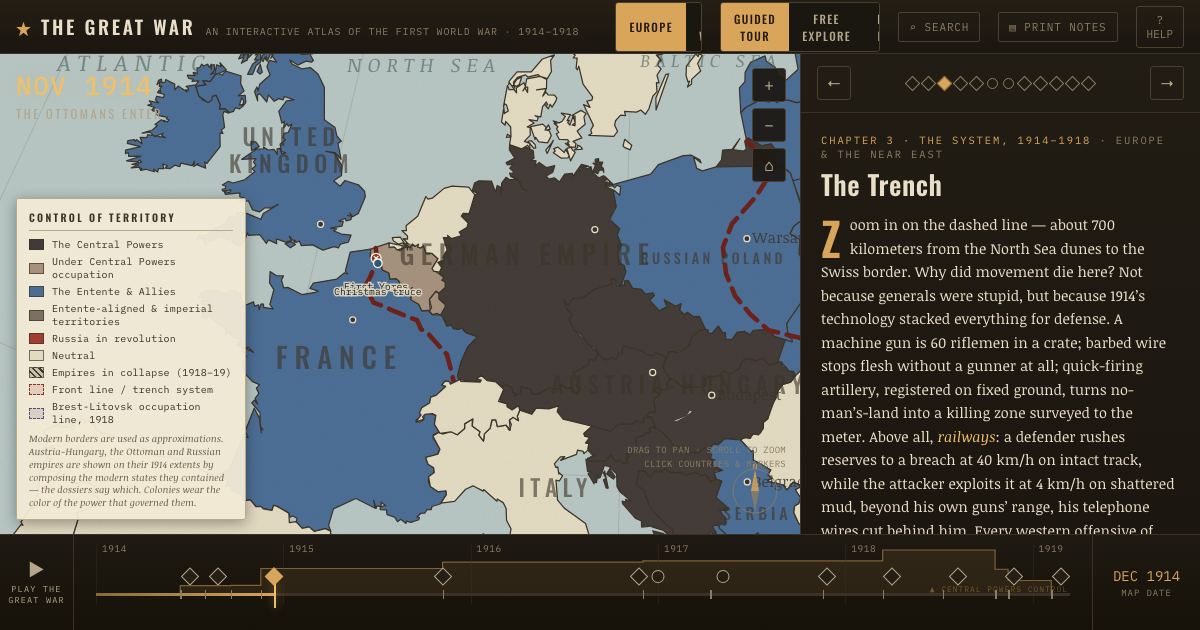
The atlas that shows it
THE FREE PRINTABLE STUDY GUIDE
Get the printable study guide for WWI free. I’ll send you a few short letters, then one when a new atlas opens. That’s all. — Paul
NO TRACKING · YOUR ADDRESS IS USED FOR THE DISPATCH AND NOTHING ELSE · UNSUBSCRIBE ANYTIME