Norse and Aztecs · CHAPTER 4 ·
Vikings in Greenland and Vinland
Chapter 4 of Climate and Innovation: The Norse and the Aztecs, c. 790–1521: “Greenland and Vinland”
In 985 or 986 Erik the Red led 25 ships west from Iceland and 14 arrived, founding Greenland’s Eastern and Western Settlements on fjord meadows the warm centuries had made green. The colony paid for its imports by hunting walrus for ivory, and Norse voyagers worked wood at L’Anse aux Meadows in Newfoundland in 1021.
Chapter 4 is included with every paid plan. WW2 is free in full, and chapter 1 of every atlas is free. A free account opens 3 more chapters a day. Starter, at $9 a month, opens all 21 with no daily limit — see the plans.
Free printable Norse and Aztecs study guide, sent by email ↓
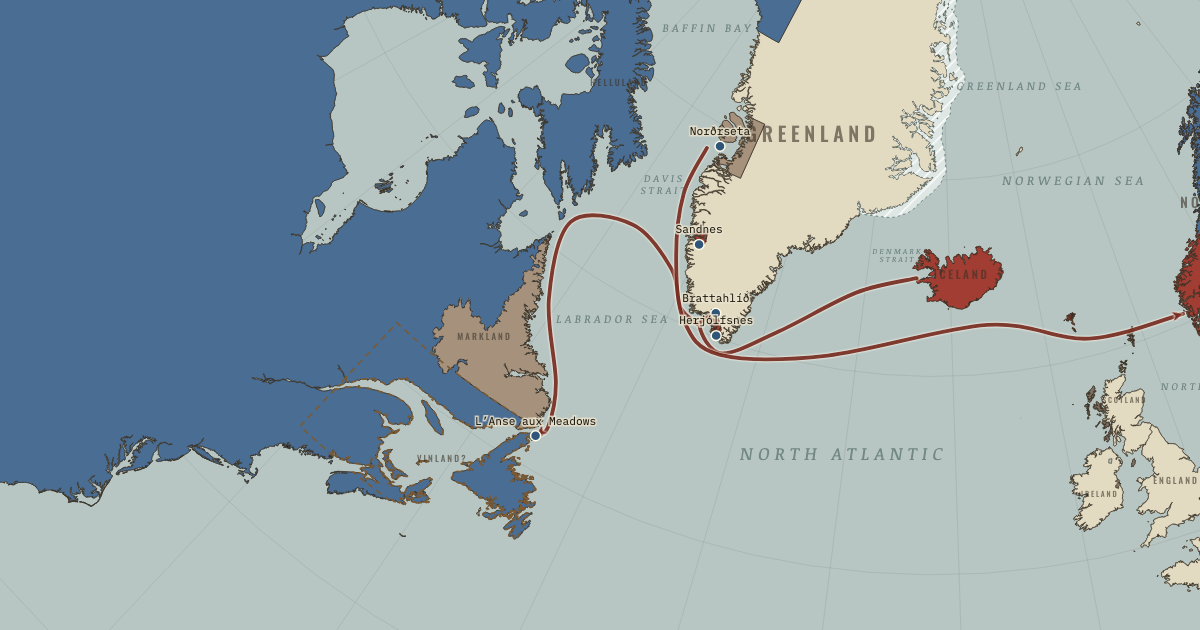
The map above is the world of The Norse North Atlantic, 1021 — Vinland: wood felled at L’Anse aux Meadows.
Part of IB History: The Norse and the Aztecs →
SHORT EXPLANATION
In 985 or 986 Erik the Red led 25 ships from Iceland to Greenland; 14 arrived. Their passengers established the Eastern Settlement near the southern tip and a smaller Western Settlement about 400 kilometers northwest. In sheltered fjords, warm summers grew grass that could be cut as hay for cattle, sheep and goats. The farms could not provide everything the settlers needed. To obtain iron, timber and grain, Greenlanders hunted walrus far to the north and sold tusks prized in Europe like elephant ivory. The map colors the settlements red and the hunting grounds of Norðrseta tan. The colony depended on farms, hunts and trade together.
Greenland became a starting point for voyages to North America around 1000. The sagas name Helluland, Markland and Vinland—flat-stone land, forest land and wine land. Excavated buildings at L’Anse aux Meadows in Newfoundland establish a Norse base, and a cosmic-radiation signal in tree rings dates metal-cut timber there to 1021. The occupation was brief. Greenland’s small population, the long journey and resistance from Indigenous people already living there help explain why reaching the continent did not lead to a lasting settlement. A tan point and dashed outline mark the far edge of the expansion.
The full story
To keep cattle in Greenland, a farmer first needed enough grass to get them through winter. Animals spent about eight months in byres, stone-and-turf sheds, eating stored fodder; the hay harvest therefore limited the herd and a farm’s wealth. Settlers chose the inner fjords, where summers were warmer and grass grew better than on the foggy outer coast. They built about 500 farms in the Eastern Settlement and perhaps 75–100 in the Western. Erik’s Brattahlíð occupied fine land at the head of a fjord, putting some of the best meadows in the hands of the leading household. At its peak around 1200 the colony probably had 2,000–2,500 inhabitants, although older estimates reached 5,000.
Hay supported the livestock, but it could not provide the iron, timber, grain and church goods Greenlanders imported. Walrus hunting supplied something to exchange for them. Each summer men rowed and sailed roughly 800 kilometers north to Norðrseta around Disko Bay, returning with tusks, hides for rope and sometimes polar-bear skins. Ancient DNA studied by Bastiaan Star and James Barrett indicates that by the twelfth century almost all walrus ivory reaching Europe came from Greenland. European craftspeople made chess pieces, crosses and book covers from it. The colony had a place in a luxury market far beyond its fjords, and its prosperity partly rested on the demand of distant buyers.
The voyages west carried Greenlanders farther still. The sagas describe Leif Eriksson finding grass, salmon and mild winters; later expeditions traded and fought with people they called Skrælings, a dismissive Norse term for Indigenous inhabitants, probably ancestors of the Innu or Beothuk of Labrador and Newfoundland. In 1960 Helge and Anne Stine Ingstad found L’Anse aux Meadows, with eight buildings that could have held perhaps 70–90 people. Butternuts found there grow no closer than New Brunswick, evidence that the Norse traveled at least into the Gulf of St Lawrence.
The date of one visit comes from the wood itself. In 2021 Margot Kuitems and colleagues identified a cosmic-radiation signal from 993 in three metal-cut pieces and counted 29 rings from that signal to the bark. The trees were felled in 1021. This fixes a year of Norse activity, though not the first arrival. The base lasted only a few years: Greenlanders could reach America, but keeping a community there posed a different problem.
FULL EXPLANATION
Saga and spade: what each can prove
Two Icelandic narratives, The Saga of the Greenlanders and Erik the Red’s Saga, describe the voyages but disagree about who first sighted America, who led particular expeditions and where people wintered. Written in the thirteenth century, they were treated as legend by many nineteenth-century scholars. The ground at L’Anse aux Meadows supplied a different kind of evidence. In 1960 George Decker guided Helge and Anne Stine Ingstad to grassy mounds there. Excavations in 1961–68 and by Parks Canada in 1973–76 uncovered Norse-style halls, iron rivets, a smithy and a bronze cloak pin. Birgitta Wallace regards the site as a gateway for repairing ships and staging voyages south, possibly the saga’s Straumfjörður. These finds establish a Norse presence without identifying everyone in the stories. The sagas supply names, motives and encounters an excavation cannot recover, although they remain later narratives that must be interpreted.
How a solar storm dated a Norse axe-cut
A natural event left a marker from which researchers could count the years to a tree’s felling. In 2012 Fusa Miyake’s team found a sharp radiocarbon spike in the ring formed in 775; a second was later identified in the ring for 993. Intense cosmic radiation, probably from the sun, produced the markers in trees alive at those times. At L’Anse aux Meadows, Margot Kuitems’s team found the 993 signal in wood from three different trees. Each piece had been cut with a metal blade and retained a bark edge, 29 annual rings beyond the signal. All three trees were felled in 1021. That establishes Norse activity in a precise year; it does not date the first arrival, which the sagas place around 1000.
Why the Norse did not stay in America
A voyage to L’Anse aux Meadows from the Eastern Settlement covered roughly 1,800 kilometers by sea, taking weeks in open boats. Greenland itself had perhaps 2,000 people, leaving few to establish and defend a community at the end of that route. The sagas describe trading furs for red cloth and milk, then attacks by the people the Norse called Skrælings. Birgitta Wallace observes that the Norse had few iron weapons and no decisive advantage over Indigenous archers fighting on familiar ground. Some scholars add that grassland and walrus, resources Greenland needed, were available nearer home. These explanations need not exclude one another: distance made supply difficult, while small numbers made resistance harder to withstand. Historians give the pressures different weight, and departure alone does not tell us which decided the outcome. Distance and population would matter to Greenland itself later.
Key places on the map
Why it happened
Warm summers greened the southern fjords. Hay depended on the summer growing season. Midge remains from Scoop Lake near the Eastern Settlement indicate that summers during the Medieval Climate Anomaly, approximately 900–1400, were about 1.5 °C warmer than in colder centuries before and after. In sheltered fjords grass could grow for the hay cattle needed through winter. Erik could see the grass, even if he could not describe the climatic window in modern terms.
Iceland was already full and divided. By the 980s Iceland’s best land had been claimed for two or three generations, leaving younger sons and newcomers fewer opportunities. Feuds could also drive people away: Erik was outlawed for killings in Norway and Iceland. Greenland offered grassland and another start. Perhaps several hundred settlers and their animals embarked in 25 ships in 985 or 986; 14 ships arrived.
A name chosen to attract settlers. A colony needed families willing to make the journey. According to Erik the Red’s Saga, Erik called the land Greenland because an attractive name would encourage people to go, rather as a developer might promote a new town. He kept choice meadows at Brattahlíð for his own farm. The saga’s account was written down more than two centuries later.
European demand for walrus ivory. European craftspeople valued walrus ivory for religious objects and games, particularly when African elephant ivory was scarce. The tusks Greenlanders obtained at Norðrseta could be exchanged for goods their farms could not produce. Ancient DNA indicates that by the twelfth century Greenland supplied almost all the walrus ivory reaching Europe. Demand abroad gave the colony an income beyond subsistence.
THE TURNING POINT
L’Anse aux Meadows, 1021. Wood cut in 1021 at L’Anse aux Meadows places Norse people in Newfoundland five centuries before Columbus, in a region already inhabited by Indigenous Americans. Their ships and seamanship had brought them to another continent. The base’s short occupation poses a further question: could Greenland’s small community supply a settlement so far away, among people whose response mattered? Making the crossing demonstrated reach; sustaining a settlement required more.
What it changed
A colony locked into hay and ivory. After Vinland, Greenlanders continued to raise cattle and sheep on fjord meadows, eat seals and caribou, and hunt northern walrus for export. This combination worked for about three centuries, but it relied on hay and European demand for ivory. Chapter 5 follows the environmental and economic pressures affecting both after 1250.
Timber trips to Markland continue. The end of the Vinland base did not end voyages to North America. An Icelandic annal records a Greenland ship with 17 or 18 men that had visited Markland and was driven by storms to Iceland in 1347. Markland is generally associated with forested Labrador, a possible source of timber scarce in Greenland. This voyage shows continued contact more than three centuries after the L’Anse aux Meadows timber was cut, though a timber trip was different from a permanent settlement.
Greenland enters the Church and the crown. A bishop took office at Garðar in 1126, and Greenlanders built about fourteen to seventeen churches. In 1261 the colony accepted the Norwegian king’s authority. Connections to Church and crown brought priests, ships and goods, but also made Greenland dependent on decisions in Bergen and Trondheim. Chapter 6 examines those ties.
DISCUSSION QUESTION — Does the abandonment of Vinland show the limits of Norse innovation or the limits of Norse numbers?
The evidence points more strongly to the resources of the society than to a failure of its ships. Norse crews crossed to Newfoundland, repaired vessels and built accommodation for perhaps 70–90 people at L’Anse aux Meadows. Keeping a distant colony supplied and defended was another undertaking. Greenland may have had only 2,000–2,500 inhabitants, and a long voyage separated it from the base. The sagas describe conflict with Indigenous people who were numerous, organized and fighting on their own ground; Norse weapons gave no decisive advantage. Distance made reinforcement and supply harder, while a larger population might have absorbed losses and long voyages more readily. Historians weigh conflict and logistics differently, and the evidence cannot establish that numbers alone decided the outcome. The ships carried this society farther than its resources could readily sustain a community.
An interesting fact
The Saga of the Greenlanders presents Snorri, born in Vinland around 1010 to Gudrid Thorbjarnardóttir and Thorfinn Karlsefni, as the first child of European parents born in the Americas. His family returned to farm in northern Iceland. The saga says Gudrid was later widowed, traveled on pilgrimage to Rome and became a nun; it counts several Icelandic bishops among her descendants. In the saga tradition her journeys took her through Iceland, Greenland, Vinland, Norway and Rome, making her one of her century’s most widely traveled people.
Related
THE FREE PRINTABLE STUDY GUIDE
Get the printable study guide for Climate and Innovation free. I’ll send you a few short letters, then one when a new atlas opens. That’s all. — Paul
NO TRACKING · YOUR ADDRESS IS USED FOR THE DISPATCH AND NOTHING ELSE · UNSUBSCRIBE ANYTIME