MAPS OF HISTORY · The Decolonization of Africa · ALL CHAPTERS · CHAPTER 6
CHAPTER 6 · 1960–1965 · JUL 1962
The Congo Crisis
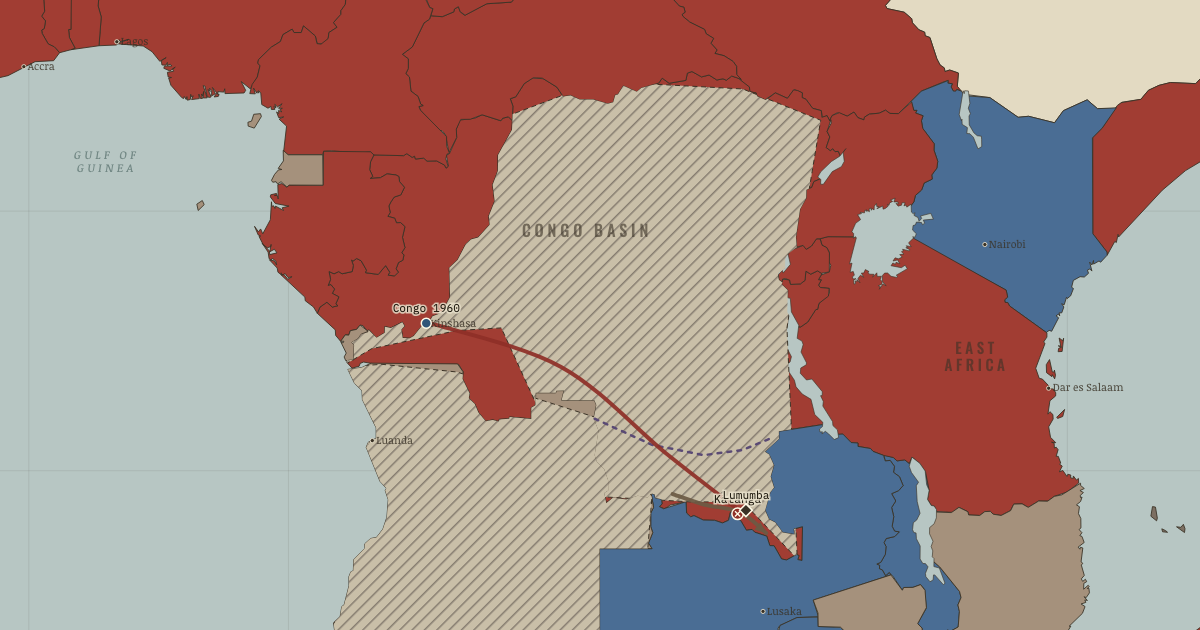
The map above is the world of JUL 1962 — Algeria, Rwanda, Burundi, Uganda.
BRIEF EXPLANATION — THE ESSENTIAL ARGUMENT
The Congo showed the darkest possibility of independence, and it did so within days of the flag being raised. Belgium had ruled its enormous central African colony with a paternalism that deliberately restricted African education and advancement, so that at independence on 30 June 1960 there were only a handful of Congolese university graduates and not a single African army officer or senior administrator. Almost immediately the colonial army mutinied against its Belgian officers, Belgium sent troops back in, and the copper-rich province of Katanga declared secession with the backing of Belgian mining money, Belgian officers and white mercenaries. The new state came apart before it had begun to function.
The crisis became the first great collision between decolonization and the Cold War, and Africa lost. Patrice Lumumba, the elected prime minister, appealed to the United Nations, which sent its largest peacekeeping force yet but refused to crush the secession; when he then turned to the Soviet Union for help, Washington and Brussels recast him as a communist threat rather than a nationalist seeking leverage. He was removed and murdered in January 1961, with Belgian responsibility and CIA complicity, in what became a founding crime of the postcolonial age. The United Nations eventually ended Katanga’s secession, but the wreckage passed to Colonel Mobutu, who seized power in 1965 and looted the country for the next thirty-two years.
GUIDED EXPLANATION
Independence on 30 June 1960 transferred sovereignty without transferring a working state, because Belgium had built none for Congolese hands. The Force Publique, the colonial army, mutinied against the Belgian officers who still commanded it, and Belgium used the disorder as grounds to send its troops back. On 11 July Moïse Tshombe declared Katanga independent, supported by the mining conglomerate Union Minière, by Belgian officers, and by hired white mercenaries. Since Katanga held the copper, cobalt and uranium that made the Congo wealthy, the secession stripped the new nation of most of its revenue at the moment it could least afford the loss.
The United Nations sent a large peacekeeping force but at first refused to fight Katanga, which left Lumumba with the appeal that destroyed him. When he requested Soviet transport to move his own troops, Washington and Brussels chose to read the request as proof of communist alignment rather than as the improvisation of an elected leader denied other help. His removal and killing in January 1961 remain a foundational crime in postcolonial memory. The United Nations later did end the secession by force, yet state weakness and foreign intervention continued, and out of the chaos the West helped install Mobutu, sustaining him for decades as an anti-communist strongman while he turned the country into a personal kleptocracy.
Belgium’s policy had been to suppress African political life and education entirely, betting that a contented, uneducated populace would never demand self-rule. When Brussels panicked and granted independence in a rush in 1960, it handed over a state with no trained administrators, officers or politicians and a mutiny-prone colonial army still under Belgian command. The Congo’s collapse was manufactured by the specific way it had been ruled. The extreme case of the whole continent’s under-preparation.
The elected premier’s removal and killing, with Western hands on it, martyred him across the Third World and taught a generation of African leaders a bitter lesson about the limits of their sovereignty. His name became shorthand for the ways decolonization was strangled where it threatened Cold War or corporate interests. This is memory, not a scorecard. But it is central to how Africa remembers 1960.
DEEP EXPLANATION — EVIDENCE & INTERPRETATION
Misrule, Intervention, and Division — in Order of Weight
Several causes drove the Congo catastrophe, but they did not carry equal weight, and distinguishing them is the whole point. The precondition was Belgian policy, which had restricted Congolese higher education, blocked promotion to officer rank, and suppressed national political organization, so that sudden independence exposed a gap that had been deliberately created. Regional tensions were real, yet Katanga’s ability to secede depended overwhelmingly on mining revenue, Belgian expertise and outside military support rather than on local sentiment alone. Cold War intervention then intensified everything the moment Lumumba’s request for Soviet help was treated as evidence of communist alignment. This ordering matters because an older colonial account blamed Congolese incapacity while ignoring how that incapacity had been manufactured and then exploited. It also guards against the opposite error of denying Congolese agency, since Lumumba, Kasavubu, Tshombe and Mobutu all made real choices under extreme constraint. A strong explanation separates the precondition, the accelerants and the actors instead of collapsing the disaster into any single cause.
The Impossible Line Between Keeping Peace and Making War
The United Nations force, known as ONUC, entered a country where no stable peace actually existed, and its mandate asked it to remove Belgian forces and preserve Congolese territorial integrity without becoming the central government’s private army. That distinction proved almost impossible to hold. Refusing at first to attack Katanga frustrated Lumumba and helped push him toward Moscow, while later UN operations used force to end the secession, so the mission drifted from neutral presence toward outright enforcement. Secretary-General Dag Hammarskjöld died in a 1961 plane crash on his way to seek a settlement, in circumstances still disputed and reinvestigated. The Congo thus established the recurring dilemmas of peacekeeping, that consent can be fragmentary, that neutrality can quietly favour the stronger party, and that defending sovereignty may require coercion that destroys the appearance of impartiality. None of these abstractions should displace the human record, which is Lumumba’s murder, widespread civilian suffering, and the long political damage caused by a crisis that international actors helped to deepen.
New here? Chapters 1–2 of every atlas are free to sample, and the WW2 atlas is free in full. One membership opens all thirteen — the Cartographer’s Circle.
THE SITES
ON THIS DAY
WHY IT HAPPENED
A colony deliberately left unprepared. Belgium’s policy had been to suppress African political life and education entirely, betting that a contented, uneducated populace would never demand self-rule. When Brussels panicked and granted independence in a rush in 1960, it handed over a state with no trained administrators, officers or politicians and a mutiny-prone colonial army still under Belgian command. The Congo’s collapse was manufactured by the specific way it had been ruled. The extreme case of the whole continent’s under-preparation.
Katanga: secession to protect a mine. Katanga held the copper, cobalt and uranium that made the Congo rich, and the Belgian conglomerate Union Minière preferred a compliant breakaway state to a nationalist central government that might control its wealth. Tshombe’s secession, armed and financed from Brussels and backed by white mercenaries, was less a nation than a corporate-colonial enclave. Naming the interests. A mining company, not a people. Is essential to understanding it.
The Cold War descends. When the UN would not reconquer Katanga for him, Lumumba asked Moscow for help. And instantly became, in Western eyes, a Soviet asset to be removed. Decolonization ran head-on into superpower paranoia: a nationalist seeking any ally became a proxy in a global struggle, and his country’s fate was decided in Washington, Brussels and Moscow as much as in Léopoldville. This subordination of African self-determination to the Cold War recurs across the atlas.
The UN’s impossible mandate. The 20,000-strong ONUC force was sent to keep a peace that did not exist, forbidden at first to take sides or end the secession, caught between a premier it could not save and a breakaway it would not initially fight. Hammarskjöld died pursuing a settlement. It was the UN’s first war and a bruising lesson in the limits of peacekeeping. One that shadowed the organization for decades, and arguably still does.
THE TURN
Katanga secedes, 11 July 1960. Eleven days after independence, Tshombe declares the mineral-rich south a separate state, with Belgian officers, Union Minière money and white mercenaries. The secession guts the new nation of its wealth, invites in foreign intervention, drives Lumumba toward Moscow and thus toward his death, and turns a fragile independence into a four-year war. It is the moment the Congo’s independence becomes the Congo crisis. And the clearest illustration on this map of how colonial economic interests, dressed as self-determination, could tear a new state apart from within.
WHAT IT CHANGED
The murder of Lumumba. The elected premier’s removal and killing, with Western hands on it, martyred him across the Third World and taught a generation of African leaders a bitter lesson about the limits of their sovereignty. His name became shorthand for the ways decolonization was strangled where it threatened Cold War or corporate interests. This is memory, not a scorecard. But it is central to how Africa remembers 1960.
Mobutu’s long shadow. Out of the chaos the West helped install and then sustained Joseph Mobutu, who renamed the country Zaïre and ran it as a personal kleptocracy for thirty-two years, tolerated as an anti-communist bulwark. The crisis thus produced not a functioning state but a durable dictatorship. A pattern (the “friendly strongman” backed against instability) repeated across Cold War Africa.
The cautionary tale. The Congo terrified every actor: African leaders saw how fast a state could dissolve and used it to justify strong central rule and one-party control. The UN learned the perils of peacekeeping. The OAU, founded three years later, made the inviolability of borders and non-interference near-sacred largely to prevent another Katanga. Much of the next chapter’s conservatism is the Congo’s legacy.
FIELD QUESTION — Was the Congo catastrophe caused mainly by Belgian misrule, by Cold War intervention, or by the Congo’s own divisions — and why does it matter which?
All three interacted, but they are not equal. The precondition was Belgian misrule: a colony stripped of educated Congolese, trained officers and any political preparation was structurally incapable of surviving the shock of sudden independence. This made collapse likely. The accelerant was foreign intervention driven by economic and Cold War interests: Union Minière’s money behind Katanga’s secession, and the American-Belgian decision to remove and permit the murder of the elected premier, turned a crisis into a catastrophe and imposed thirty years of Mobutu. The Congo’s internal divisions were real but were largely produced and then weaponized by the first two factors. It matters which because the lazy reading. “Africans could not govern themselves”. Inverts the causation: the Congo did not fail because it was independent, it failed because of how it had been ruled and how its independence was then subverted from outside. Getting the causation right is the difference between blaming the victim and understanding the crime.
AN INTERESTING FACT
From captivity Lumumba wrote a last letter to his wife Pauline: “history will one day have its say… it will not be the history that is taught in Brussels, Paris, Washington or the United Nations… Africa will write its own history.” Smuggled out and published after his murder, the letter became one of the founding texts of postcolonial memory. And in June 2022 — after his daughter Juliana petitioned the Belgian king — Belgium returned to his children the only remains that survive, a single tooth, in a state ceremony sixty-one years late.
THE DISPATCH
One short letter when a new atlas opens — and the printable study guide for The Decolonization of Africa is yours now, free.
NO TRACKING · YOUR ADDRESS IS USED FOR THE DISPATCH AND NOTHING ELSE · UNSUBSCRIBE ANYTIME