MAPS OF HISTORY · The Decolonization of Africa · ALL CHAPTERS · CHAPTER 7
CHAPTER 7 · 1963–1979 · JAN 1967
Building States from Colonies
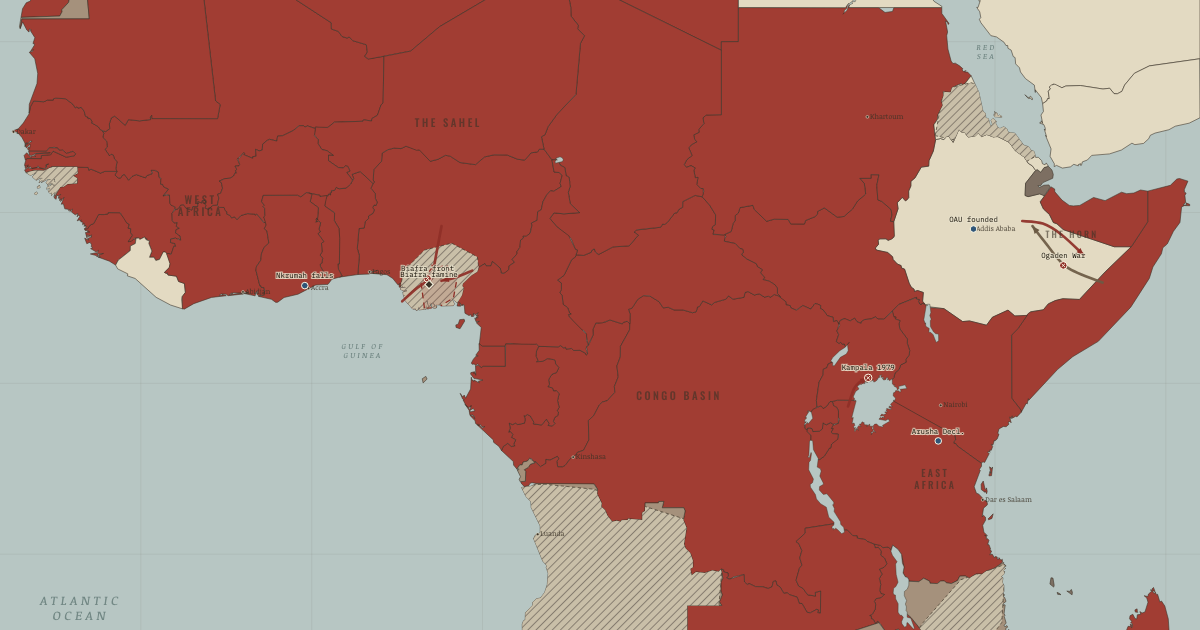
The map above is the world of 1966–68 — The enclaves — and Biafra.
BRIEF EXPLANATION — THE ESSENTIAL ARGUMENT
Once the flags were raised, the harder task began, which was turning colonies into functioning countries. The new states had to build nations inside borders drawn in European boardrooms, atop economies designed to serve Europe, and with very little time. Their most consequential shared decision came at the founding of the Organisation of African Unity, whose members resolved to keep the inherited colonial borders exactly as they stood. The logic was that any redrawing would invite endless secessions and border wars; the cost was that peoples split by colonial lines stayed split, and millions remained locked inside states they had never agreed to form.
The strains of state-building showed most sharply where they turned violent. In Nigeria the federal bargain broke down after two 1966 coups and pogroms against the Igbo, and the oil-rich east seceded as Biafra, which federal forces closed off over three years while perhaps a million people, many of them children, starved behind the blockade. That famine is a human catastrophe to be remembered, not a strategy to be assessed. Elsewhere the army, often the only well-organized institution the colonizers had built, seized power again and again, and leaders such as Nyerere defended the one-party state as the honest African answer to fragmentation, with results that varied widely. The era was a genuine struggle over stability, justice and the capacity of the state itself.
GUIDED EXPLANATION
The border decision of 1963–64 was a deliberate tradeoff rather than an oversight. The colonial lines had divided some peoples and forced others into shared states, yet reopening every frontier risked producing a Katanga on every disputed boundary, so Africa’s leaders chose legal stability instead. The choice largely worked on its own terms, because most international borders held even when governments were overthrown by force, and outright wars between African states remained rare. What it could not do was relieve the internal pressure that artificial borders and inherited economies generated, and that pressure found other outlets.
Nigeria became the hardest test of all. Coups and anti-Igbo violence preceded Biafra’s secession in 1967, and federal forces squeezed the enclave shut over three years, with perhaps a million dead, many of them children who starved. The famine belongs in memory, not in strategic arithmetic. Across the continent, armies were frequently the strongest national institution the colonizers had left behind, and coups multiplied as civilian governments failed to deliver on independence’s promises. Some leaders argued in good faith that fragile new nations could not afford divisive multiparty politics; Tanzania under Nyerere built an unusual national cohesion, though its coercive villagization and weak economy carried serious costs. The pattern was mixed, and it resists a single verdict.
The OAU enshrined uti possidetis. Colonial borders are inviolable. To prevent a continent-wide unravelling into secession and irredentist war. The logic was that any redrawing would open the door to endless claims. The cost was that peoples split by colonial lines (Somalis across five states, the Igbo, the Ewe) stayed split, and citizens were locked into states they had never consented to form. It was a conservative choice for stability over justice, and the debate over whether it was wise is unresolved.
The Nigerian civil war was the OAU’s doctrine enforced at terrible cost. Most African states backed the federation against secession, and the blockade that starved a million people was defended as the price of national unity. It set the precedent: Africa would not recognize secession (a rule that held until Eritrea and South Sudan, decades later). The famine is a memorial, not a lesson in strategy. Remember the children of Biafra.
DEEP EXPLANATION — EVIDENCE & INTERPRETATION
Stability Against Justice at the Border
The Organisation of African Unity adopted the principle later summarized as uti possidetis, under which new states would retain the administrative borders they had inherited. The case for it was preventive, since almost any frontier could be contested, and a single successful secession might set off overlapping claims, mass expulsions and interstate war across the continent. The case against it was moral and political, because those lines reflected imperial bargaining, cut through communities such as the Somalis, and enclosed groups that had never consented to share a state, so preserving them could weaken legitimacy and shelter rulers behind the doctrine of non-interference. The historical record supports both sides at once. Africa’s international borders changed remarkably little, while civil wars and centralized repression imposed heavy internal costs. It is therefore misleading to call the policy simply wise or simply artificial. Its architects chose one distribution of risk over another, accepting harder nation-building inside fixed maps in exchange for far fewer wars to redraw them, and that is a real tradeoff rather than a puzzle with a cost-free solution.
Why Military Takeovers Became the Pattern
Postcolonial armies were often among the very few national organizations that possessed transport, communications, regular salaries and a clear chain of command, which gave them a decisive advantage whenever civilian authority faltered. Civilian governments, by contrast, inherited thin revenues and enormous expectations, and commodity shocks and regional rivalries steadily weakened them. When ruling parties closed off the constitutional routes by which power might change hands, officers could present a takeover as the only way to restore order, and each successful coup lowered the threshold for the next. This is institutional path dependence, not any supposed African disposition toward disorder, and outside patrons made it worse by rewarding rulers who offered strategic alignment, with Mobutu the clearest Cold War example. The one-party alternative had its own rationale, since leaders genuinely feared that competitive parties would map straight onto ethnic and regional divisions. Tanzania shows that deliberate nation-building and a shared language could produce cohesion, and also that centralized development schemes could become coercive, which is why comparison across cases matters more than a single sweeping judgement.
New here? Chapters 1–2 of every atlas are free to sample, and the WW2 atlas is free in full. One membership opens all thirteen — the Cartographer’s Circle.
THE SITES
ON THIS DAY
WHY IT HAPPENED
The border bargain of 1964. The OAU enshrined uti possidetis. Colonial borders are inviolable. To prevent a continent-wide unravelling into secession and irredentist war. The logic was that any redrawing would open the door to endless claims. The cost was that peoples split by colonial lines (Somalis across five states, the Igbo, the Ewe) stayed split, and citizens were locked into states they had never consented to form. It was a conservative choice for stability over justice, and the debate over whether it was wise is unresolved.
Economies inherited, not chosen. Independence changed the flag, not the economic structure: single-commodity exports at prices set in London and New York, no manufacturing, transport built to drain resources to the coast, tiny skilled workforces. The 1960s “development decades” and grand schemes (Nkrumah’s Volta dam, Tanzania’s villagization, Senegal’s groundnuts) often failed or disappointed because they were fighting a structure designed to keep Africa a supplier. When commodity prices fell, revenues and political stability fell with them.
Why the coups came. Over forty coups by 1970 had common mechanics: armies were often the only organized, resourced institutions the colonizers had built. Single-party rule removed peaceful ways to change governments. Economic failure discredited civilian politicians. And ethnic and regional rivalries, frozen by colonial borders, found no other outlet. The soldier stepping in “to restore order” became the era’s recurring figure. Sometimes reformer, more often simply the next strongman.
Françafrique and the persistence of dependence. Formal independence often masked continued control. France in particular kept its former colonies tied through the CFA franc, defence pacts, troops, and personal networks (“Françafrique”) that installed and protected friendly rulers and intervened against unfriendly ones. Nkrumah called this neo-colonialism: political flags over economic subjection. It is why several “independent” states remained, in practice, clients. And why the map’s red does not tell the whole story.
THE TURN
Addis Ababa & Cairo, 1963–64 — the borders are frozen. In founding the OAU and then resolving to respect inherited frontiers, Africa’s leaders made the single most consequential structural decision of the post-independence era. It almost certainly prevented a continent of Katangas and Biafras. Inter-state border wars in Africa have been remarkably rare. But it also froze in place the artificial states colonialism drew, committing every new nation to the hard, often bloody work of forging unity inside borders it had not chosen. Nearly every conflict on the rest of this map is shaped by that choice to hold the lines.
WHAT IT CHANGED
Biafra: the border principle tested in blood. The Nigerian civil war was the OAU’s doctrine enforced at terrible cost. Most African states backed the federation against secession, and the blockade that starved a million people was defended as the price of national unity. It set the precedent: Africa would not recognize secession (a rule that held until Eritrea and South Sudan, decades later). The famine is a memorial, not a lesson in strategy. Remember the children of Biafra.
One-party rule: rationalized and abused. Leaders from Nyerere to Kaunda argued that fragile new nations could not afford the luxury of divisive multiparty politics and needed unity under one movement. Made in good faith by some, the argument was seized by many others to justify dictatorship for its own sake. The record is genuinely mixed. Tanzania held together where others fractured. But the one-party state mostly delivered neither the development nor the unity it promised.
The borders hold — mostly. For all the internal violence, the striking fact is that Africa’s international borders barely moved. Even wars between states (Somalia-Ethiopia, Uganda-Tanzania) ended with the frontiers restored, not redrawn. The 1964 bargain worked as intended: it contained conflict inside states rather than between them. A stability bought at the price of freezing colonial injustice into the permanent map.
FIELD QUESTION — The OAU’s decision to keep colonial borders is defended as the guarantor of African peace and attacked as the freezing of colonial injustice. Weigh the case.
For the decision: inter-state and secessionist wars in Africa have been strikingly rare given the arbitrariness of the borders, and the two great secession attempts of the era (Katanga, Biafra) were catastrophic. Evidence that opening the question of borders risks continent-wide war. Freezing the lines gave fragile states a fixed frame in which to build and denied every ethnic grievance the explosive precedent of a successful breakaway. Against it: the borders were drawn for European convenience, splitting nations (the Somalis across five states) and forcing hostile peoples together, guaranteeing internal conflict, weak legitimacy and the “artificial state” problem that fuels much of Africa’s instability. The principle also protected dictators behind the shield of non-interference. The honest verdict is a genuine trade-off: the bargain probably did prevent a worse chaos of border wars, but it did so by locking in injustices whose costs were paid internally, in civil wars and failed states, rather than between nations. Stability and justice pulled in opposite directions, and Africa’s leaders chose stability. Reasonably, but not without a heavy price.
AN INTERESTING FACT
Julius Nyerere — “Mwalimu,” the teacher, as Tanzanians called him — translated Shakespeare into Swahili while running the country: Julius Caesar appeared as Juliasi Kaizari in 1963, and in 1969 came The Merchant of Venice, under a title that distils the Arusha years into three words — Mabepari wa Venisi, “The Capitalists of Venice.” The point was political as much as literary: proof that Swahili, the language he used to bind more than a hundred language groups into one nation, could carry anything Europe’s tongues could.
THE DISPATCH
One short letter when a new atlas opens — and the printable study guide for The Decolonization of Africa is yours now, free.
NO TRACKING · YOUR ADDRESS IS USED FOR THE DISPATCH AND NOTHING ELSE · UNSUBSCRIBE ANYTIME