MAPS OF HISTORY · The Decolonization of Africa · ALL CHAPTERS · CHAPTER 5
CHAPTER 5 · 1960 · JUL 1960
The Year of Africa
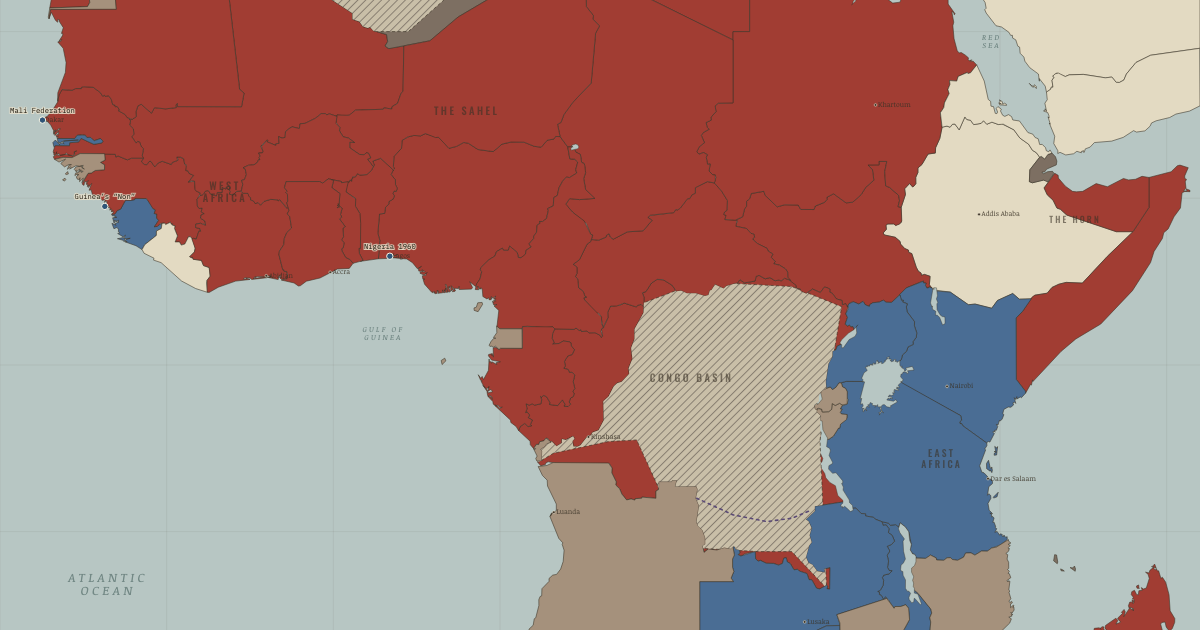
The map above is the world of 1960 — The Year of Africa.
BRIEF EXPLANATION — THE ESSENTIAL ARGUMENT
The year 1960 saw seventeen African states become independent, the largest single burst of decolonization in history, and its suddenness had specific causes rather than being a coincidence. Most of French Africa, the vast Belgian Congo, British Nigeria and Italian Somaliland all reached sovereignty within a few months. The clustering was partly administrative, because France’s constitutional reforms had already installed elected African governments and ministers who governed before the flag changed, so independence completed a transfer largely made. It was partly psychological, because Ghana and Guinea had shown it could be done and the United Nations was filling with new members for whom independence was the expected outcome.
A liberation on this scale was a genuine triumph, yet the very speed exposed the weaknesses each new state inherited. They received colonial borders that enclosed peoples who had never chosen to live together, economies pinned to one or two export commodities, and administrations with few trained staff. Nigeria’s carefully engineered federal bargain tried to hold a huge and diverse country together, while the Belgian Congo, handed independence with almost no preparation, showed how catastrophically an unready transfer could fail. The differences among them traced directly back to the differences in how each had been ruled.
GUIDED EXPLANATION
The mechanics of 1960 begin with France’s 1956 framework law, the loi-cadre, which devolved real power to elected territorial assemblies and African executives. Men such as Houphouët-Boigny and Senghor had already governed as ministers, so when full sovereignty arrived it was less a rupture than the final step of a handover mostly complete, and that is why so many territories could change colour at once. The wave then fed on itself. After Ghana, and with the General Assembly increasingly hostile to colonialism, holding out began to look like the aberration rather than the norm, and both superpowers courted the states about to be born.
Guinea had shown the way and the risk together. In 1958 de Gaulle offered France’s colonies membership in a French Community, meaning autonomy without independence, or immediate separation if they voted no; only Guinea refused, and France retaliated by stripping the country of everything it could carry. Guinea nevertheless survived, and its example, along with the evident hollowness of the Community, led the other territories to accept autonomy and then demand full independence within two years. Nigeria offered a different template, a federation of three great regions built to contain a huge and plural population. That structure held the country together for six years, and it also marked the fault line along which it would later crack.
France’s 1956 framework law devolved real power to elected territorial assemblies and African executives. Men like Houphouët-Boigny and Senghor who governed as ministers before independence. When full sovereignty came in 1960, there were experienced African governments ready to receive it. Independence was less a rupture than the last step of a transfer already largely made. That prior groundwork is why so many flips could happen in one year.
The class of 1960 transformed the United Nations, giving the Afro-Asian bloc a permanent majority in the General Assembly and making decolonization and anti-racism central to world politics. The new states used that platform relentlessly. Against apartheid, against Portuguese colonialism, for non-alignment. Independence was not just a national event. It rewired the international system.
DEEP EXPLANATION — EVIDENCE & INTERPRETATION
How Independence Fed on Itself
Political change often moves in cascades, when one outcome alters expectations about the next, and 1960 is a textbook case. Ghana had shown that Britain would in fact transfer power, and Guinea had shown that immediate separation from France could survive even punitive retaliation. Each new United Nations member strengthened the anti-colonial majority in the General Assembly and offered diplomatic cover to movements still fighting. Colonial governments also learned from one another that a negotiated withdrawal could preserve trade and influence far more cheaply than a war, while in French Africa the loi-cadre had already moved African ministers and assemblies into government, shrinking the administrative gap at the moment of transfer. This combination explains why the flips clustered so dramatically in a single year. Momentum did not erase local differences, since Nigeria’s federal negotiations, Cameroon’s hidden war and the Congo’s abrupt Belgian exit were not one process but several. The cascade accelerated many cases at once, while the distinct policies of each empire determined how stable the resulting handovers turned out to be.
The False Comfort of “Too Soon”
It is often said that African independence came before the new states were ready, and the phrase quietly reverses the causation. Colonial governments had themselves controlled education, senior appointments and political participation, and then pointed to the resulting shortages of trained Africans as a reason to keep ruling. Belgium’s Congo is the extreme instance, but a slower timetable under the same system offered no guarantee of genuine preparation and might simply have postponed accountability. Institutional capacity was nonetheless a real constraint, since governments needed trained officials, working revenue systems and accepted rules for regional competition. The honest tradeoff is therefore not freedom against competence, but immediate sovereignty carrying inherited weaknesses against a promised colonial apprenticeship that might never be honoured. The cases differ sharply and should be compared rather than lumped together. French territorial governments handed several states experienced ministers; Nigeria negotiated elaborate federal arrangements; the Congo received a rushed transfer after decades of deliberate exclusion. “Speed” had a different meaning, and a different price, in each.
New here? Chapters 1–2 of every atlas are free to sample, and the WW2 atlas is free in full. One membership opens all thirteen — the Cartographer’s Circle.
THE SITES
ON THIS DAY
WHY IT HAPPENED
The loi-cadre alumni. France’s 1956 framework law devolved real power to elected territorial assemblies and African executives. Men like Houphouët-Boigny and Senghor who governed as ministers before independence. When full sovereignty came in 1960, there were experienced African governments ready to receive it. Independence was less a rupture than the last step of a transfer already largely made. That prior groundwork is why so many flips could happen in one year.
Guinea’s “Non” and the collapse of the Community. In 1958 de Gaulle offered France’s African colonies membership in a French Community. Autonomy without independence. Or, if they voted no, immediate separation. Only Guinea refused, and France retaliated by stripping the country of everything it could carry. But Guinea survived. And its example, plus the manifest hollowness of the Community, led the other territories to demand full independence within two years. De Gaulle, preferring willing partners to sullen ones, let them go.
The international tipping point. By 1960 the General Assembly was filling with new members who made anti-colonialism a global majority position. That December the UN passed Resolution 1514 declaring colonialism must end. Both superpowers courted the new states. Independence had become the internationally expected outcome, and holding out looked increasingly like the aberration. A reversal of the assumptions of 1945.
Momentum and the fear of being last. Nothing accelerates a political tide like the sense that it is unstoppable. Once Ghana, Guinea and the Congo had gone, no French or British territory wanted to be the colony still waiting. Nationalist pressure and colonial calculation pushed in the same direction. Decolonization became partly self-propelling. Each independence made the next one easier to imagine and harder to refuse.
THE TURN
Lagos, 1 October 1960 — the giant rises. Nigeria. The most populous nation in Africa, a federation of three regions and some 250 peoples. Lowers the Union Jack. Its sheer scale makes it the continent’s great test: can a huge, plural, artificially-bordered colony hold together as one democratic federal state? For six years the answer looks like yes. Then the same regional fault lines the federal bargain was built to manage will crack into coup and civil war (Chapter 7). Nigeria’s midnight is the high-water mark of independence’s optimism. And the setup for its hardest lesson.
WHAT IT CHANGED
A new majority at the UN. The class of 1960 transformed the United Nations, giving the Afro-Asian bloc a permanent majority in the General Assembly and making decolonization and anti-racism central to world politics. The new states used that platform relentlessly. Against apartheid, against Portuguese colonialism, for non-alignment. Independence was not just a national event. It rewired the international system.
Borders and the coming strain. Seventeen states inherited seventeen sets of colonial borders, enclosing peoples who had never chosen to live together and dividing others across lines. The optimism of 1960 rested on the assumption that these states would cohere. The Congo would test it within days, Nigeria within six years. The Year of Africa handed the continent both its freedom and its hardest structural problem.
Freedom, then the reckoning with what it could not deliver. 1960’s ceremonies promised development, dignity and unity. The economies were still colonial. Single crops, no industry, ports facing Europe. And the honeymoon was short. The coups, one-party states and disappointments of the later 1960s all begin from the gap between what independence promised and what the inherited structures could actually provide.
FIELD QUESTION — Why did seventeen countries become independent in the single year 1960 — and was the speed a triumph or a problem?
The clustering was mechanical and psychological: France had pre-built African governments through the loi-cadre so the handover was largely complete before the flag changed. The collapse of de Gaulle’s Community after Guinea’s survival converted autonomy into full independence across French Africa within two years. The UN and both superpowers had made independence the expected norm. And momentum made each transfer easier than the last. Whether it was triumph or problem is genuinely debatable, and the honest answer is both. Triumph: an epochal, largely peaceful liberation of a continent. Problem: many states arrived sovereign but structurally unready. Colonial economies, arbitrary borders, shallow institutions, tiny educated classes. And the speed meant almost no time to build the foundations independence needed. The Congo (next chapter) shows the catastrophic end of the spectrum. The enduring debate is whether a slower transition would have built stronger states or simply prolonged colonial rule under a new name.
AN INTERESTING FACT
Nigeria’s green-white-green was the work of a twenty-three-year-old: Michael Taiwo Akinkunmi, a Nigerian student in England, won the 1959 flag competition against nearly three thousand entries — though the judges deleted the red sun he had drawn on the central band. And when the UN General Assembly declared that December that colonialism must end, not a single state voted against Resolution 1514: the tally was 89 to 0, and the nine abstainers — Britain, France, Portugal, Spain, Belgium, South Africa and the United States among them — could only stand aside in the chamber the Year of Africa had just filled.
THE DISPATCH
One short letter when a new atlas opens — and the printable study guide for The Decolonization of Africa is yours now, free.
NO TRACKING · YOUR ADDRESS IS USED FOR THE DISPATCH AND NOTHING ELSE · UNSUBSCRIBE ANYTIME