MAPS OF HISTORY · ON THIS DAY · December 3 · 1934
ON THIS DAY · 3 DECEMBER 1934
The Xiang River
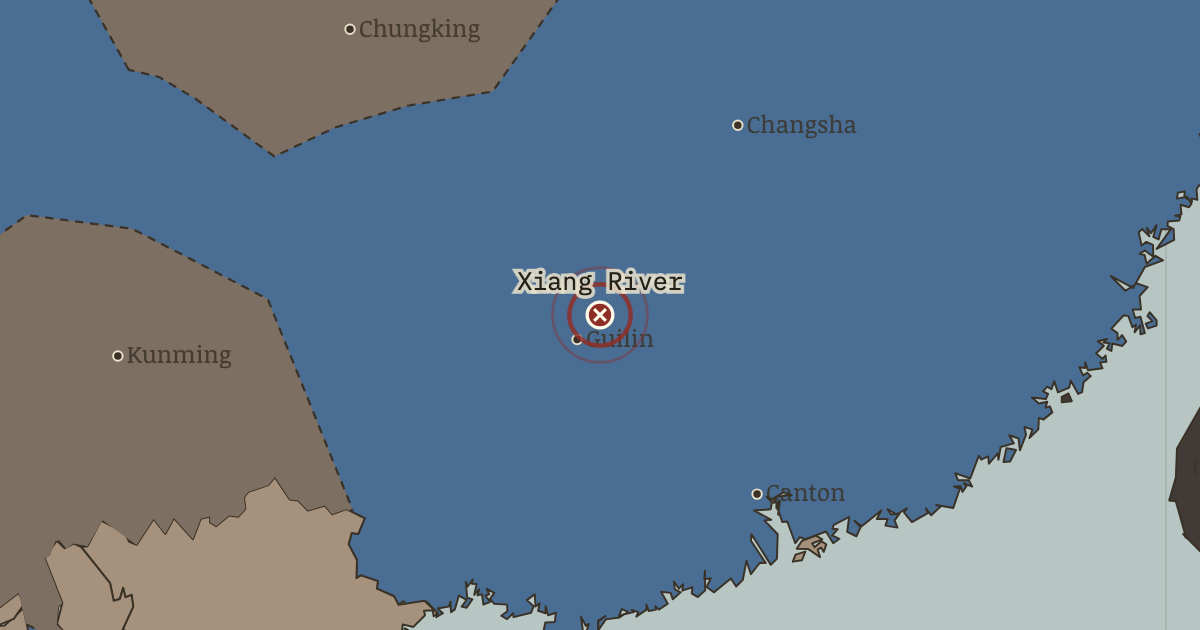
25 Nov–3 Dec 1934 — The breakout column, 86,000 strong and hauling its archives and arsenal like a moving state, is caught crossing the Xiang: perhaps half are lost. The disaster discredits the leadership that ordered it — the road to Zunyi begins in this river.
THE MOMENT IN CONTEXT
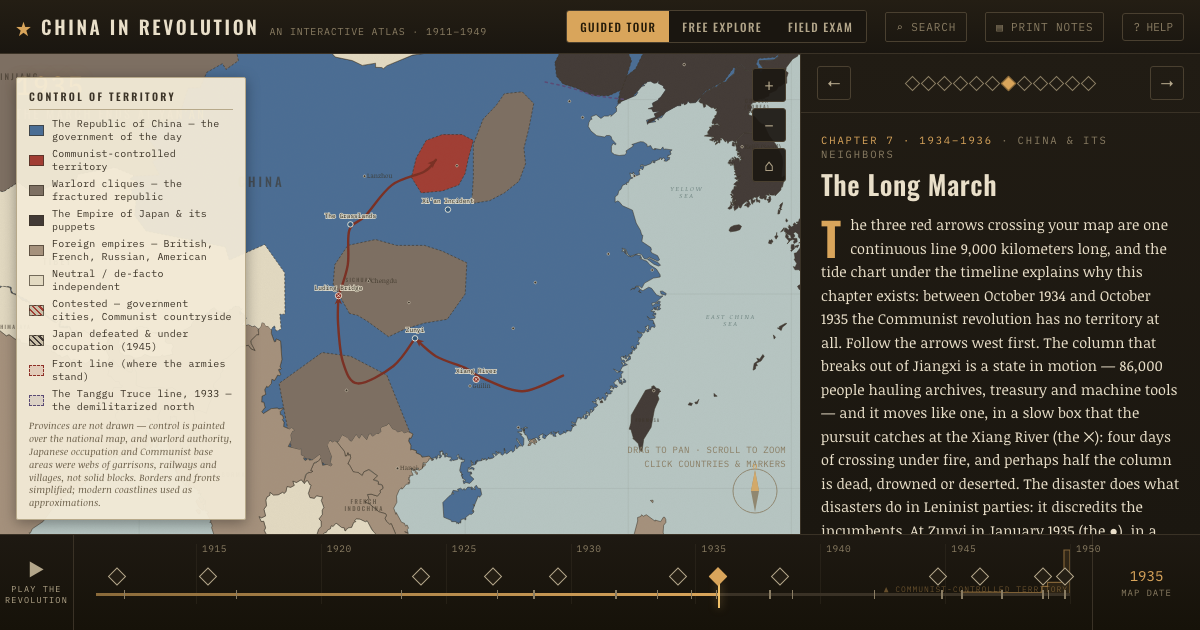
The Long March was a sequence of retreats and regroupings that was later shaped into a founding story, and the three red arrows on the map trace one continuous line some 9,000 kilometers long. The chapter exists because, between October 1934 and October 1935, the Communist revolution held no territory at all. The column that broke out of Jiangxi was a state in motion, 86,000 people hauling archives, treasury and machine tools. It moved like one too, in a slow box that the pursuit caught at the Xiang River (the ✕). Four days of crossing under fire cost perhaps half the column, dead, drowned or deserted. Disaster then did what disaster does inside a Leninist party, which is to discredit the incumbents. At Zunyi in January 1935 (the ●), in a merchant’s upstairs room, the surviving leadership turned on the Comintern-backed commanders, and Mao Zedong, sidelined for two years, joined the military leadership. The march changed character at once, with feints, doubling-back and split columns, and the fourfold crossing of the Chishui left the pursuit’s maps a mess of contradictory arrows.
From Chapter 7 — The Long March of China in Revolution, 1911–1949 (1935).
OPEN THE INTERACTIVE MAP →New here? Chapters 1–2 of every atlas are free to sample, and the WW2 atlas is free in full. One membership opens all thirteen — the Cartographer’s Circle.
TEACH THIS IN 5 MINUTES
- Why it happened — Breakout was forced, direction was chosen. Leaving Jiangxi was arithmetic (Chapter 6), but everything after was decision: west along the watersheds because the pursuit and the warlord armies…
- The turn — Zunyi, 15–17 January 1935. The march’s military escapes — Luding, the Grasslands — saved bodies. Zunyi decided what the bodies would be for. It ended imported strategy as the…
- What it changed — Yan’an becomes the laboratory. In the loess country the party builds the model it will scale after 1945: rent reduction rather than terror, village elections it can steer, army…
Then ask the room: How much of the Long March’s significance is myth-making — and does the myth-making diminish or constitute its importance? The argued answer is on the chapter page →
THE ATLAS THAT SHOWS IT
THE DISPATCH
One short letter when a new atlas opens — and the printable study guide for China in Revolution is yours now, free.
NO TRACKING · YOUR ADDRESS IS USED FOR THE DISPATCH AND NOTHING ELSE · UNSUBSCRIBE ANYTIME