ON THIS DAY ·
Battle of Kars
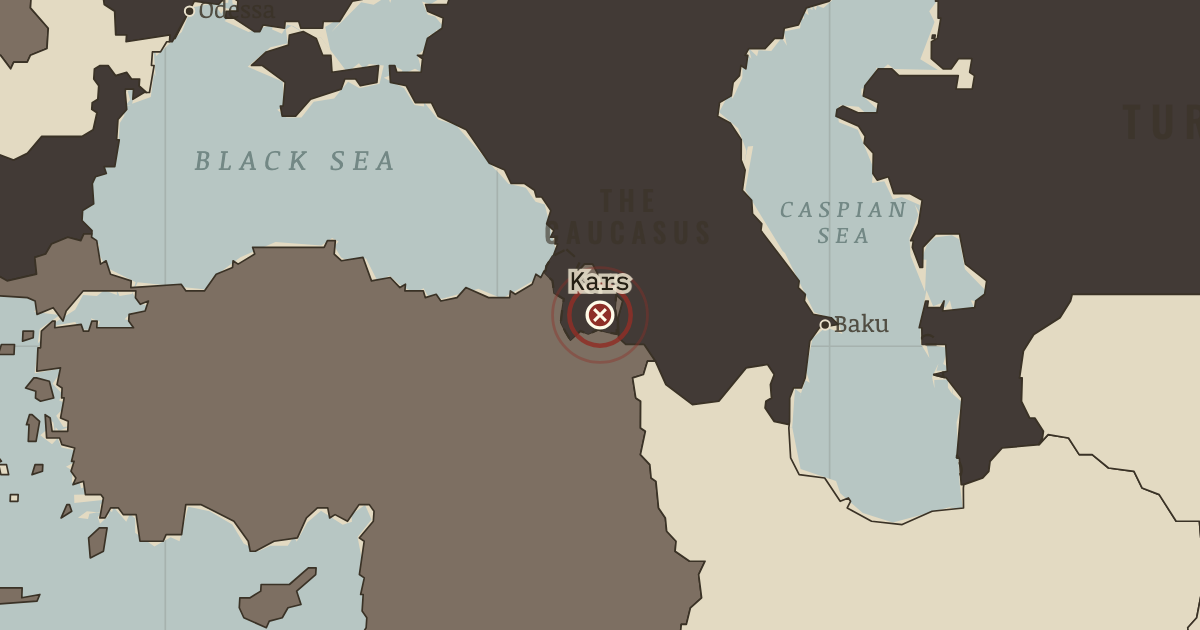
17–18 Nov 1877 — In a night assault, the reformed Russian army takes Kars, a great Ottoman fortress. The war of 1877–78 shows what universal service has made possible; the Congress of Berlin shows the limits of that success. There the great powers rewrite Russia's peace with the Ottomans. Russia keeps Kars, Batum and southern Bessarabia, but loses most of the Balkan settlement for which it fought.
WW2 is free in full, and chapter 1 of every atlas is free. A free account opens 3 more chapters a day. Starter, at $9 a month, opens all 21 with no daily limit — see the plans.
Free printable Russian Revolution study guide, sent by email ↓
The moment in context
The Crimean War exposed weaknesses that reached far beyond the battlefield. Follow the arrow across the Black Sea to the British and French landing in 1854. Russia lost at least 450,000 soldiers, mostly to disease. About half its peasants were bound to landlords, and a serf became free upon completing military service. To avoid releasing men back to civilian life, the army kept conscripts for as long as twenty-five years. It consequently lacked a reserve of trained former soldiers to recall in an emergency. Serfdom tied up money as well: landlords had pledged two-thirds of their serfs as security for state-bank loans, and by 1857 the banks were short of funds. Emancipation was a calculation about state survival as well as a moral choice.
From Great Reforms of Alexander II, chapter 1 of The Russian Revolution, 1855–1924 (JUL 1878).
The place: Battle of Kars — map and full story →
Teach this in 5 minutes
- Why it happened — Defeat on home soil. Sevastopol fell in September 1855 after an eleven-month siege. Britain and France could supply their forces by sea, while Russia had to rely on…
- The turn — The Emancipation Manifesto, 19 February / 3 March 1861. On 19 February / 3 March 1861 the Manifesto changed the legal status of more than a third of European Russia’s people. Landlords had governed and…
- What it changed — A free peasantry in debt. Peasants became free while owing redemption payments, annual installments repaying the state for land. Arrears accumulated in many provinces until…
Then ask the room: Did the Great Reforms make revolution in Russia less likely or more likely? The argued answer is on the chapter page →
The atlas that shows it
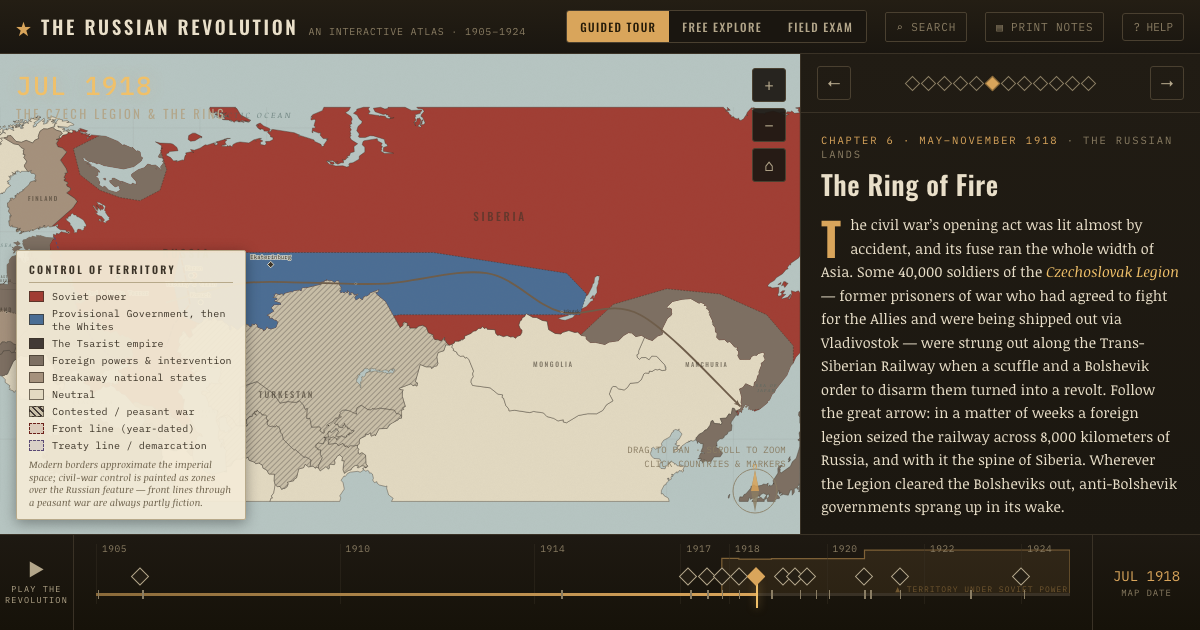
THE FREE PRINTABLE STUDY GUIDE
Get the printable study guide for The Russian Revolution free. I’ll send you a few short letters, then one when a new atlas opens. That’s all. — Paul
NO TRACKING · YOUR ADDRESS IS USED FOR THE DISPATCH AND NOTHING ELSE · UNSUBSCRIBE ANYTIME