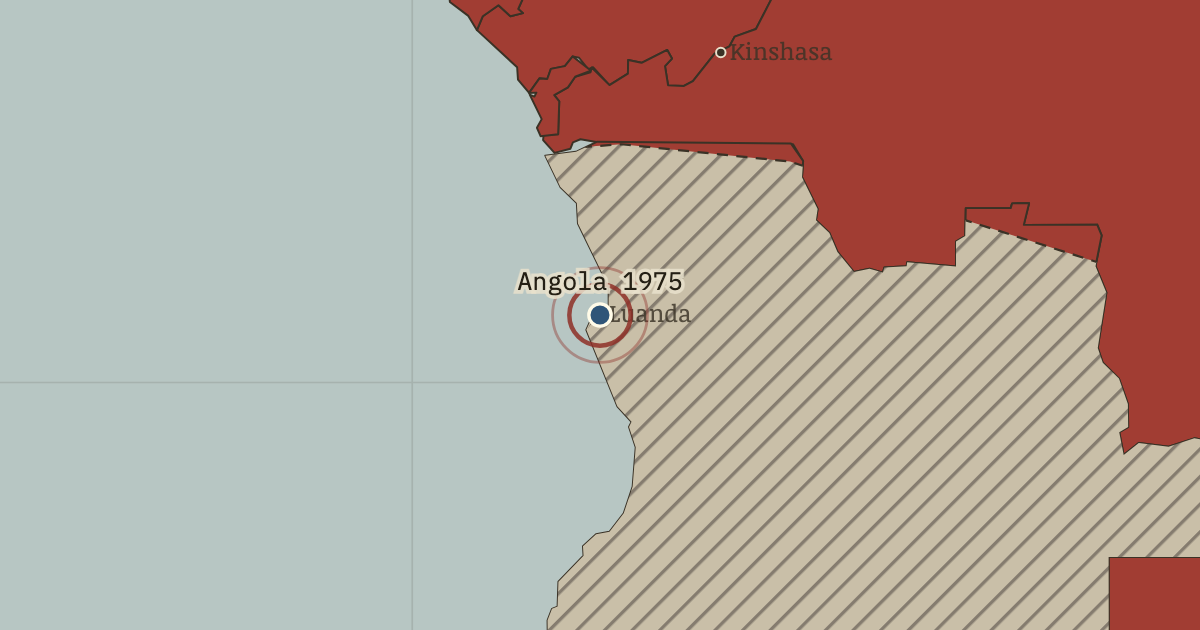
11 Nov 1975 — The Portuguese flag comes down in Angola, but three liberation movements are fighting for the capital. Cuban troops and South African columns are already in the country. Independence and civil war arrive together.
WW2 is free in full, and chapter 1 of every atlas is free. A free account opens 3 more chapters a day. Starter, at $9 a month, opens all 21 with no daily limit — see the plans.
11 NOVEMBER 1975 · THE DECOLONIZATION OF AFRICA, 1945–1994
The moment in context
Portugal called its African colonies overseas provinces and, from the early 1960s, fought to keep them. Resistance took different forms in each territory. In Guinea-Bissau, Amílcar Cabral's PAIGC built liberated zones with schools and clinics; in Mozambique, FRELIMO waged war; in Angola, the MPLA, FNLA and UNITA competed with one another. Cold War and regional patrons armed movements on different sides, but the wars also arose from the local character of Portuguese rule and, in Angola, rivalries among the movements themselves.
From Portuguese Colonial War, chapter 8 of The Decolonization of Africa, 1945–1994 (AUG 1975).
Why it happened — Empire and the dictatorship. For Salazar's dictatorship, empire was part of the claim that Portugal remained a great power. The colonies supplied resources, and settler…
The turn — Luanda, 11 November 1975 — independence amid war. On 11 November 1975, Portugal's flag comes down in Luanda, but Angola's three liberation movements are already fighting for the capital. Cuban…
What it changed — A rapid withdrawal. Portugal recognized Guinea-Bissau in 1974. Mozambique, Angola and the island states followed in 1975. Once Lisbon decided to leave, the last major…
Then ask the room: Why did the Portuguese empire, the weakest of the colonial powers, hold on to its African colonies longest — and why did it then collapse all at once? The argued answer is on the chapter page →
Get the printable study guide for The Decolonization of Africa free. I’ll send you a few short letters, then one when a new atlas opens. That’s all. — Paul
NO TRACKING · YOUR ADDRESS IS USED FOR THE DISPATCH AND NOTHING ELSE ·
UNSUBSCRIBE ANYTIME