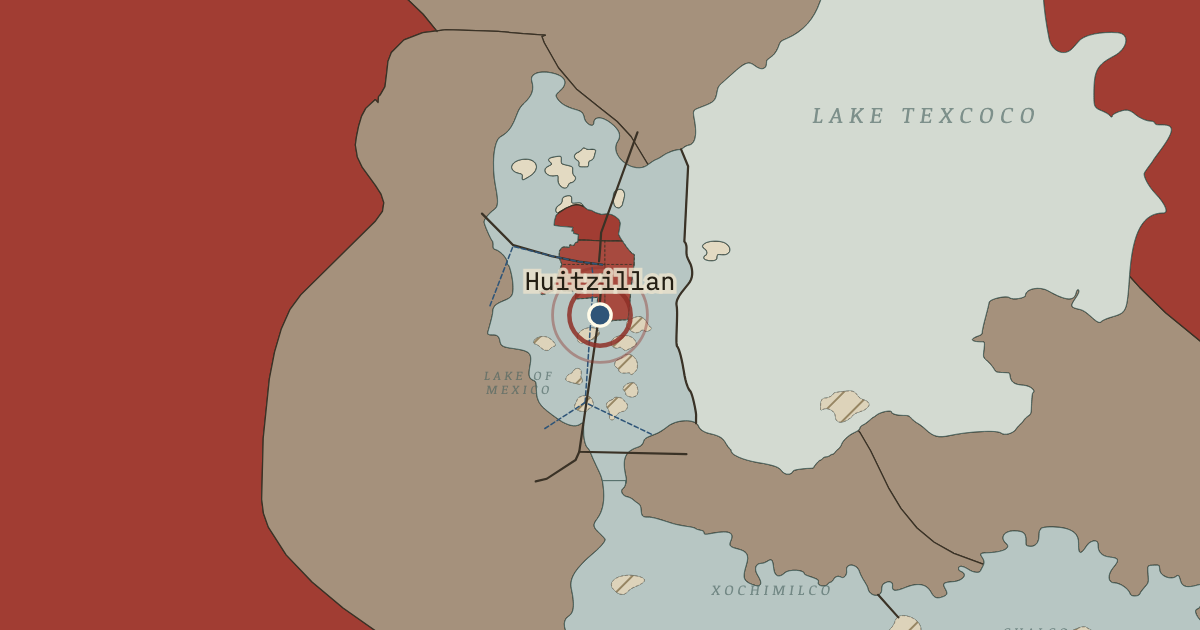
8 November 1519 — Moctezuma II came with his nobles to meet Hernán Cortés at Huitzillan, near the point where the southern causeway entered Tenochtitlan. He lodged the Spaniards in a palace beside the sacred precinct. Their astonished accounts describe the city at its height.
WW2 is free in full, and chapter 1 of every atlas is free. A free account opens 3 more chapters a day. Starter, at $9 a month, opens all 21 with no daily limit — see the plans.
8 NOVEMBER 1519 · CLIMATE AND INNOVATION: THE NORSE AND THE AZTECS, C. 790–1521
The moment in context
At the heart of Tenochtitlan stood a sacred precinct roughly 430–460 metres across. Bernardino de Sahagún’s informants listed 78 structures within it. The largest was the Templo Mayor, a pyramid with shrines to Huitzilopochtli, god of war and the sun, and Tlaloc, god of rain. Rulers enlarged it repeatedly: excavations led by Eduardo Matos Moctezuma since 1978 have identified seven major building stages. The city around this religious center was divided into four quarters, Moyotlan, Teopan, Atzacoalco and Cuepopan, with causeways leading north, west and south. Within the quarters were about seventy calpolli. These neighborhoods, each with temples, schools and officials, gave the capital manageable units of local government, much like boroughs.
From Layout of Tenochtitlan, chapter 10 of Climate and Innovation: The Norse and the Aztecs, c. 790–1521 (1519).
Why it happened — Life on water demanded planning. On an island in a shallow lake, adding a house meant first making ground for it. Builders raised lots from the lake bed and connected them to…
The turn — Huitzillan, 8 November 1519. When Moctezuma II met Hernán Cortés at Huitzillan on 8 November 1519, the visitors encountered the result of ninety years of Mexica engineering.…
What it changed — A city the Spaniards would rebuild on. The conquerors built Mexico City over the ruins, but much of the earlier arrangement shaped what followed. Main causeways became streets; the…
Then ask the room: Was Tenochtitlan’s plan primarily a solution to environmental problems or an expression of political and religious power? The argued answer is on the chapter page →