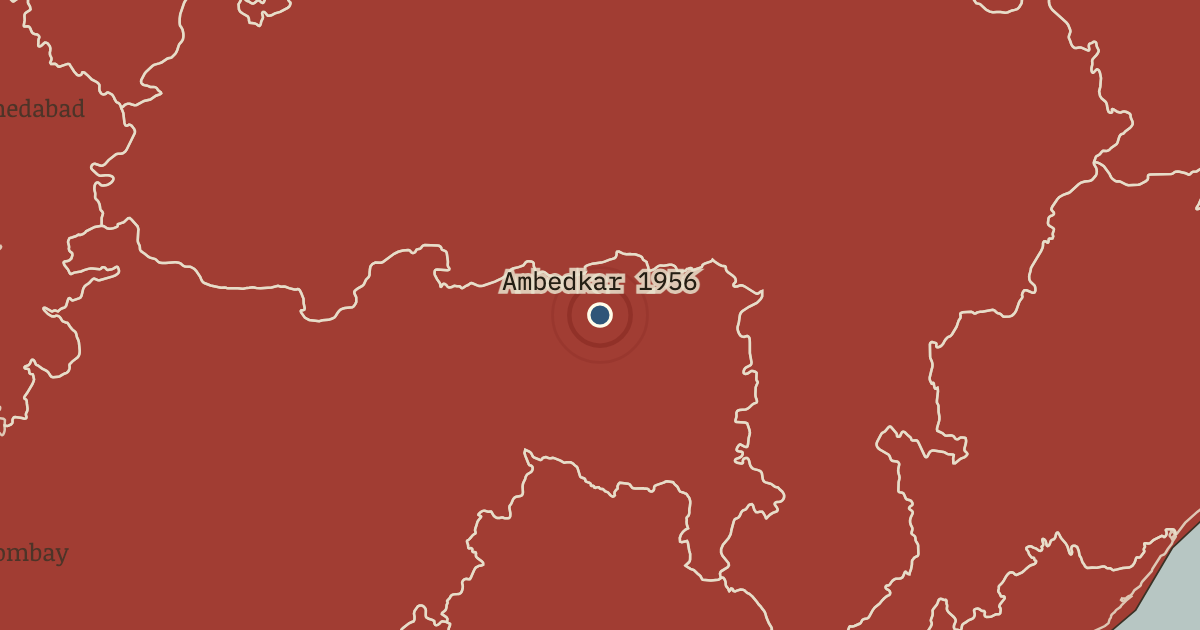
14 Oct 1956 — B. R. Ambedkar, the constitution’s framer, renounced Hinduism and took Buddhist vows at Nagpur. Several hundred thousand followers joined him, most of them Dalits of the Mahar community. Untouchability had been abolished in law, but Ambedkar had concluded that the social order would not abolish it. He died seven weeks later, on 6 December 1956.
WW2 is free in full, and chapter 1 of every atlas is free. A free account opens 3 more chapters a day. Starter, at $9 a month, opens all 21 with no daily limit — see the plans.
14 OCTOBER 1956 · INDIAN INDEPENDENCE & PARTITION, 1857–1964
The moment in context
The leaders of independent India had claimed to speak for a whole people. The constitution that took effect on 26 January 1950 put that claim to a demanding test: it gave every adult over twenty-one a vote, although most Indians could not read. Its drafting committee was chaired by B. R. Ambedkar, a Dalit from a caste Hindu custom had branded “untouchable”. The constitution made India a republic of citizens, established rights enforceable in court, abolished untouchability in Article 17, and reserved parliamentary seats for the lowest castes and tribal peoples, much like a modern quota. As the country’s supreme law, it set both the powers of government and the claims citizens could make against it.
From India under Nehru, chapter 15 of Indian Independence & Partition, 1857–1964 (MAY 1964).
Why it happened — Partition’s legacy: a state that feared its own divisions. Partition shaped the constitution’s balance of power. The founders had seen political mobilization around identity help break the country in 1947,…
The turn — Madras, 15 December 1952. Nehru had delayed linguistic states for five years when Potti Sriramulu, a former follower of Gandhi, used a fast unto death to press for Andhra.…
What it changed — A democracy that held. Elections had to become a habit before the first one could count as the beginning of a durable democracy. India held its second and third general…
Get the printable study guide for Indian Independence & Partition free. I’ll send you a few short letters, then one when a new atlas opens. That’s all. — Paul
NO TRACKING · YOUR ADDRESS IS USED FOR THE DISPATCH AND NOTHING ELSE ·
UNSUBSCRIBE ANYTIME