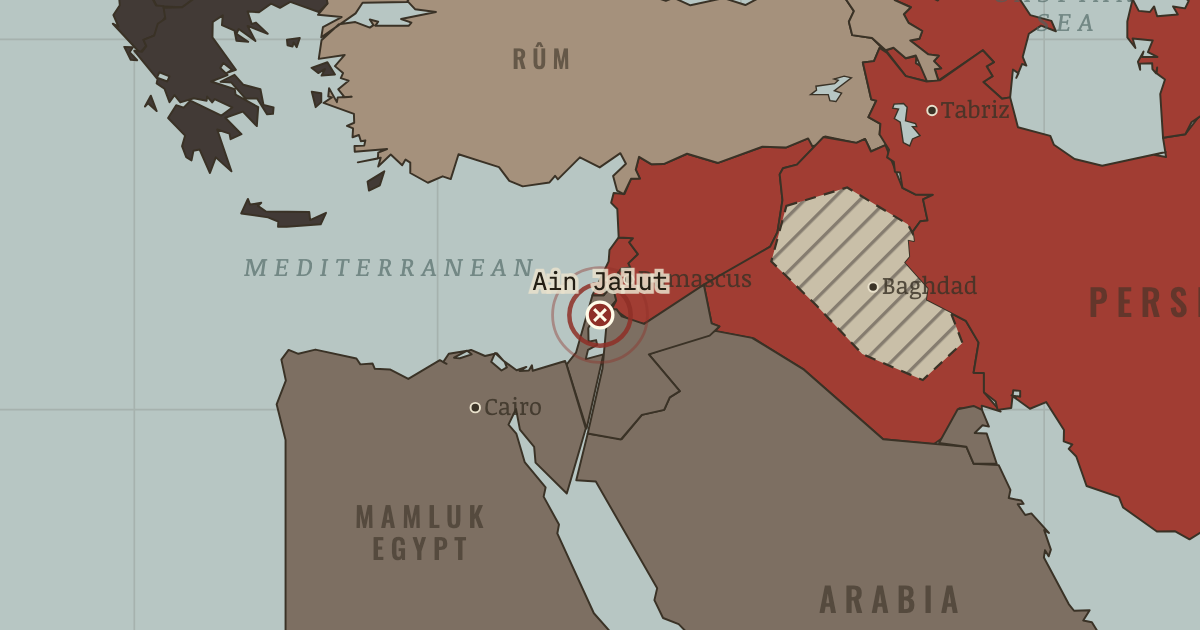
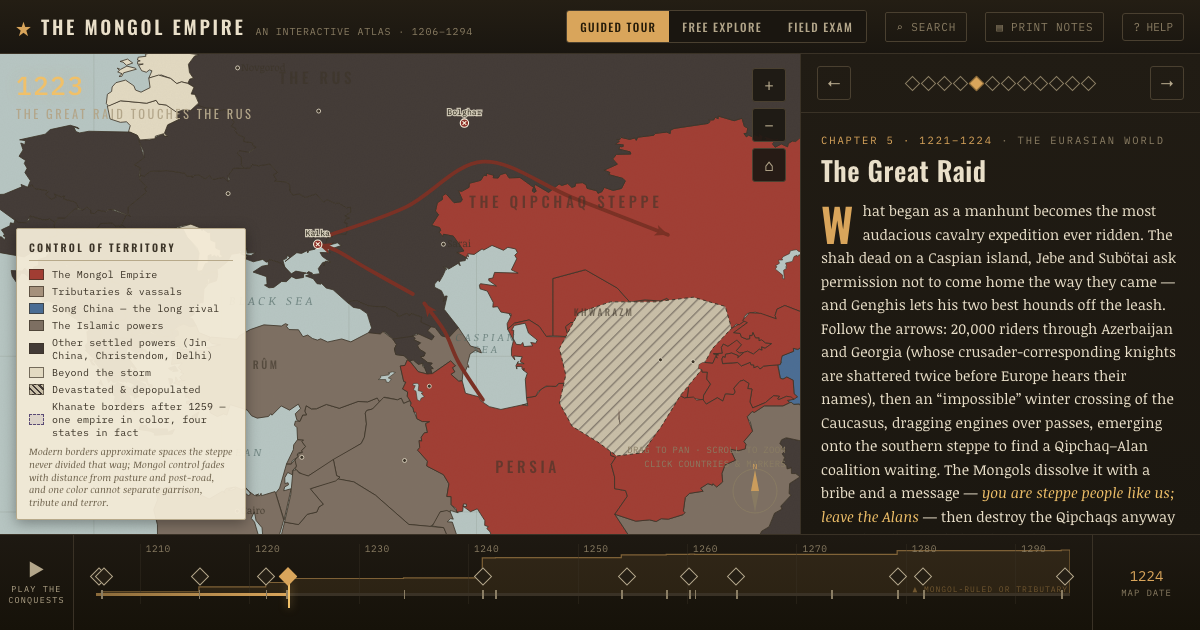
3 Sep 1260 — At the Spring of Goliath, the Mamluks of Egypt turn a feigned retreat against the Mongols. The Mamluks are slave-soldiers drawn from the same steppe peoples, and they destroy Kitbuqa’s army. This is the empire’s first defeat that is never avenged; its western advance has met a lasting limit.
WW2 is free in full, and chapter 1 of every atlas is free. A free account opens 3 more chapters a day. Starter, at $9 a month, opens all 21 with no daily limit — see the plans.
Möngke's western campaign first confronted the Nizari Ismailis, known as the Assassins in hostile sources. Their strongholds could resist from fortified positions, but Mongol engineers reduced the castles, and Alamut surrendered in 1256. Hülegü then turned to Baghdad and demanded submission from the Abbasid caliph, al-Musta‘sim. The caliph refused without preparing an effective defense. Baghdad fell in February 1258.
Why it happened — The western campaign. At Möngke's kurultai in 1251, the Mongols planned campaigns against two powers whose claims stood alongside their own: the Song in China and the…
The turn — Ain Jalut, 3 September 1260. The Mamluk victory at Ain Jalut, a spring in Galilee, came on 3 September 1260. Estimates vary, with accounts putting tens of thousands on each…
What it changed — Cairo and the caliphate. After Baghdad's fall, the Mamluks installed a refugee Abbasid as caliph in Cairo. The office lent religious standing to their rule, and Egypt…
Then ask the room: Ain Jalut is often called the battle that saved Islam, and often called overrated because Hülegü had already left with the main army. How should we weigh both claims? The argued answer is on the chapter page →