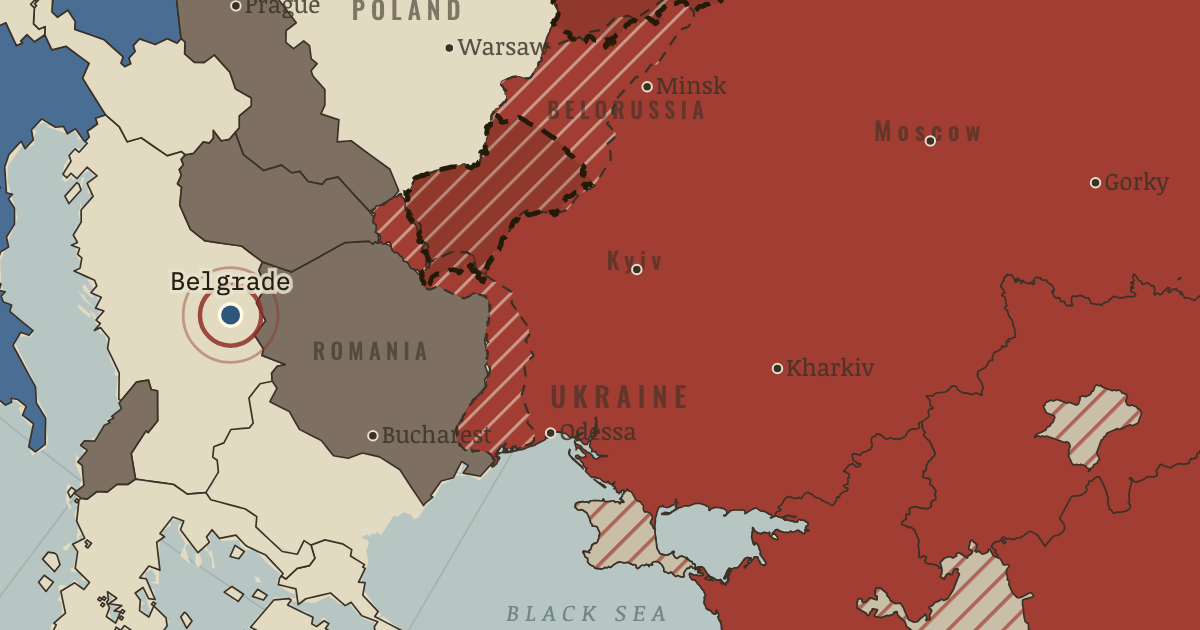
28 Jun 1948 — Tito refused Moscow’s direction, and the Cominform expelled Yugoslavia, the most independent of the new communist states. Yugoslavia survived Soviet pressure. Across the bloc, Stalin responded by purging alleged “Titoists”.
WW2 is free in full, and chapter 1 of every atlas is free. A free account opens 3 more chapters a day. Starter, at $9 a month, opens all 21 with no daily limit — see the plans.
28 JUNE 1948 · THE SOVIET UNION UNDER STALIN, 1924–1953
The moment in context
The government faced a devastated country after the war. Its choices during the famine of 1946–47 show how reconstruction was to proceed. Drought struck Ukraine, Moldavia and the Volga in 1946, but farms still had to meet high procurement quotas: the grain they were obliged to deliver to the state. The government retained large reserves and continued exports to Eastern Europe while people went hungry. Estimates of the dead range from under 1 million to about 2 million, many in Moldavia, which the Soviet Union had annexed only in 1940.
Why it happened — Victory confirmed Stalin’s methods. Victory seemed to Stalin to vindicate the system of collective farms, plans and purges under which the country had survived. War had nevertheless…
The turn — Tito’s expulsion, 28 June 1948. Tito could refuse Stalin because he had resources of his own: an army, a revolution and popular support. Yugoslavia survived Soviet threats and…
What it changed — An empire held by force. The Eastern European satellites remained under Soviet control until 1989. Rigged elections, purges and Soviet advisers in security services had…
Get the printable study guide for The Soviet Union under Stalin free. I’ll send you a few short letters, then one when a new atlas opens. That’s all. — Paul
NO TRACKING · YOUR ADDRESS IS USED FOR THE DISPATCH AND NOTHING ELSE ·
UNSUBSCRIBE ANYTIME