ON THIS DAY ·
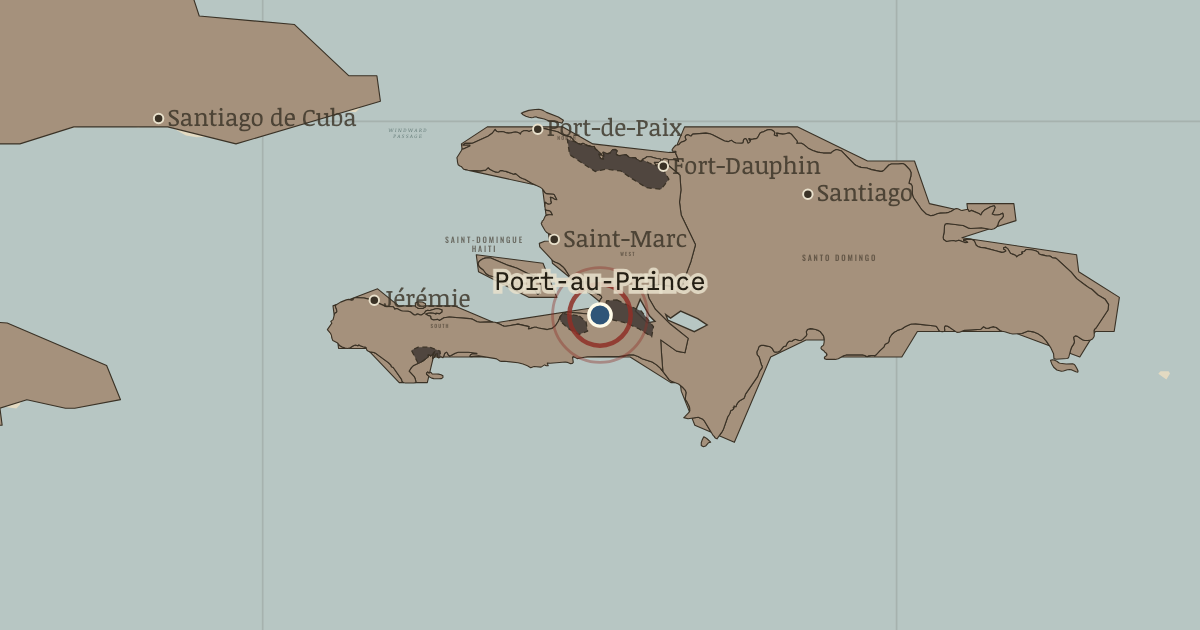
Port-au-Prince
1770–1915 — Port-au-Prince became the colonial capital in 1770. Under the name Port-Républicain, it hosted the assembly that adopted Toussaint’s constitution on 9 May 1801. Here, too, President Boyer accepted France’s indemnity under Mackau’s guns in July 1825. In December 1914 US Marines removed the national bank’s gold.
WW2 is free in full, and chapter 1 of every atlas is free. A free account opens 3 more chapters a day. Starter, at $9 a month, opens all 21 with no daily limit — see the plans.
Free printable Haiti and Kenya independence study guide, sent by email ↓
The moment in context
The sugar on European tables passed through a system that joined French ports, African coasts and Caribbean plantations. Ships left Nantes, Bordeaux and Le Havre carrying French goods, bought captives in Africa and landed nearly 30,000 people a year in Saint-Domingue in the late 1780s. Most came from West Central Africa, the region of the Kongo kingdom, and the Bight of Benin, on the coast of present-day Togo, Benin and southwestern Nigeria. From roughly 800 sugar estates and more than 3,000 coffee farms, produce went back to France for refining and re-export across Europe. The arrows trace this traffic. Cap-Français, the main port, known to everyone as Le Cap, had a theater, newspapers and a scientific society. Its prosperity was inseparable from the violence that supplied its labor.
From Slavery in colonial Saint-Domingue, chapter 1 of Two Roads to Independence: Haiti 1789–1838 and Kenya 1895–1978 (1789).
The place: Port-au-Prince — map and full story →
Teach this in 5 minutes
- Why it happened — Sugar demanded an unending supply of labour. Cane had to be cut and milled within hours before it spoiled. That made sugar, the eighteenth century's most profitable crop, exceptionally…
- The turn — Cap-Français, autumn 1789. News from France reached Le Cap in autumn 1789 with several groups ready to draw different lessons from it. The Estates-General, the king's…
- What it changed — The colonists demand power. The planters created colonial assemblies to pursue autonomy against the royal governor. At Saint-Marc in 1790, the most radical assembly insisted…
Then ask the room: Was Saint-Domingue’s wealth the main reason it erupted into revolution? The argued answer is on the chapter page →
The atlas that shows it
THE FREE PRINTABLE STUDY GUIDE
Get the printable study guide for Two Roads to Independence free. I’ll send you a few short letters, then one when a new atlas opens. That’s all. — Paul
NO TRACKING · YOUR ADDRESS IS USED FOR THE DISPATCH AND NOTHING ELSE · UNSUBSCRIBE ANYTIME