ON THIS DAY ·
April 9 tragedy in Tbilisi
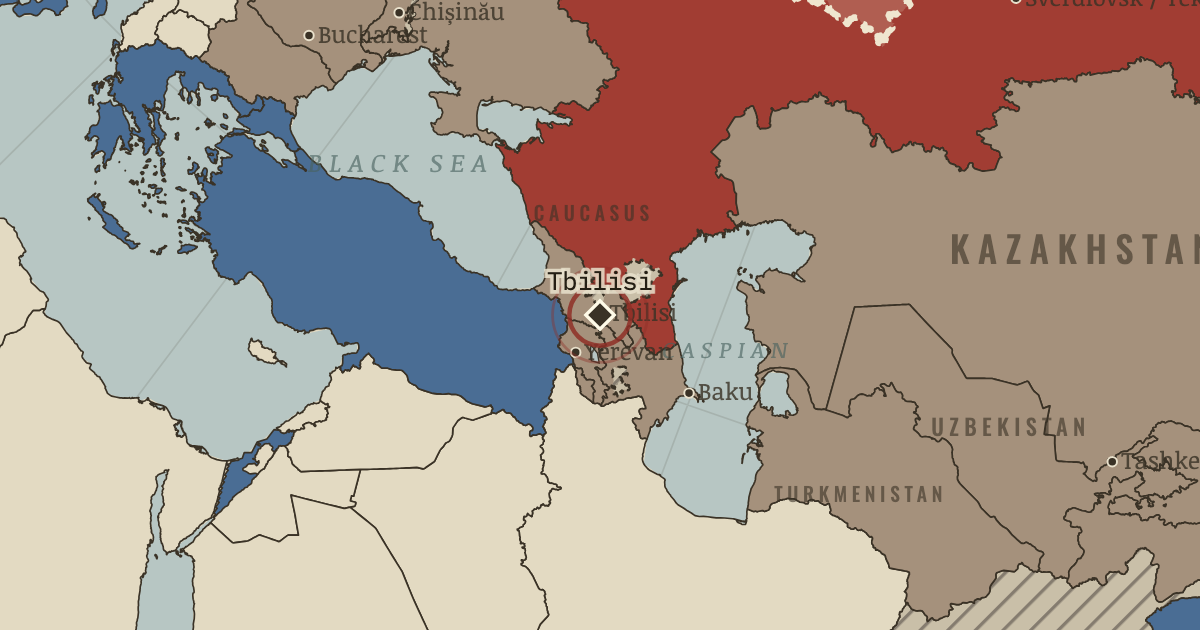
9 Apr 1989 — Outside Georgia’s government house, Soviet troops broke up a peaceful pro-independence vigil using clubs, sharpened spades and gas. Twenty-one people were killed, most of them women. The killings turned Georgian opinion decisively toward independence.
WW2 is free in full, and chapter 1 of every atlas is free. A free account opens 3 more chapters a day. Starter, at $9 a month, opens all 21 with no daily limit — see the plans.
Free printable Meiji Japan and post-Soviet Russia study guide, sent by email ↓
The moment in context
The communist governments of Eastern Europe had reason to fear opposition at home, but their opponents had reason to fear Soviet tanks. In 1989 Gorbachev removed that last assurance of rescue. His spokesman joked that the new policy was the “Sinatra doctrine”: each country could do it “my way”. Poland’s Solidarity, an independent trade union turned national movement, defeated the communists in semi-free elections in June. Hungary opened its Austrian border, allowing thousands of East Germans to travel west along the route shown by the arrow. Protests grew in East Germany itself, and on 9 November the Berlin Wall opened. Within weeks communist rule also ended in Czechoslovakia, Bulgaria and Romania. The former bloc states turn tan on the December 1989 map; Germany reunited in October 1990. Once Moscow would no longer defend these governments, they fell within months.
From Collapse of the Soviet Union, chapter 9 of Remaking the State: Meiji Japan 1600–1912 and Post-Soviet Russia 1964–2000 (1991).
The place: April 9 tragedy in Tbilisi — map and full story →
Teach this in 5 minutes
- Why it happened — Glasnost and elections gave nations a voice. Glasnost made public discussion of deportations, annexations and suppressed languages possible for Balts, Georgians, Armenians and others. The…
- The turn — The White House, 19–21 August 1991. The plotters hoped to preserve the Union, but their defeat discredited three of its central pillars: the KGB, army leadership and Communist Party.…
- What it changed — Fifteen states with inherited borders. The lines between Soviet republics became borders between states. About 25 million ethnic Russians now lived outside Russia, and other minorities…
Then ask the room: Was the Soviet Union destroyed more by the nations on its edges or by Russia at its centre? The argued answer is on the chapter page →
The atlas that shows it
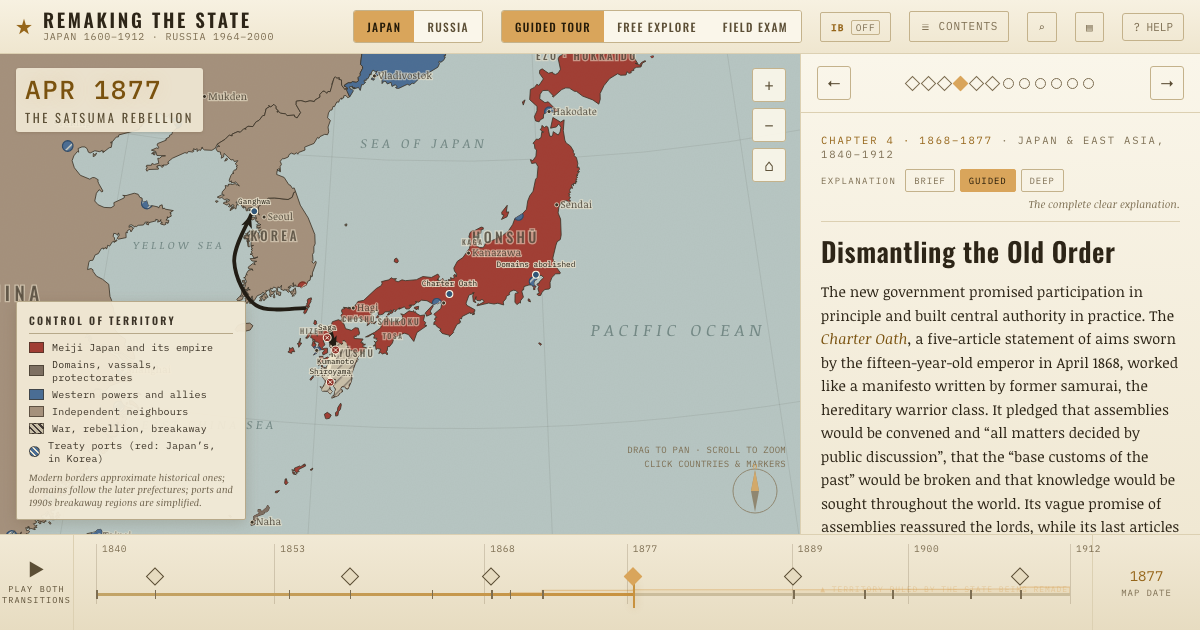
THE FREE PRINTABLE STUDY GUIDE
Get the printable study guide for Remaking the State free. I’ll send you a few short letters, then one when a new atlas opens. That’s all. — Paul
NO TRACKING · YOUR ADDRESS IS USED FOR THE DISPATCH AND NOTHING ELSE · UNSUBSCRIBE ANYTIME