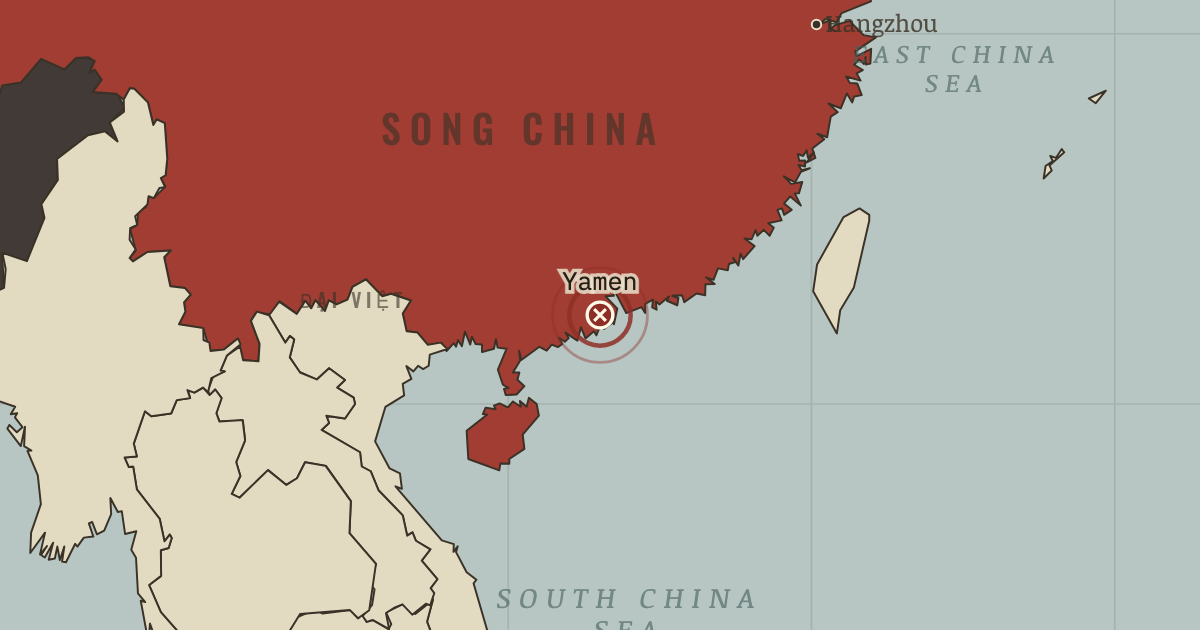
19 Mar 1279 — Off this headland, the last Song fleet is destroyed with the exiled court aboard. Chancellor Lu Xiufu carries the eight-year-old emperor on his back into the sea. All of China now comes under the rule of conquerors from the steppe for the first time in its history.
WW2 is free in full, and chapter 1 of every atlas is free. A free account opens 3 more chapters a day. Starter, at $9 a month, opens all 21 with no daily limit — see the plans.
For decades the Southern Song could resist a method of war that had served the Mongols elsewhere. Its fortified cities received supplies by river, while wet rice fields and limited pasture restricted the movement and feeding of horses. A cavalry victory might defeat an army in the field without cutting a city off from the water routes that kept it alive.
Why it happened — The problem of water. A fortress supplied by river could survive the passage of a mounted army nearby. The Song had many such defenses, set among wet fields where pasture…
The turn — Xiangyang and Fancheng, 1268–1273. For five years Yuan forces worked to take Xiangyang and Fancheng. Because the two cities could receive supplies by river, bombardment alone was not…
What it changed — A reunited China under the Yuan. The Yuan brought much of China under one dynasty after centuries of political division, with its capital at Beijing. Its authority also encompassed…